




More than salvage: Tugs take on Europe’s toughest marine jobs
European salvage contractors have been deploying an increasingly diverse range of tugs, sheerlegs and specialist marine assets as they respond to casualties while expanding into offshore energy and infrastructure projects.
Recent operations highlighted by the International Salvage Union (ISU) illustrate how modern salvage companies are combining traditional emergency response with heavy lifting, marine engineering and support for major construction programmes.
Black Sea operations
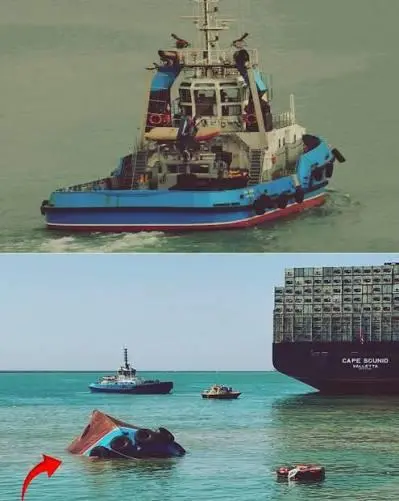
One of the most technically demanding recoveries took place off the Romanian coast in May, when Turkish contractor Aras Marine Group salvaged the sunken tug Astana while simultaneously supporting the Deep Neptune Gas Development Project in the Black Sea.
Astana capsized and sank during berthing operations at the Midia Marine Terminal’s offshore single-point mooring (SPM), about 8km offshore. Five crew were on board; two died immediately and three were initially reported missing.
The tug recovery required the mobilisation of Aras’ newly commissioned 1,600-tonne-capacity sheerleg Anadolu, together with the anchor handling tug Ataman and a team of salvage engineers, naval architects, commercial divers and project managers. The operation was complicated by poor underwater visibility, adverse weather and the recovery of crew members believed to still be inside the wreck. Following engineering studies, underwater inspections and detailed planning, the vessel was recovered within the programme agreed with Romanian authorities.
While the salvage was under way, Aras also deployed the offshore support vessel Mavi Vatan-1 and the anchor handling tug Aras Salvor to provide logistics, equipment transport and offshore construction support for the gas development, underlining the growing overlap between salvage capability and offshore energy support.
Towage and heavy lifting
Belgian and Dutch waters also saw several high-profile operations undertaken by Multraship Towage & Salvage.
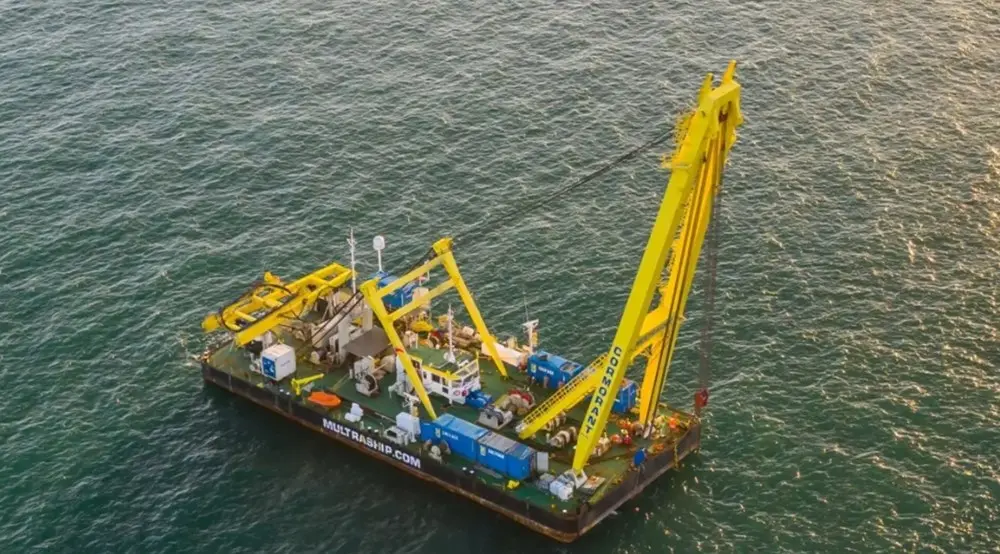
Source: Multraship
Multraship Salvage and Herbosch-Kiere salvaged the sunken inland vessel Sola Gratia using Motorship’s Cormorant
The company recovered the 86m inland cargo vessel Sola Gratia, which sank in Belgium’s River Scheldt after striking mooring posts near Antwerp’s Royers Lock while carrying 1,600 tonnes of sand.
Before lifting operations could begin, the cargo was removed to improve stability before heavy-lifting slings were installed beneath the wreck. Strong tidal currents and narrow lifting windows added to the complexity before floating sheerlegs completed the recovery.
“People often see the final lift and assume that’s the difficult part,” said Multraship managing director Leendert Muller. “But a great deal of the work happens beforehand. The engineering, the planning, the risk assessments and the discussions between all the parties are often what determine whether an operation is successful.”
Multraship also demonstrated the continuing importance of rapid-response harbour towage after refloating the grounded cargo vessel Pendrecht in the Oosterschelde using the tugs Echo and Multraship Rescue 4. A day later it mobilised five vessels to assist the grounded cargo ship AI Stratis in the Everingen, safely refloating the vessel before escorting it to anchorage for cargo operations.
“Often the challenge is responding quickly, making the right decisions and mobilising the appropriate assets before a situation deteriorates,” Muller said. “Those smaller interventions are just as important because they rely on the same fundamentals of seamanship, teamwork and expert knowledge.”
Expanding roles
In Ireland, Atlantic Towage & Marine completed the removal of the grounded fishing vessel Fastnet after it lost power while leaving Dingle Harbour and was driven onto rocks in an exposed surf zone last December.
Atlantic started the recovery in April, when a conventional crane lift was ruled out following marine surveys that prompted engineers to adopt a controlled top-down dismantling methodology. The company mobilised a 400-tonne jack-up barge fitted with a crawler crane and long-reach excavator equipped with hydraulic shears and a selector grab. Once elevated above the tide, the jack-up provided a stable working platform from which the vessel was dismantled progressively in situ.
The operation also showcased the increasing emphasis on environmental protection during salvage work, with Atlantic Towage maintaining oil spill response equipment on site throughout the project.
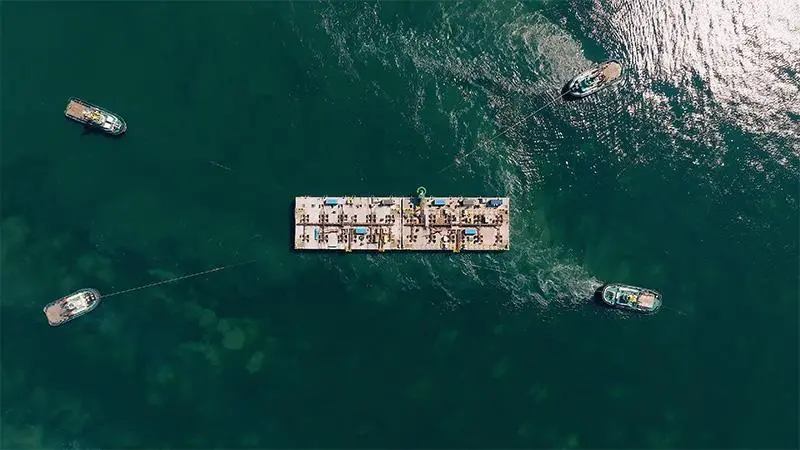
Beyond emergency response, towage and salvage contractors are becoming increasingly involved in long-term marine infrastructure schemes.
Multraship continues to support Belgium’s Princess Elisabeth Energy Island project, transporting the final 22,000-tonne concrete caissons forming the island’s outer wall. The company is also supplying five tugs and two multipurpose vessels for construction of the 18.2km Fehmarnbelt tunnel between Denmark and Germany, while providing specialist marine support for Belgium’s Oosterweel Link transport project.
“As offshore energy developments become larger and more complex, the need for versatile maritime companies that can combine operational experience, technical capability and rapid response will only continue to increase,” Muller said.
The ISU examples illustrate how today’s salvage operators are increasingly deploying the same specialist towage assets, engineering expertise and heavy-lift capability across casualty response, offshore energy developments and major civil engineering projects, reflecting the widening role of the modern salvage industry.
Related Articles
 OTHER NEWS
 SPONSOREDSTORY
 INDUSTRY NEWS