

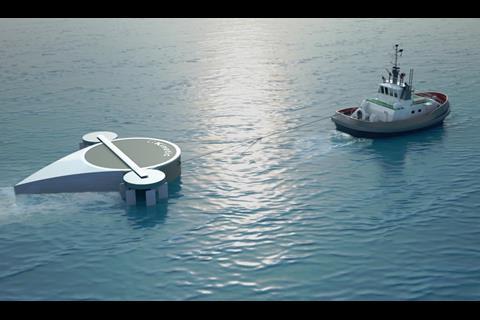
In recent years, the Irish wave and tidal energy sector has steadily grown - with a number of companies and organisations now making solid progress in the development of devices around the country.
So what are the most recent trends and developments? And what are the prospects for the ongoing growth of the Irish wave and tidal sectors over the next few years?
ORGANISATIONAL INNOVATION
A number of recent trends in the Irish wave and tidal sectors point to a very positive outlook for the industry across the country. In particular, a vast improvement in the way organisations coordinate the indigenous research, academic and government infrastructure means that Irish developers are now better supported than ever before. A key example is the Centre for Marine and Renewable Energy (MaREI) at University College Cork (UCC), which now integrates all the major academic institutions that work on offshore renewable energy around the country, including UCC itself, as well as the University of Limerick (UL), the National University of Ireland Galway (NUIG), University College Dublin (UCD), Cork Institute of Technology (CIT) and Maynooth University (MU).
According to Jimmy Murphy, Principal Investigator at MaREI, both the Science Foundation Ireland (SFI) and the Sustainable Energy Authority of Ireland (SEAI) have also provided 'significant funding' to develop and sustain the required infrastructure and expertise, in addition to taking on the role of supporting industry 'for the advancement of wave and tidal energy devices.'
"The MaREI Centre is the first stop for most Irish technology developers and increasingly for international developers so we are familiar with many of the current innovations in this sector," says Murphy.
"We are now more aware of the challenges facing marine renewable energy (MRE) and are working to design devices that have better reliability and survivability as well as being more efficient - such that to reduce the Levelised Cost of Energy (LCOE) to levels that will encourage investment," he adds.
In particular, Murphy singles out innovations relating to individual device concepts and how they interact with waves or currents, as well as power take off (PTO) systems and control systems for maximizing power production.
"The development of new materials may [also] become a game changer for the industry and facilitate a move away from steel and concrete," he says.
TECHNOLOGICAL DEVELOPMENT
Dr. Jamie Goggins, Senior Lecturer at the College of Engineering and Informatics at NUIG, agrees that MaREI has been instrumental in creating an 'integrated cluster of critical mass with industry' - and he points to numerous examples of how the Centre, through collaboration on targeted projects with industry, has helped companies to prepare ocean technologies for market by removing technical barriers. Such examples include Éirecomposites, which will build the turbine blade for the FloTEC tidal energy project at their facilities in Inverin, Co. Galway - and Greencore, Co. Louth-based Openhydro, which is making advances in commercialising tidal energy and collaborating with MaREI on a project in NUIG to assess a novel blade attachment design.
Another boost to technological development came during March, when Irish wave energy company Sea Power announced that it had concluded the winter survivability testing programme of its quarter scale prototype wave energy device at the Galway Bay Marine and Renewable Energy Test Site.
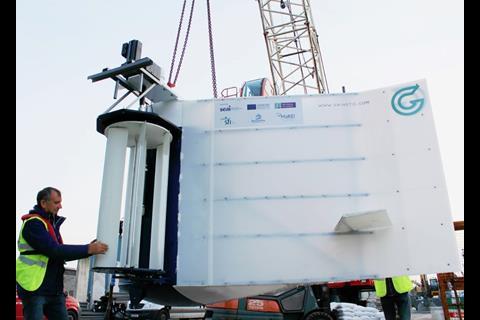
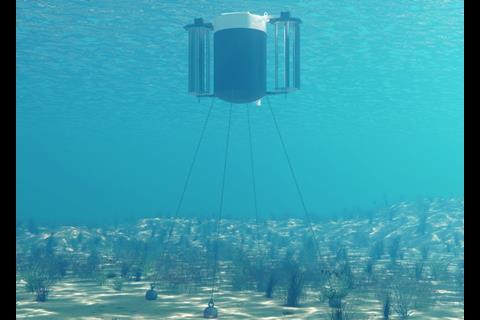
Since the successful deployment of a 10kW prototype of its marine energy device in Limerick Docks in October 2015, GKinetic has also achieved a number of major milestones, including the completion of 2D and 3D Computational Fluid Dynamics (CFD) Models of the device at NUIG and Numerics Warehouse. As Vincent McCormack, Managing Director at GKinetic Energy, explains, a 'huge effort' has also been applied to the devices' PTO (Power Take Off) system over the past year, meaning that, with help and support from staff at MaREI and the LiR National Ocean Test Facility, the 'PTO control law is now successfully defined.'
"This was a crucial step in developing the technology and will be put to the test when the device is re-deployed back in Limerick Docks in June this year," he says.
In March this year, the GKinetic business plan also received a seal of approval when machine builders, DesignPro secured €2 Million in H2020 funding to commercialise small-scale river devices utilising GKinetic technology. While DesignPro are taking this range of devices to market, GKinetic will continue to work on R&D relating to its technology, with a particular focus on developing larger machines for maritime uses. The company is also currently putting together a European team of experts to collaborate with it on the design, build and demonstration of a 250kW tidal device.
In McCormack's view, the Irish tidal and wave energy sectors have 'progressed immensely' over the last couple of years, largely as a result of 'more funding opportunities and R&D support.'
"There has been an increase in funding available for Irish developers to help minimise the high costs involved in this sector, for example the SEAI Prototype Development Fund. This funding has resulted in more deployments for testing both in Ireland and abroad for Irish developers," he says.
"Also, GKinetic has experienced first-hand the R&D support through Irish Universities and organisations such as MaREI, NUI Galway and LiR. Our collaboration with these organisations to date has allowed us to develop our technology further at a lower cost with access to industry experts," he adds.
INFRASTRUCTURE TESTING
In addition to enjoying support from improved financial support and an increasingly sophisticated organisational set-up, companies operating in the Irish wave and tidal sectors also benefit from access to several state-of-the-art technology testing facilities. These facilities include the MaREI tidal rotor blade test facility at NUIG, as well as the deep ocean basin, ocean emulator and wave & current flume at the LiR National Ocean Test Facility and a Remotely Operated Vehicle (ROV) at the University of Limerick.
Another major development in recent months has been the launch of two high profile Irish-led initiatives relating to the testing of infrastructure for the offshore renewable energy industry, including wave and tidal energy.
The MaRINET2 scheme is a €10.5m project funded under the European Union (EU) Horizon 2020 (H2020) programme - and featuring 39 partners drawn from all across Europe. As well as focusing research aimed at standardizing and improving testing methods, the project also provides around €5m worth of free transnational access to 59 test infrastructures around the continent. In Ireland, test facilities in UCC, UL and NUIG are available for foreign companies, whilst Irish firms can test in facilities in other European countries. The ultimate hope is that the scheme will promote better integration and collaboration, which will be of benefit to the wider industry.
Meanwhile, the MARINERG-i initiative is a H2020 project charged with producing a scientific and business plan for an integrated European Research Infrastructure designed to facilitate the future growth and development of the Offshore Renewable Energy sector.
"This plan will ensure that the MARINERG-i Research Infrastructure model attains the criteria necessary for being successful in an application to the European Strategy Forum on Research Infrastructures (ESFRI) roadmap in 2020," says Murphy.
"The MaREI Centre co-ordinates both these projects, so internationally is in a very central position in relation to the development of offshore renewable energy technologies," he adds.
ONGOING CHALLENGES
Although buoyant about the prospects for continued growth, Goggins admits that the Irish wave and tidal sectors still face a number of challenges, including those related to site accessibility for deployment and maintenance, installation costs and 'more extreme loading and harsher environmental conditions,' meaning that materials need to be 'stronger and more durable.' However, in facing up to these potential hurdles, he reveals that MaREI is working closely with industry and researchers across Europe to develop solutions.
"For example, we are developing new composite materials, surface treatment processes and coatings to improve the durability of the materials for use in the marine environment under significant loading," he says.
According to Goggins, another major factor to consider for wave energy systems is the lack of a fixed point of anchorage, particularly in deep seas, meaning that the moorings for floating platforms or structures still allow 'significant movement, which will cause problems when tuning or controlling the operation frequency of the device for efficient power extraction.'
"This issue is not seen on land or for nearshore devices as they can be fixed to the ground and establishing a similar mooring point offshore would be very expensive. Through tank testing in the LIR National Ocean Test Facility, scale testing in the Galway Bay test site and full scale prototype testing in open waters, as well as numerical simulations, researchers in MaREI are assessing developers to overcome some of these problems," he says.
COMMERCIAL PROSPECTS
Murphy predicts that the next few years will be 'very important' in showing that the Irish MRE industry is 'progressing and proving that it will contribute to the future energy supply.'
"The tidal industry is now at the early stages of commercialisation, with the first small scale arrays being deployed, and it is important that these deployments meet their targets. If technology is proved then the industry can move very quickly - remember the first commercial offshore wind farm was installed in 2001, and by 2020 it is expected that there will be 24GW capacity in Europe," he says.
Murphy also hails the Irish company OpenHydro as a 'major success story, being one of the leading technology suppliers' - and believes that the country's future involvement in tidal energy will 'revolve around technology development because the commercially extractable tidal current resource in Ireland is small.'
As far as wave energy is concerned, Murphy reveals that, although Ireland has a 'huge resource,' commercial devices are not yet available, and confirms that the sector has recovered from a few setbacks in recent years, leaving it 'at a stage where full scale devices are being deployed in open ocean sites.'
"Again it is critical to prove that we have learnt from past mistakes and that any deployment is successfully executed, such that we build up knowledge and experience on operations in energetic wave environments," he says.
"Ireland again has companies who are at high Technology Readiness Levels (TRLs), such as Ocean energy, who will be deploying a full scale device in Hawaii late this year, and SeaPower who successfully deployed a quarter scale device in Galway Bay," he adds.
Elsewhere, McCormack is confident that Ireland's tidal and wave sectors will 'continue to develop and prosper into a future with a focus on freedom from fossil fuels.' Thanks to 'great support' from organisations like SEAI and the growing number of deployments, he also expects commercialised tidal and wave energy devices by Irish developers to be available on the market 'in the very near future.'
"As a MaREI Industry partner, we are involved in their approach to continue to grow their facilities and resources available to technology developers and researchers. A key trend in Ireland will be more support, facilities and a vision to become leaders in marine energy research and development," he adds.
Meanwhile, Goggins believes that the capture of wind, tidal and wave energy resource to electricity for consumption in Ireland is 'only one side of the marine renewable energy sector in Ireland.'
"We also have companies that are leading the way in terms of technology development, which could position Ireland as a global leader in design, development and manufacturing of marine renewable energy technology," he adds.
By Andrew Williams