

Stillstrom by Maersk has successfully demonstrated fully automated cable control for its Offshore eCharger, removing a key practical barrier to charging hybrid and electric vessels while they operate on dynamic positioning (DP) at offshore wind farms.
The trial, witnessed by DNV as part of Stillstrom’s technology qualification process, tested the system’s ability to manage a moving charging cable automatically as a vessel moved away from and returned towards the charging point.
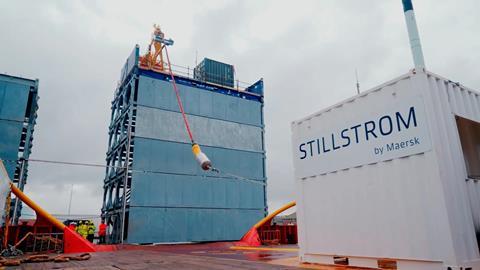
Conducted with offshore wind vessel operator ESVAGT and development partner Semco Maritime at Semco’s Esbjerg yard in Denmark, the test deployed the charging connector from a height of 15.5 metres. A 125-metre cable was automatically paid out and retrieved by the tower-mounted reel, maintaining a constant cable profile as the vessel changed position.
The trial covered automated cable control, RTK GPS positioning, synchronised reel and vessel winch speeds, user-interface and data-logging functions, and system behaviour under realistic yard conditions.
“Cable control is one of the trickier parts of offshore charging to get right, and this successful trial showed our system safely managing it automatically as the vessel moves,” said Stillstrom CEO Kristian Borum Jørgensen.
The company says the technology could help make offshore charging more practical for electric and hybrid support vessels, reducing the need for manual intervention while vessels are connected.
The test follows yard and harbour trials in 2024 and a dry test in February 2026. Stillstrom’s next step is an integrated test with an SOV and the complete charging system, followed by a sea trial ahead of final certification and potential first deployment.