![MaritimeJournal[Seawork]](https://www.maritimejournal.com/wp-content/uploads/2026/09/MaritimeJournalSeawork.svg)


KT Marine Rotortug details revealed
Rotterdam based Rotortug BV are set to play a significant role in a project currently attracting media interest with development of Shell’s Prelude FLNG floating LNG production plant off Australia’s north west coast.
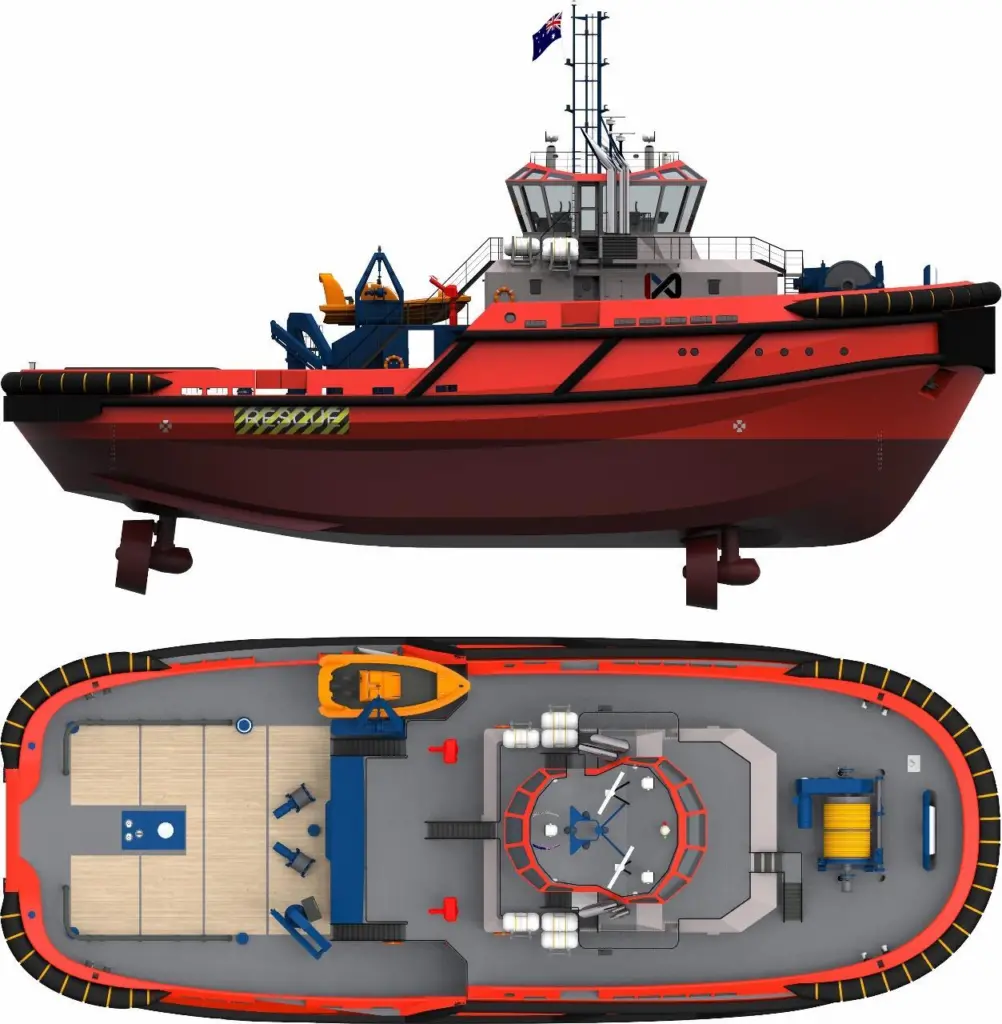
To provide marine support for the project, KT Marine Services (a JV between Kotug International BV and Teekay Shipping Australia Pty Ltd) are building three Infield Support Vessels (ISVs) based on one of Rotortug’s larger vessels, the ART 100-42 class. With commencement of steel-cutting at ASL Shipyard in Singapore further details of the vessels have been announced.
The ART 100-42 Rotortug is designed by Robert Allan Ltd in close collaboration with KT Marine and are described as the world’s first purpose-built FLNG ISVs. The nature of the client’s requirements goes somewhat beyond a tug’s typical role of shiphandling at ports and terminals however. As well as assisting with berthing and un-berthing of LNG tankers at the floating terminal, their role also includes: FiFi 1 capability, floating hose handling operations, pilot transfer, security activities and rescue and emergency evacuation capability.
With the requirement for towing operations over the bow and stern including large angles of the towline, the additional duties presented interesting challenges for the vessels’ designers. Attention had to be paid to the arrangement of key equipment such as: the fast response craft, Dacon scoop and deck crane, deck cargo crash rails and hose handling equipment. Innovative solutions included an 800mm diameter vertically retractable towing staple and creative arrangement of hose handling equipment.
High environmental standards were demanded with all fuel, lube oil and other pollutants required to be located away from the shell plating. This was to be extremely challenging for a 42m LOA vessel with fore and aft propulsion systems and the requirement for very high fuel oil and fresh water capacity for a 35 day offshore endurance with reserve.
The wide range of operational requirements of course do not preclude the basic role of providing traditional towage assistance in what are described as “fairly significant environmental conditions”. The RAstar hull form was selected because of its proven seakeeping performance in high sea states, providing reduction in motions and accelerations compared to more standard wall-sided forms. Extensive model testing was conducted along with a CFD analysis to ensure that Shell’s bollard pull requirements (operating in both directions) were met with the triple-drive arrangement.
The various roles planned for the vessels demand best possible visibility from the wheelhouse to ensure a safe and efficient operation. A detailed wheelhouse visibility study was therefore carried out to ensure clear sightline requirements were achieved. The 42m long, 16m wide vessels will produce over 100 tonnes bollard pull, ahead and astern and it is hoped this column will be able to report on them in greater detail as the project progresses.
By Peter Barker
Related Articles
 TUGS & SALVAGE
 EQUIPMENT
 MARINE CONSTRUCTION