![MaritimeJournal[Seawork]](https://www.maritimejournal.com/wp-content/uploads/2026/09/MaritimeJournalSeawork.svg)




Turkey commits to controversial canal project
Despite years of controversy, Turkish president Recep Tayyip Erdoğan’s ‘crazy project’ to dig a 45km canal parallel to the Bosphorous remains on Turkey’s long-term agenda.
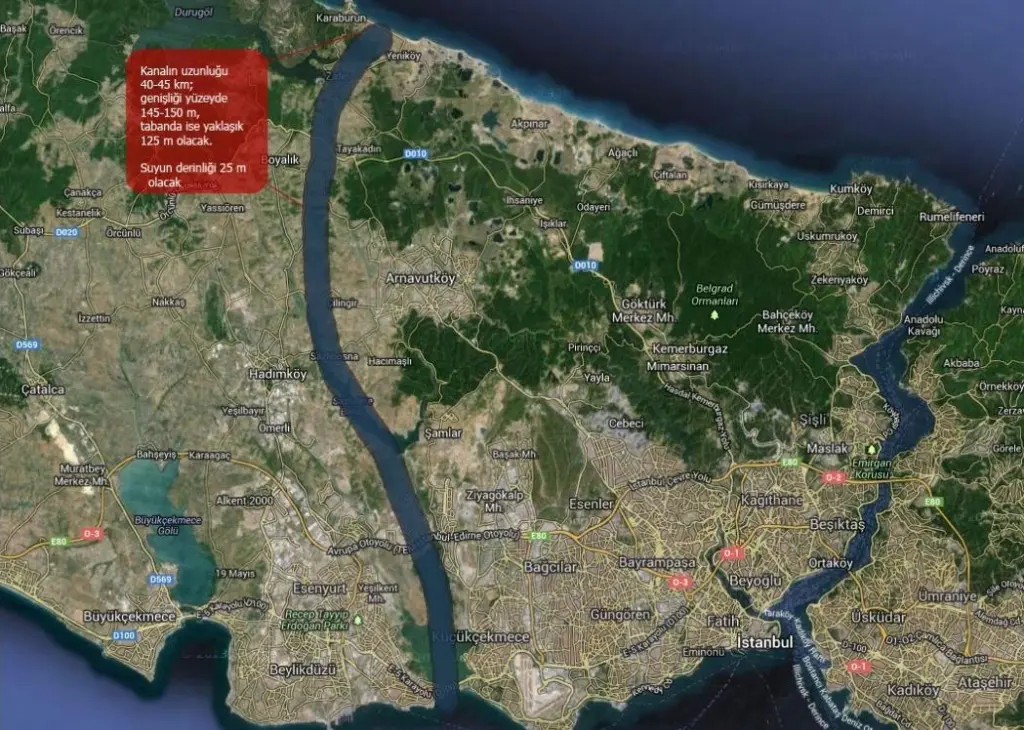
Reuters news agency quoted the Transport and Infrastructure Minister, Abdulkadir Uraloglu, as saying that although the Kanal Istanbul project was not on the day’s agenda, ‘when the day comes, the right financing is found, we will definitely do it’.
President Erdogan first mooted the idea in around 2011 as a solution to the increasing number of delays experienced by ships transiting the Straits of Bosphorous, the only link between the Black Sea and the Sea of Marmara.
But it would involve digging through villages and farmland, potentially destroying ecosystems and archaeological sites, and the eye-watering cost – somewhere between $15 billion and $20 billion – has raised questions about its economic viability.
After years of discussions on the best route for the 400m wide waterway, which saw at least four proposals for alternatives, the chosen route runs through the Kucukcekmece Lake to the Durusu region on the outskirts of the city, and it would be a sea-level canal with no locks.
Specifications published in 2021 show a depth of 25 metres and a width of between 250 and 1,000 metres. New islands would be created in the Sea of Marmara with spoil removed from the canal bed.
Breakwaters would have to be installed at both ends to protect the entrances, and up to five high-level bridges would be included, along with canal bank development to make the waterway a major logistics hub serving the Black Sea.
The Turkish website Turkish Minute has just published what it says are the results of a survey by an agency affiliated with the Istanbul Municipality.
More than three quarters of Istanbul residents oppose the controversial Kanal Istanbul project,” it says. “According to the Istanbul Planning Agency, 77.2 per cent of respondents said they do not support the project, which critics warn would cause severe environmental damage and increase earthquake risks,” it says.