

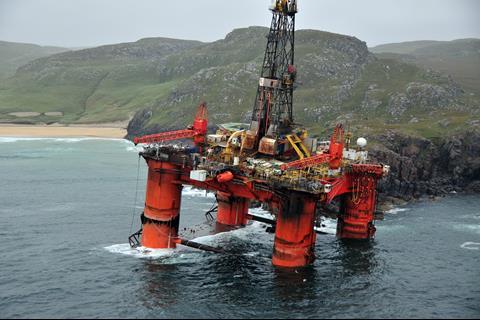
Smit Salvage has successfully refloated a drilling rig which stranded on a rocky coastline off Scotland’s west coast after breaking adrift from its towing tug.
The semi-submersible Transocean Winner was under tow from Norway to Malta when it encountered unseasonably bad weather west of the Isle of Lewis, Scotland in early August. The tug contacted Stornoway Coastguard stating that while they were still connected to the rig, were unable to make headway. The MCA’s ETV Herakles was deployed from Orkney to assist.
Some hours later the tow line parted and with no possibility of re-connecting, the tug stood by as the rig drifted towards the coast and subsequently grounded near Carloway on the Isle of Lewis. As standard with such incidents in UK waters, Hugh Shaw - the Secretary of State’s Representative for Salvage and Intervention (SOSREP) and the MCA counter pollution branch were notified. The rig was unmanned but there was 280mt of diesel on board.
Local authorities, coastguard rescue teams, police, Scottish Environmental Group and Marine Scotland were among those who also became involved and a 300m exclusion zone was established around the rig with an appeal made for people to stay away from the site to ensure specialist equipment had access and to prevent sightseers getting into difficulties themselves on the remote cliff paths.
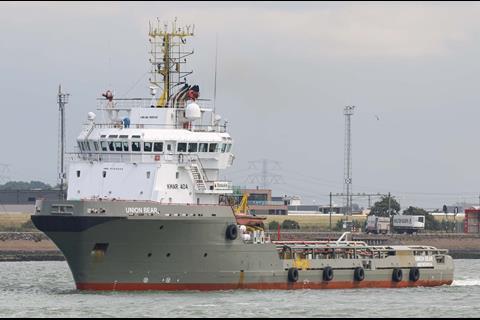
Rotterdam-based Smit Salvage was soon appointed to refloat the rig by its owner Transocean and personnel and equipment were mobilised to the site. Smit deployed their recently acquired KMAR-404 AHTS Union Bear and the UT719-T AHTS Union Princess for the salvage. UK involvement came in the form of Briggs Marine Services’ Forth Drummer and its latest fleet addition the Damen Multi Cat Forth Warrior, a vessel attracting much attention at Seawork 2016.
There has long been campaigning locally for the provision of ETV coverage around the Scottish coastline since previous UK-wide arrangements were scaled back in September 2011 leaving just the Herakles covering northern Scottish waters. Under previous ownership and name Union Princess was one of the tugs engaged for ETV duties around the UK coastline.
SALVORS ON BOARD
Meanwhile plans were drawn up to put a small team of salvors on the Transocean Winner by helicopter to conduct initial assessments. Establishing the integrity of the fuel tanks was important and a second team established that two of the four diesel fuel tanks had been breached although it was unclear how much oil had been released into the environment.
Monitoring for pollution is always a high priority with salvage operations and the MCA used counter-pollution surveillance aircraft to overfly the area checking for any signs of oil escaping. Initial observations indicated no sign of pollution although it was estimated a maximum of 53mt of diesel could have been lost. It was pointed out that diesel is a light and non-persistent oil presenting a much lower environmental threat than heavy crude oil.
Bad weather made it impossible to board from the sea with another important task being to inspect the emergency generator to establish the amount of power available. Alternative boarding methods were explored including using a rope access team and salvors were able to climb partly up the installation. The use of additional air assets was also explored.
Nearly a week after the grounding, weather more attributable to the time of year allowed a team of eight salvors to set up temporary home on Transocean Winner. Rope access technicians created a safe alternative access with a supply line allowing equipment and supplies to be transferred.
As a clearer picture emerged of the rig’s condition a more detailed salvage plan was drawn up including transferring 137mt of fuel to un-breached tanks using onboard pumps, a multi-beam survey was also carried out in close proximity to the rig to identify a safe route for towing clear. More salvors joined the on-board team which by now included personnel from Transocean; additional air support came from an AugustaWestland AW139 temporarily based at Stornoway.
By day nine over 200 people were involved from: the MCA, Transocean, Smit Salvage and Briggs Environmental and preparations included plans to attach a second tow line to the Transocean Winner and to transfer compressors to provide buoyancy for the refloating operation. The platform supply vessel Olympic Orion was able to remove 200mt of diesel from the rig.
With steady progress all was now set for the final phase of the operation, the refloating attempt. So it was that two weeks after the stranding, Union Bear and Union Princess were able to refloat Transocean Winner and tow it clear of the rocks. The rig was moved north around the Butt of Lewis to Broad Bay some 40 miles away.
At the time of writing the rig was held by eight anchors in Broad Bay with further work continuing in preparation for its next move. In the end the unseasonable weather which led to the grounding gave way to weather more usual for the time of year aiding final stages of the operation. SOSREP Hugh Shaw paid tribute to all involved in the salvage stating: ‘I would like to offer my sincere thanks to the Western Isles Council and community for their patience and their gracious hospitality during this challenging and disruptive period. This salvage operation has required the united cooperation from so many different organisations who have spared no effort to ensure that this rig reaches safer waters’. Adding: ‘I would like to specifically mention Salvage Master, Sylvia Tervoort and the Smit Salvage team, Transocean, Briggs Environmental, Western Isles Council and local community, Scottish Environment Group and other supporting government departments, the Maritime & Coastguard Agency, the emergency services – not to mention all the other supporting organisations, stakeholders and businesses who’ve assisted in this operation.’
By Peter Barker