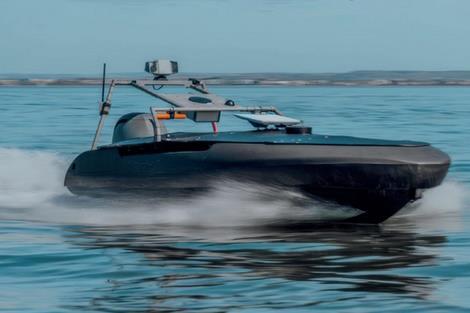



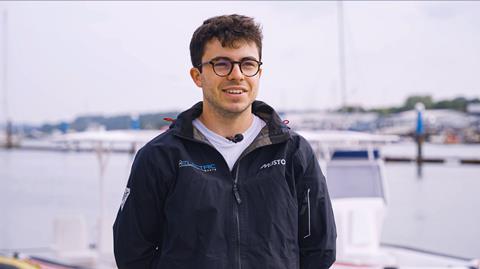
Rigid Inflatable Boats (RIBs) are obviously at the smaller end of the market for batteries in commercial marine, and one well-known adopter, RS Electric Boats, is confident they are up to the job. Head of Engineering Alex Middleton spoke to MJ about the company’s use of batteries in their fleet.
”The motivation behind launching RS Electric Boats (a sister company to RS Sailing and Cheetah Marine, all within the RS Marine Group) was to address the growing need for zero-emission workboats and RIBs in both commercial and leisure marine sectors – with a focus on sustainability without compromising performance,” he says.
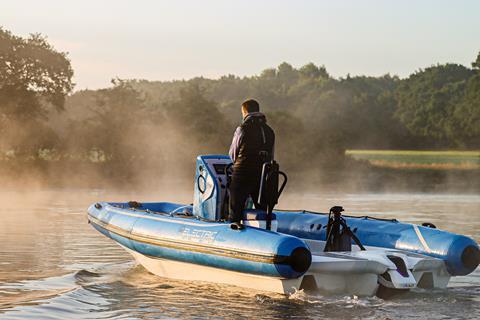
”The development began with the Torque 58, followed by Pulse 58, followed by the Pulse 63, the world’s first fully integrated electric RIB, which launched in 2021. It was designed from the ground up as an electric vessel, rather than retrofitting an existing hull design.”
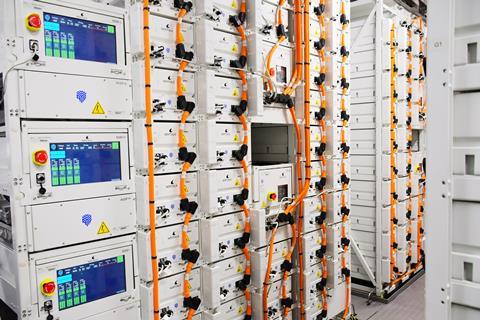
RS Electric Boats uses high-capacity lithium batteries, which it says are marinised and specifically engineered for safety and longevity in harsh salt-water environments.
”The Pulse 63m, for example, is powered by a 61kWh system,” he says. “It is integrated into the fully electric drivetrain with intelligent monitoring systems. The batteries are built to automotive standards for robustness and undergo extensive testing for thermal management, vibration and water ingress.
“They are of an NMC chemistry, chosen for its safety, stability, high energy density and long cycle life.”
Performance comparison
Alex Middleton says when comparing a fully electric battery-powered RIB with a conventional diesel one, there are definitely trade-offs.
“But there are also significant gains,” he says, listing them:
- Performance: Acceleration is instant due to the electric torque curve. Top speeds can be slightly lower, but for many operational profiles (eg port use or safety boats), that’s not a limiting factor.
- Speed & range: Current electric RIBs are best suited for short to medium-range use. The Pulse 63, for example, can run for 1.5-3 hours at full/cruising speeds, or much longer at lower speeds.
- Charging vs refuelling: Charging can take a few hours depending on infrastructure — fast chargers (DC) drastically reduce downtime, but aren’t yet universally available.
- Cost: Upfront costs are higher, but running costs are dramatically lower — electricity is cheaper than petrol or diesel, and maintenance is minimal.
- Maintenance: Electric drivetrains require very little upkeep — no oil other than within the gearbox, fewer moving parts, and fewer failures. The only scheduled maintenance required are oil changes and anode changes.
- Operation: Operators notice lower noise levels, less vibration, and a generally smoother ride. There’s also increased confidence in reliability.
The batteries have so far met or exceeded expectations in terms of cycle life and performance consistency, says Middleton, and thousands of charge/discharge cycles are expected.
The future
The motivation was twofold, Middleton says: environmental responsibility and future proofing.
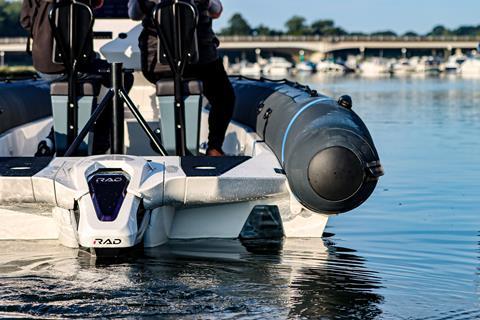
“The marine industry is under increasing pressure to decarbonise, and we saw an opportunity to lead from the front. We’ve seen interest and uptake in a wide range of applications: port authorities, marinas, event support boats, safety vessels, and offshore wind farm operations, where low noise, low maintenance, zero emissions, and reliability are highly valued.”
The batteries will not last forever, which is a consideration for some clients, he says – but prices are steadily coming down ‘as the global supply chain matures’.
“It is also not something we are expecting customers to have to carry out until the 8-10 year mark.”
There is still a dark cloud over end-of-life for batteries, which, whatever anyone says, have not yet reached commercial-scale recycling; but RS Boats says it is ‘committed to responsible battery lifecycle management’, working with recycling partners and looking at second-life systems such as in static storage.
Charging challenges
Charging infrastructure is possibly the biggest challenge facing every battery-powered vessel operator and manufacturer that we spoke to, and it’s no different with RS Boats.
“While many marinas and ports have basic AC shore power, few currently have high-speed DC charging, which can be ideal for commercial turnaround times,” says Middleton. “We have however been observing most users are finding slower AC charging to be sufficient for their use case. Very few customers require fast charging regularly if AC charging is planned properly.
“We have designed our systems to be as flexible as possible — compatible with both single-phase and three-phase AC, as well as DC fast charging where available. In some cases, customers also install their own solar or off-grid systems to supplement charging, which ties in well with sustainability goals.
”Of course, challenges exist — mainly around charging infrastructure, range and customer familiarity,” says Middleton. “But performance and reliability have been excellent.”