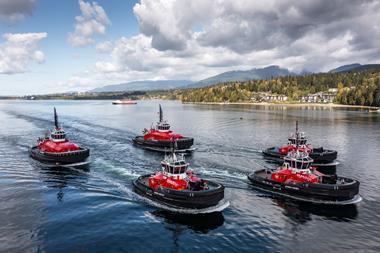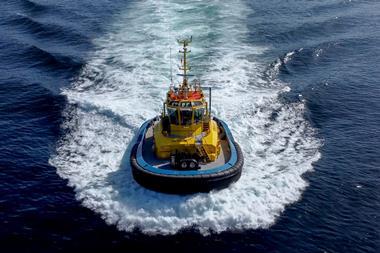


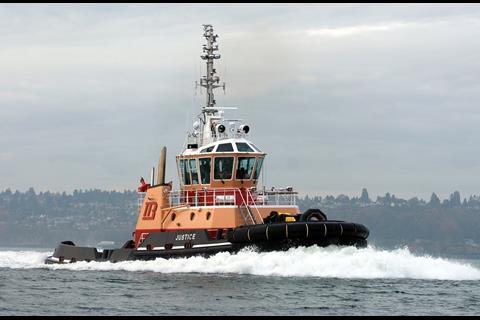
Boston Towing and Transportation Company of the USA has taken delivery of two new tugs designed by Robert Allan Ltd (RAL), Naval Architects of Vancouver, BC, to support offshore LNG terminal operations at the Neptune LNG LLC, Deep Water Port, in Massachusetts Bay.
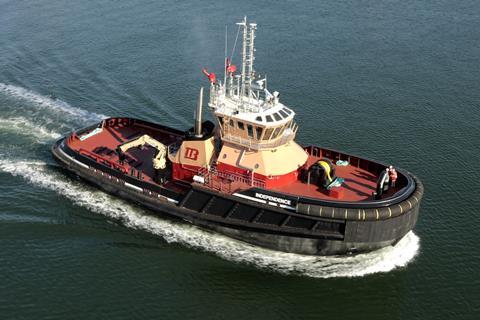
The first and larger tug of the pair, named
Independence, was handed over early in November. Designated the ASD 39/70, this unique new design is very similar to comparable RAstar Class tugs from the RAL office, but due to its many unique features it has been given a more general ASD type designation.
The tug is configured for a wide range of duties including harbour towage and shiphandling, fire fighting, coastal towing, salvage and rescue towing operations. However, the primary role will be to stand-by tankers using an offshore mooring buoy, located in a fully exposed deepwater location some 15 to 20 miles offshore.
Independence was built at the Derecktor Shipyards in Bridgeport, Connecticut, and is classed by ABS: ABS X A1 Tug, Fire-fighting Class 1, complies with International Loadline, USCG and Marpol.
The design features a full raised forecastle running nearly half the length of the tug which provides a very high standard of accommodation, the ability to work in quite extreme sea states, and the best possible seakeeping capability for operation in very exposed locations.
Principal dimensions of the ASD 39/70 are 39.10m in length overall, with a beam (moulded) of 13.50m, and a maximum draft of 5.75m. Tanks spaces are allocated for 251.5cu/m of fuel oil, 38cu/m of potable water, 335cu/m of water ballast, 6.6cu/m of lubricating oil, 2.3cu/m of hydraulic oil, 5.3cu/m of waste oil, and 4.7cu/m of oily water.
A unique, ‘sponsoned’ hull form, a feature in common with the Robert Allan Ltd RAstar Class tugs, provides roll amplitudes and roll accelerations less than half those of other recognized ‘standard’ tug forms of equal size and displacement. This special design measure will provide the crew with a much safer work platform and much better rest conditions. By current standards the power installed is rather small for a tug of this size but was dictated by demands to provide a high standard of comfort and sea worthiness for the crews which will be on station in fully exposed North Atlantic sea conditions for up to two weeks at a time.
Independence has a main propulsion system comprising a pair of MTU 16V-4000 diesel engines, each rated 2,000 kW at 1,800 rpm (total approximately 5,436bhp), driving Rolls-Royce model US 255 CP azimuthing propulsion units. Controllable pitch propellers incorporated in these units provide enhanced fuel economy, operational flexibility, and enable efficient operation of the main engine driven fire fighting system. They also significantly reduce prop wash when the tug is operating at low power in confined waters. This drive combination is guaranteed to deliver a minimum bollard pull of 67 tons and a free running speed of at least13.5 knots.
For shiphandling, the forward towing winch is a single drum Markey EEPC-52 model, with a brake capacity of 264 short tons carrying 750' of 10" circumference synthetic towline. A JonRie model 512 winch is located aft for towing astern and is equipped with a 2,500' (760m) 2.25" steel wire rope.
The vessel is outfitted to the highest standards for a normal crew of up to eight people. A spacious suite for the Master is located in the forecastle level deckhouse, and two single cabins for officers and two double cabins for crew on the main deck. There is also a fully equipped modern galley and a spacious lounge/mess room. The well glazed wheelhouse has a single control station providing maximum visibility over the working decks fore and aft. Noise levels throughout the crew accommodation are predicted to be in the range of 65 to 70 dBA, based on utilising advanced methods of isolating the main propulsion machinery vibration and high grade insulation materials.
The second, smaller, tug delivered to Boston Towing and Transportation, is the Justice. This vessel is a modified RAmparts 3000 Class tug to be engaged primarily on harbour duties, but it will serve as the back-up for the larger Independence during the latter's service periods. The RAmparts 3000 Class vessel is also designed for a wide range of duties including harbour towage and ship handling, fire fighting and coastal towing, but the key role will also be standing by tankers using the offshore mooring buoy.
Justice was constructed by J M Martinac Shipbuilders of Tacoma, WA USA, to a very high standard, and will be assigned an International Loadline by ABS and comply with the latest regulations for towing vessels issued by USCG and IMO/Marpol.
The design is a variant of the well established RAmparts 3000 and measures 29.9m in length overall, with a beam of 11.0m and loaded draft of 5.3m. A comprehensive outfit of fendering is installed in order to offer protection during all of the vessel’s likely roles. For shiphandling the bow fender comprises an 800mm cylindrical rubber moulding, mounted above a row of 450 mm ‘W’ block fenders. A 300 x 300mm hollow ‘D’ fender provides protection at the main and forecastle deck sheer lines, in conjunction with aircraft tires. ‘Soft loop’ style fendering protects the aft quarters, with an open transom for buoy handling, etc.
An almost identical MTU/Rolls-Royce ASD propulsion system was chosen for the Justice as in the larger Independence. In this instance a bollard pull of 70 tons was achieved and a free running speed of 13 knots.
Fire fighting equipment is installed to Fi-Fi 1 standard, with two FFS pumps each rated 1,360 cu/m/hour, driven by the main engines.
Again a Markey/ JonRie winch installation is used. The shiphandling winch forward is a single drum Markey model DEPCF-50 with a brake capacity of 180 tons, equipped with 250m of 254mm circumference synthetic towline. The aft towing winch is a JonRie model 512 with 760m of 57mm (2.25") diameter steel wire towline for ocean towing.
Comfortable modern accommodation is provided for a crew of six in two single and two double cabins.