![MaritimeJournal[Seawork]](https://www.maritimejournal.com/wp-content/uploads/2026/09/MaritimeJournalSeawork.svg)






FEATURE: Living next to an explosive WW2 wreck
Despite fears being raised over the risk of the wreck of the SS Richard Montgomery lying laden with explosives off the coat of Kent, recent surveys have shown she remains stable.
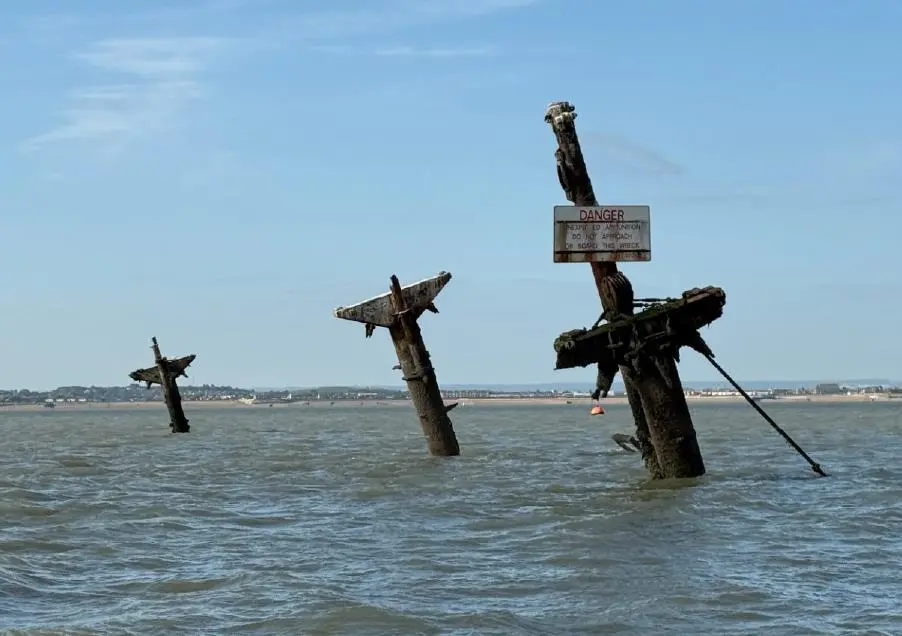
Gradual deterioration of the vessel, which broke in two during World War II containing an estimated 1,400 tonnes of munitions, has caused unease about her being a ticking time bomb, but communities have come to feel almost affectionate about her tilted masts that are still visible today. Indeed, few residents can remember a time before they were part of the landscape.
The wreck is just one example of the region’s close connection with activities of World War Two, the legacy of which includes unexploded mines and munitions dropped during abandoned bombing raids on London and still being uncovered today by aggregate dredgers and fishing vessels, some even exposed on the shoreline with military unexploded ordnance experts kept busy disposing of these leftovers from war.
Fifteen miles north of the wreck of SS Richard Montgomery is Foulness Sand, a vast uninhabited sandbank linked to the shore at low tide and home to a secretive military firing range. When active, explosions send shock waves that rattle windows as far away as Thanet, 20 miles south east on the Kent coast, with emergency services familiar with calls reporting explosions or even earthquakes at sea.
Recent events
A social media frenzy ensued when the troubled bulk carrier Ruby anchored around 15 miles north east of Thanet in 2024.
The vessel had loaded 20,000 tonnes of ammonium nitrate in Russia but experienced hull damage in an Arctic storm leading to the requirement to discharge its cargo before entering drydocking for repairs.
It soon became a maritime leper, roaming the Baltic and North Sea with ports unable or unwilling to unload or transship its cargo, eventually ending up in a relatively sheltered anchorage off north Kent.
Conspiracy theories abounded, including there being a Russian plot to destroy NATO bases along with unfounded claims that an explosion would obliterate everything within a 50-mile range.
Eventually the UK’s understanding and pragmatic attitude to the subject of Ports of Refuge allowed Ruby’s cargo to be unloaded – without incident – at Great Yarmouth on the east coast.
Fateful voyage
In August 1944, the US-built Liberty Ship SS Richard Montgomery, loaded with some 7,000 tonnes of munitions, sailed in convoy from the US, bound for the UK and then on to Cherbourg. While awaiting the formation of another convoy it anchored in the Great Nore anchorage off Sheerness in Kent.
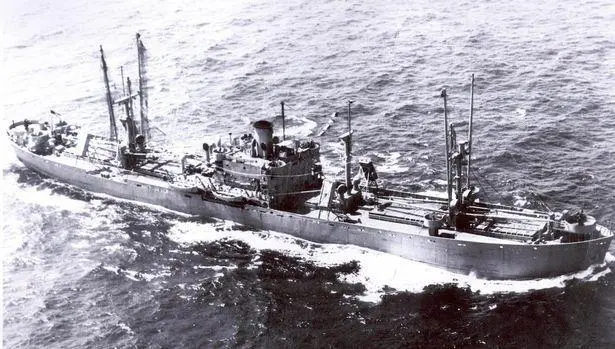
It subsequently dragged its anchor and grounded on a sandbank around 250m north of the Medway Approach Channel. Having endured arguably the most dangerous part of its voyage across the Atlantic from New York, it was ironic that the vessel’s final resting place should be less than two miles off the friendly coast of the UK.
Intensive efforts to unload its cargo followed but by the following day a crack appeared in the hull, the forward part starting to flood. After a month of work, however, where around half its cargo was removed, the salvage effort was abandoned when the vessel finally flooded completely.
It has remained there since, its masts clearly visible above the water at all states of the tide with around 1,400 tons of explosives remaining on board contained within the two forward holds.
Designated under the Protection of Wrecks Act 1973, a no-entry exclusion zone exists around the vessel with warning notices attached to its masts. Medway Ports were contracted by the Maritime and Coastguard Agency (MCA) to mark and guard the wreck, including 24-hour radar surveillance, with the operations room within sight of the wreck.
The wreck has been routinely inspected and surveyed since it ran aground. Ongoing monitoring is considered essential as the wreck has continued to support potentially dangerous materials over the past decades.
Various survey methods have been adopted over the years, including by Ministry of Defence (MoD) salvage divers and more recently surveys undertaken on behalf of the MCA by contractors working under MoD supervision.
Following the 1993 survey and due to poor visibility hampering the work of the divers, advances in sonar technology took over, although divers did return to the wreck site in 2003 to undertake ultrasonic hull thickness analysis.
Seabed support
The 2003 survey included assessing the level of seabed support with the wreck, together with the crack at No.2 hold, and was repeated in 2013 with high-resolution multibeam sonar surveys that have been carried out on a regular basis since 2002.
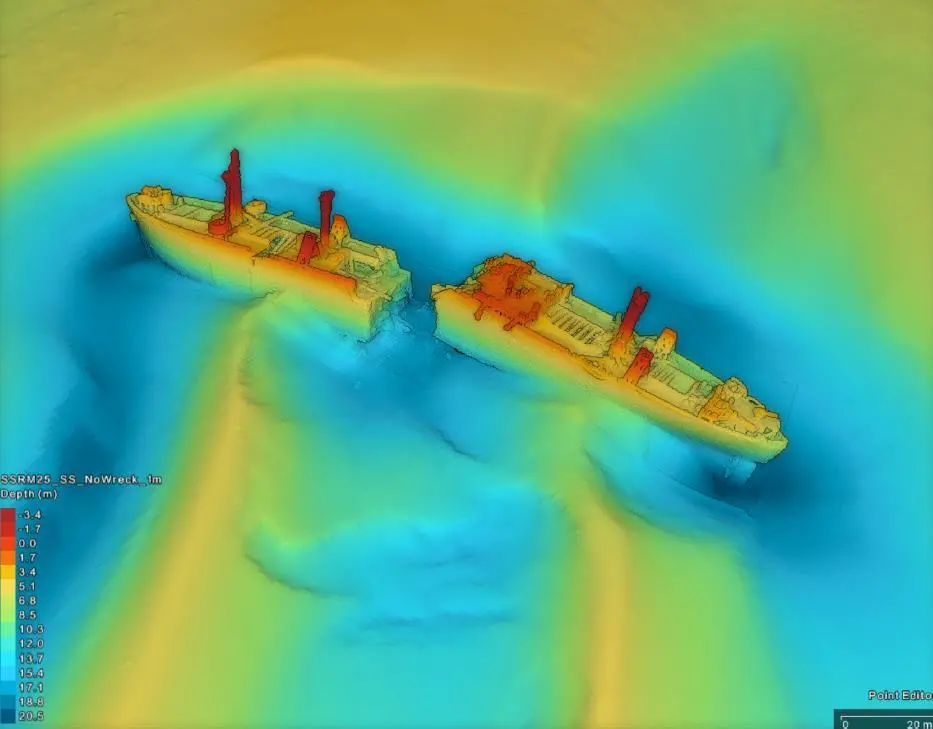
The latest seabed survey has found that between 2024 and 2025 most of the surrounding seabed has experienced depth changes within +/-0.3m, with more local areas reaching up to 2.5m in difference.
In the immediate surroundings, the largest change between the two surveys above is at the aft end of the wreck, where there is a depth increase of approximately 1.4m. Comparing the 2023 and 2025 data, the greatest change is seen on the western side of the front section with a depth increase of approximately 2m.
The report says the full survey successfully covered all significant portions of the wreck with high-quality multibeam echo sounder and laser data including the surrounding seabed area.
The displacement of approximately 2m is described as a “significant change”, highlighting the gradually changing situation for SS Richard Montgomery. The continued increase in tilt of the forward section and continuing erosion of surrounding seabed confirms the importance of regular surveys of the wreck.
For the half a million residents of Sheerness, the Medway Towns and Southend, environmental conditions that literally support SS Richard Mongomery will continue to be of relevance, more so perhaps than the non-story of Ruby and occasional rumblings from Foulness, or when their dogs uncover World War II mortars and shells on local beaches.
Were the remaining munitions recovered they could in theory be transported to Foulness Sand for ultimate disposal, the residents of Kent and Essex still getting to witness their final committal, but from a safe distance.
Related Articles
 SPECIAL REPORTS
 FEATURES & VIDEOS
 FEATURES & VIDEOS