

With two new heavy-duty marine engines and an industry-leading remote diagnostics platform now ready for production, Seawork Premium exhibitor and Platinum Sponsor John Deere Power Systems is making its biggest R&D investment in marine yet – and offering it all as standard.
The launch of the John Deere JD14 and JD18 marine engines represents the largest investment it has ever made in its marine engine programme. The JD14, a 13.6-litre engine, and the JD18, at 18 litres, were developed simultaneously, bringing significant engineering benefits and a more comprehensive power range.
Vincent P. Rodomista, Marine Business & Product Manager at John Deere, tells Maritime Journal how it came about – and what happens next.

“Developing both engines at the same time was a major R&D effort and a real challenge, but it also created strong design synergies. In the end, it allowed us to deliver two engines that were developed together as a cohesive series.”
The JD14 programme builds on the advantages of the newer 13.6-litre platform already deployed across its machine and industrial portfolio. “The JD14 marine engine represents a significant step forward,” says Rodomista. “It’s not simply a replacement, but a substantial upgrade that delivers clear added value for our customers.”
Commercial workhorse and performer
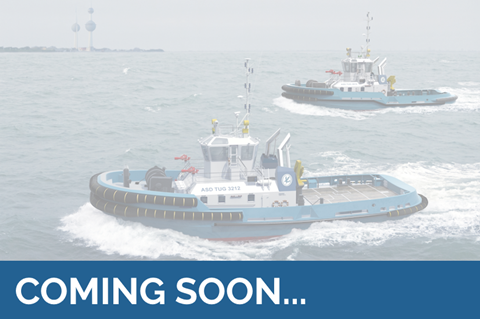
The two engines are designed for different, though sometimes overlapping, markets. The JD18 is squarely aimed at heavy-duty commercial applications: tugs, fishing vessels, passenger vessels, and commercial gensets. It is not conceived as a high-speed planing pleasure craft engine.
“We want to focus on what we do really well and the customers we serve today,” says Rodomista. “That’s largely heavy-duty commercial applications.”
Both engines reach a top rating of up to 803 horsepower, but the classification at that power level differs significantly. At up to 803 hp, the JD18 carries a heavy-duty rating, reflecting duty cycles designed to run hard for extended periods.
The JD14 at the same range of up to 803 hp output is rated as a lighter duty engine for commercial applications.
“The JD14 and JD18 both offer ratings up to 803 hp but serve different applications and markets,” says Rodomista. The higher power density of the JD14’s ratings make it very suitable for commercial high-speed craft.
Significant efforts were made to optimise the weight-to-power ratio of the JD14.
“The base JD14 engine features a more robust bottom end than the 13.5L engine, resulting in a heavier core architecture. To improve power density and broaden its applicability, we reduced weight through the use of an aluminium flywheel housing and oil pan, making it well suited to higher-speed and planing hull applications.”
Production of both engines begins in July at Engine Works in Waterloo, Iowa. Interest in the market extends beyond propulsion: Rodomista points to genset packages and variable-speed auxiliary applications – cargo pumps, deck pumps and deck machinery – as key targets alongside direct-drive propulsion.
Common rail, rear gear train and hydraulic valve adjustments
Both engines incorporate three engineering advances that together enhance performance and minimise vibration.
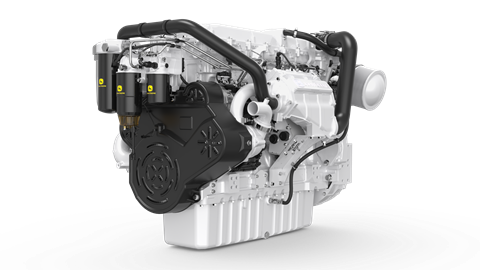
The most significant change is the move to high-pressure common rail fuel injection system, replacing the unit injector system used on the John Deere 13.5L engine. Both engines use a single high-pressure pump supplying a common rail, optimizing fuel mapping flexibility and performance.
“The high-pressure common rail fuel system provides significant flexibility in fuel mapping, allowing us to optimize combustion without being constrained by the timing limitations of a cam-driven, mechanically linked injection system,” says Rodomista.
As a secondary benefit, common rail injection is smoother than unit injection.
The second advance is the adoption of a rear gear train on both engines, replacing the front gear train.
“With greater mass and stiffness at the rear of the engine, the rear gear train is subject to lower torsional vibration than a front-mounted arrangement,” says Rodomista. “The result is reduced gear whine and rattle, along with more precise combustion and smoother overall operation.”
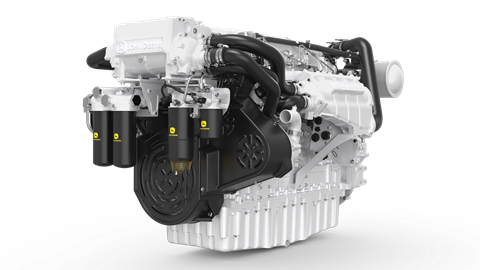
The third major innovation is a hydraulic lash adjustment system, eliminating the need for periodic valve clearance adjustment. While the 6135 engine requires service every 2,000 hours, the JD14 and JD18 maintain correct clearances automatically. By keeping the valve train pre-loaded, the system ensures consistent performance over time.
The combined effect of these changes was consistently demonstrated during pre-production field trials.
“By far the most consistent feedback we received from our pre-production customers was on how smooth the engines are,” says Rodomista. “That initial impression is typically followed by the acceleration, with customers placing real value on the available power, strong transient response and overall responsiveness.”
Renewable fuels
On alternative fuels, John Deere is prioritising HVO (hydrotreated vegetable oil) and biodiesel fuels for its new marine engines. The JD14 and JD18 are approved for biodiesel blends up to B20 as a drop-in replacement, with the possibility of operating beyond that concentration, provided the fuel meets specifications set by John Deere.
Higher biodiesel concentrations require additional operational care.
“As you go up in the percentage of biodiesel, it becomes just a little bit more challenging for customers. They have got to be really careful in cold weather and with condensation,” says Rodomista. “We may lose some power – just not as much energy per volume in biodiesel.” For operators in suitable climates with access to certified fuel, however, concentrations above B20 are achievable.
HVO is a different proposition. “The JD14 and JD18 engines can run on 100 per cent HVO (R100) as long as the fuel meets John Deere HVO guidelines” says Rodomista. The practical barriers are cost and availability: HVO is generally more expensive than marine diesel and can be harder to source.
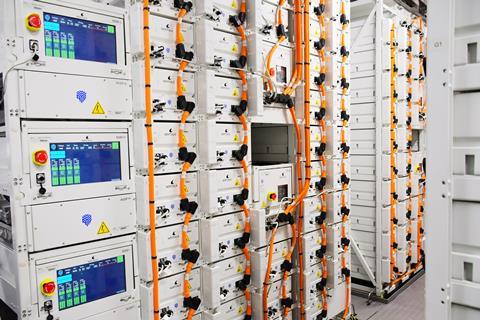
Looking further ahead, John Deere has entered the hybrid and all-electric space through an investment in KREISEL Electric (KREISEL), an Austrian manufacturer of NMC (Nickel, Manganese, cobalt) - chemistry battery systems holding DNV-type certification. Through vetted marine systems integrators, the John Deere channel can now offer complete hybrid propulsion packages – combining its diesel engines with KREISEL battery packs and third-party power electronics – available to customers via its distributor network.
Longer maintenance intervals
Alongside the engineering advances, both new engines deliver substantial reductions in scheduled maintenance.
The oil change interval has doubled from 250 hours to 500 hours.
The seawater pump impeller has been upgraded from rubber to bronze and is now rated to 10,000 hours instead of 500.
The HLO (hydraulic lash adjustment) system also eliminates what has traditionally been a routine service requirement. “On these engines, valve clearances are automatically maintained by a hydraulic system, removing the need for scheduled lash adjustment—typically a 2,000-hour service interval on the 6135 engine and similar non-HLA engines,” says Rodomista.
John Deere Connected Support
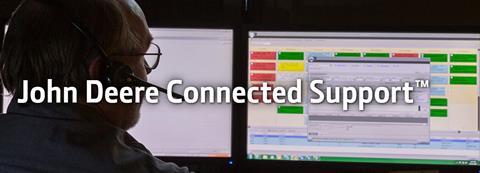
Perhaps the most commercially significant aspect of the JD14 and JD18 launch is not the engines themselves, but the telematics and remote diagnostics platform that comes standard with no subscription fees.
‘John Deere Connected Support’, proven across John Deere agriculture, construction and forestry fleets, captures engine data via an onboard modem and antenna, transmitting it to proprietary servers over cellular networks—at no additional cost to the customer. Where cellular coverage is unavailable, the system can route data through the vessel’s onboard network and satellite connection, if equipped.
Owners, port engineers and port captains can access their data through a web portal, monitoring all engines in a fleet from a single dashboard, building maintenance schedules and viewing the performance parameters that matter to their operation.
Remote fleet monitoring is increasingly available in the market. What differentiates John Deere Connected Support is the ability for authorised John Deere marine dealers and distributors to conduct remote diagnostics on a vessel’s engines from shore – including running specific tests such as a cylinder cutout – to assess the condition of the engine in real time.
“A vessel may be operating miles offshore when an issue arises,” says Rodomista. “In that situation, operators may need clear guidance on the immediate actions to take and how to plan their return to port. Providing that level of insight delivers significant value.”
“The value proposition in the marine application can be even greater than on land. Operators are often working in remote environments, without immediate access to service support. In that context, the remote diagnostic capability becomes a critical differentiator.”
Even where remote repair is not possible, the system lets the authorised dealer identify the likely fault, source the correct parts and arrive dockside fully prepared on the vessel’s return rather than arriving blind and having to then go and source equipment, another round trip.
Predictive alerts
The second distinguishing feature is predictive alerting. The system compares live engine data against performance profiles drawn from thousands of other John Deere engines of the same model – across marine, construction and agriculture fleets – and automatically contacts the local distributor if it detects an anomaly that could indicate an impending issue.
“We refer to it as predictive alerting—it aims to identify potential issues before they occur,” says Rodomista. “It may not capture every imminent issue, but as the models continue to improve, its effectiveness will only increase over time.”
All of this – hardware, modem, antenna, cellular data costs, and server access – comes standard with no ongoing subscription fees for the customer.
John Deere Connected Support is not restricted to the new JD14 and JD18 engines. John Deere can retrofit the hardware to any of its existing electronic marine engines already in service – the John Deere 4.5L, 6.8L and 9.oL and 13.5L – bringing the full suite of remote monitoring and diagnostic capabilities to operators.
“John Deere Connected Support can be retrofitted to any John Deere electronically controlled engine to enable connectivity,” he says. “Retrofit installations require additional hardware and installation, but no ongoing data costs or subscription fees apply for the life of the engine.” Customers are advised to contact their local authorised John Deere marine dealer for further details.
“The JD14 and JD18 bring together a number of key advancements—John Deere Connected Support, extended maintenance intervals, high-pressure common rail performance, hydraulic lash adjustment and the rear gear train,” says Rodomista. “All together, these features deliver a well-balanced, highly capable engine platform,” says Rodomista.