


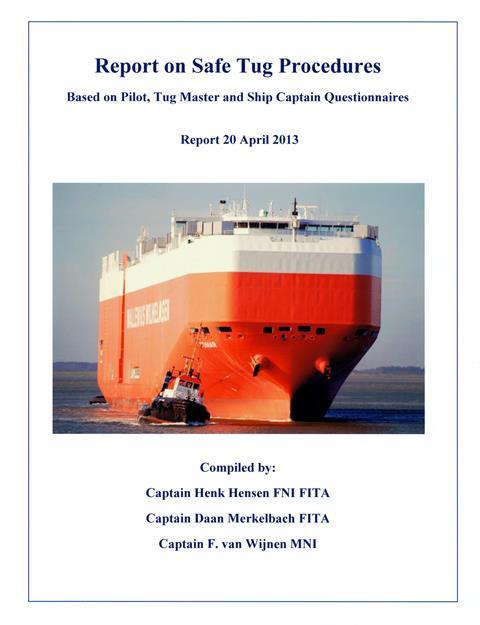
The ‘Report on Safe Tug Procedures’ has now been published and is widely available to all those involved in the operation of tugs during shiphandling manoeuvres.
Following the collision and capsizing of tug Fairplay 22 on the Nieuwe Waterweg in 2010, a Working Group was set up by three members representing the International Tug masters Association (ITA) and the Nautical Institute(NI). A massive amount of important and painstaking work was undertaken by a working group comprising:
Captain Henk Hensen FNI. Patron ITA, Master Mariner F.G.; Marine Consultant.
Captain Daan Merkelbach FITA,Tug Master; Head QHSE Department; Nautical Manager.
Captain Fred van Wijnen MNI. Master Mariner F.G.; Secretary NI Netherlands Branch.
Captain Hensen explains: “The Dutch Safety Board recently investigated an accident involving the harbour tug Fairplay 22 at Hook of Holland, the Netherlands. The accident took place during stormy weather on 11 November 2010. The tug, while trying to make a towline connection at the bow of the ferry Stena Britannica, was trapped under the bow and capsized. Tragically, the captain and engineer were drowned.
The tug Holland (twin screw; 29.00m LOA, 8.60beam and 4.00m draft; 33 tonnes bollard pull, built in 1992) had the same kind of accident as the Fairplay 22 during the night of 21-22 April 2000.
When trying to make a towline connection with the car carrier Tancred, the stern of the tug touched the bow of the Tancred. The tug did not get free of the bow but swung to port across the bow and was then overrun by the ship and capsized. When it got free, it quickly righted itself. The tug suffered a lot of damage, but luckily there were no fatalities.
In the investigation reports, high speed is mentioned as one of the main causes of the accident. Speed is known to be a crucial factor for bow tugs, particularly when securing. In Rotterdam a working group was formed to investigate what should be considered a safe speed and safe procedures for such operations.
To assist the initiative, three questionnaires were devised for tug masters, pilots and ship captains. An example of the pilot questionnaire is shown in the Appendix of the report, and the other questionnaires were mostly similar, focussed on the specific professions.
The questionnaires were circulated to several maritime organizations around the world and published in Seaways, the journal of the Nautical Institute (NI), and on the websites of the NI and the International Tug masters Association (ITA).
Approximately 160 pilots, tug masters and ship captains contributed by responding to the questionnaires. Tug masters, pilots and ship captains did not just answer the questions posed but also made a large number of remarks including suggestions to improve the safety of tug operations. They have played a very valuable role in this attempt to improve the safety of tug operations. The results of the completed questionnaires and the findings derived from them are presented in the unique report, with a foreword by the chairman of the Dutch Safety Board and the Harbourmaster of the Port of Rotterdam.
The report can be downloaded from www.tugmasters.org