


Smit Salvage is a long-enduring name in the world of salvage and recent activities indicate its expertise as much in demand as ever.
Early in 2020 Smit Salvage's parent Royal Boskalis Westminster announced its acquisition of Ardent Americas LLC, at the time a leading player under OPA90 for provision of marine emergency response services in the US. Boskalis' position in the US was thus further strengthened with its existing OPA90 services with Donjon-Smit through Smit Salvage and its partner Donjon Marine. An operation here marks the first salvage in the USA since the acquisition.
Closer to home for Smit, demonstrating that not all salvages occur on the high seas, Smit was called in when the 120m inland vessel Pampero allided with a gate at Sablons lock on the Rhone River in France. The vessel was loaded with 2,000 tons of highly flammable vinyl chloride and with local organisations reportedly not equipped to deal with the situation Smit successfully removed the cargo, advising insurers and authorities on measures to mitigate the situation.
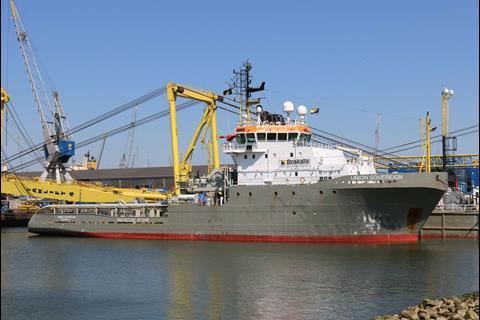
Back in 2013 the 75m OSV Ramco Crusader sank 45km off Fortaleza, Brazil settling upside down in 25m of water. Subsequently, Smitbarge 1 was mobilised in 2019, salvors applying patches making a large number of tanks airtight, work including installation of pipes and connections. Bad weather halted work until spring of 2020 when Smit's tug Sovereign returned with Smitbarge 1 and in an operation described as ‘extremely complicated and risky’ the vessel was refloated. Smit's first US post-acquisition salvage involved refloating the 12,959dwt general cargo vessel Nomadic Milde following grounding in the Mississippi in Louisiana
PARBUCKLING
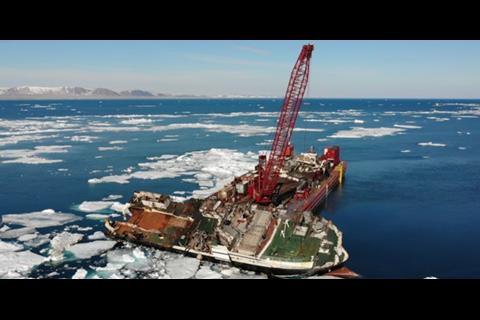
Back in Europe another weather-delayed operation saw Smit along with fellow ISU member Multraship complete a complex operation in a particularly sensitive environment following grounding and partial submerging of the fishing vessel Northguider late in 2018 on Sparreneset in the Nordaustlandet nature reserve in the northern part of Svalbard. Following bunker removal by Ardent Global, Smit was awarded a wreck removal contract in June 2019 based on preparing, parbuckling and patching of the wreck for a supported refloating. The pristine and sensitive environment and wildlife required particular attention involving major mitigation measures.
During parbuckling however it became clear that hull damage was far more extensive than anticipated which combined with the worst ice season in 30 years, led to the operation being halted. Four different removal methods were subsequently developed, the salvors able to draw on the knowledge previously gained. The biggest risk however was posed by forecasting ice conditions while for the client, certainty of removal of the wreck for whom the whole episode was becoming a protracted affair was essential so cutting-up in situ with subsequent disposal of the Northguider was the eventual method selected.
In July 2020 Smit returned to the site, mobilising nine vessels including two barges, an accommodation vessel and tugs along with heavy machinery, equipment and a team of 40 salvage and demolition personnel. The wreck was successfully cut up and loaded onto barges for onward transport well ahead of schedule and in ‘excellent cooperation’ with the owners P&I Club Gard, local authorities and Governor of Svalbard.
SENSITIVE ENVIRONMENT
Smit clearly faced two associated challenges with this operation. Apart from the requirement and desire to preserve the sensitive environment the conditions at the location presented challenges, Smit stating: ‘Working in one of the most hostile and remote locations on the planet was no mean feat.’ Conditions required the managing and mitigation of the impact of high winds and low temperatures on personnel and machinery, compliance with the polar code for vessels, ice in the water and inside the wreck itself and the presence on polar bears.
Two of the examples mentioned here concern wreck removals rather than traditional salvage, operations still requiring the same level of professional attention and skill. Coastal states are increasingly aware of the negative impact in the eyes of the public of just abandoning wrecks to the elements and ISU statistics for 2019 show that of a total gross revenue for ISU members of US$482M, wreck removal income totalled US$284M from 101 services compared to US$208M from 71 services in 2018 with ISU President Richard Janssen commenting that 'Gross income [from all services] has rallied somewhat … driven by large scale wreck removals.'
By Peter Barker