


Norway''s coastline now has an increased layer of protection with the arrival of two additional Emergency Towing Vessels (ETVs).
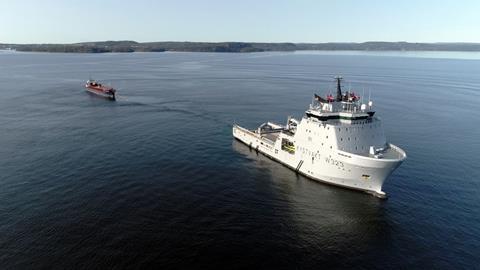
The Norwegian coastline is beautiful yet rugged with a rich wildlife while at the same time a busy sea route with the risk of significant potential pollution from passing shipping when things go wrong. Earlier this year the process was started to enhance the country’s already impressive ETV provision further with addition of two powerful AHTSs, a process now complete with the two tugs in operation.
The arrangement is a collaboration between the Norwegian Coastal Administration and Coast Guard, the former being the responsible authority for state towing preparedness, the latter responsible for the operational side of the service.
For this additional provision tugs Boa Jarl and Boa Bison have been chartered from Boa Offshore initially for a five-year period with possible extension options and renamed KV Jarl and KV Bison, their transition including their previous red and white hull receiving the grey livery of Kystvakten.
These are significant vessels, Boa Offshore's literature stating the 91m long tugs have a designed bollard pull of 275t from two Wärtsilä main engines developing 19,830kW in total driving twin CP propellers in nozzles in a conventional arrangement. Built in 2014/15 by Bergen Group the pair are VS 491 CD designs, specifically intended for anchor-handling and deepsea towing for the offshore oil and gas industry in the harshest of conditions. They are ice-classed and DP2 capable with an extensive anchor-handling/towing winch from National Oilwell Varco including a 600t main drum with capacity for 3,800m of 92mm wire.
They will also carry out regular coastguard operations joining the four other Coast Guard vessels KV Bergen, KV Sortland, KV Barentshav and KV Harstad. The first three are 93m long Barents Sea class VS 794 CGV design vessel owned by Remoy Management and while listed as patrol vessels their profile gives away their ETV capabilities with towing listed in their notation. They are each powered by a single main engine delivering 4,000kW driving a CP propeller with maximum speed 20kn.
KV Harstad is a similarly capable 83m vessel built in 2005 to a UT512 design powered by twin Bergen (Rolls-Royce) main engines producing in total 8,000kW and a speed of 18kn through twin CP propellers.
By Peter Barker