

Belgium has launched its largest unexploded ordnance (UXO) clearance project to support subsea cable installation for offshore renewables.
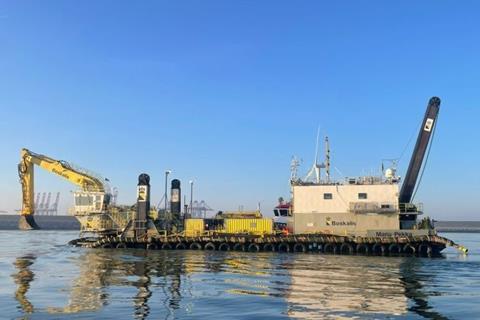
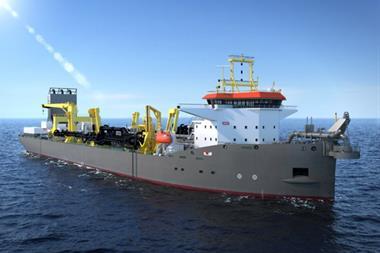
Boskalis Hirdes EOD Services has deployed the backhoe dredger Manu Pekka and diving pontoon Medusa 1 to begin dredging and UXO clearance off the Belgian coast.
The work is vital for the Modular Offshore Grid 2 (MOG2) project, which will connect to Princess Elisabeth Island – the world’s first artificial energy island designed to support Europe’s offshore renewables expansion.
Milestone project
The Medusa 1 will operate in nearshore zones, where divers will inspect the seabed and identify potential UXOs. In deeper sections, the Manu Pekka will use a multitool to detect and clear hazards.
Later, the offshore vessel Kamara will be mobilised for the deepest parts of the 55-kilometre subsea cable route. Boskalis said this phased approach ensures a safe corridor for the installation of critical offshore energy infrastructure.
Princess Elisabeth Island is already under construction with high-voltage alternating current (HVAC) structure builds underway following the installation of caissons earlier this year.
When completed, the island will serve as a major offshore hub, channelling at least 2.1 GW of offshore wind energy to Belgium’s mainland.
It is a cornerstone project in Europe’s transition to renewable energy and a key step in Belgium’s electrification strategy.
The marine civils and dredging effort underscores Belgium’s commitment to developing safe, efficient offshore renewables infrastructure, despite ongoing cost concerns surrounding high-voltage direct current (HVDC) connections.
Boskalis said that this subsea UXO clearance project is a landmark milestone in securing Europe’s future energy supply.