

Husky and Sheepdog, the last two ‘Dog’ class tugs originally built for the Royal Maritime Auxiliary Service (RMAS), have been sold by Serco, the current contractor for Marine Services to the UK Ministry of Defence (Navy).
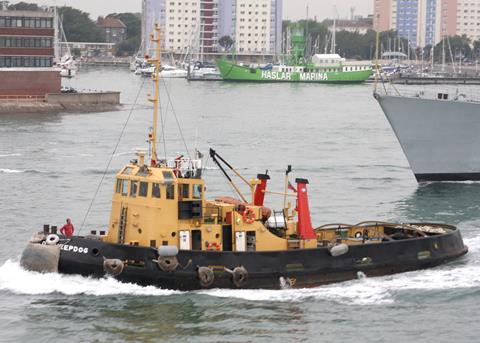
The sister ships were sold to Akoto Ventures of Nigeria, a company already owning two former ‘Dogs’, and will be delivered under their own power by the company’s own crews.
This final pair of ‘Dogs’ to see service in the naval bases and dockyards were built in 1969 and were part of a class of 19 tugs first introduced in1961. Every tug carried a 'Dog' name and tugs of the class gradually replaced many of the older vessels, including many steam tugs remaining in service after World War 2. The tugs were manned by civilian RMAS crews and employed in naval establishments around the UK and, in a very few cases, overseas.
The entire class were built to the same basic design for a manoeuvrable twin screw tug that became a ‘maid of all work’, carrying out shiphandling duties, coastal towing and a wide range of other duties. Although there were changes in the configuration of the superstructure on the later vessels, the hull design and machinery remained the same throughout. The tugs were all 28.65m in length overall, with a 7.39m beam and a draft of 3.66m. Two Lister Blackstone ERS 8 MGR main engines were installed, producing a total of 1,360 bhp to turn a pair of fixed pitch, open propellers. The latter gave the vessels a bollard pull of just 16 tons and a top speed of 10 knots.
Richard Dunston of Hessle on Humberside constructed the first four tugs Airedale and Alsatian in 1961, and Beagle (later renamed Basset) and Boxer (later renamed Foxhound) in 1963. Four more came from J S Doig Ltd in Grimsby and Rowhedge Ironworks of Colchester before production was passed to Appledore Shipbuilding in 1966, where the remaining eleven were completed.
As the Royal Navy shrank in size, and along with it the number of naval bases, and hence the demand for towage services, the ‘Dogs’ were gradually sold off. This process was accelerated more recently when the last few survivors were replaced by new tonnage introduced by Serco. Several were purchased by commercial companies in the UK but most, inevitably, ended their lives with overseas operators. Two remain in regular use in Britain, the Collie T (ex; Te Awhina; ex Collie) with Targe Towing in Scotland and the Sandsfoot Castle (ex; Dalmatian) with the Portland Port Authority.