
Kotug Canada is on the cusp of taking delivery of what it claims are the world’s first large, purpose-built dual-fuel methanol escort tugs – a pair of 44-metre vessels built by Sanmar Shipyards in Turkey to a design by Vancouver-based naval architects Robert Allan.
The first vessel, SD Aisemaht, was granted full class certification by ABS on 26 May, clearing the way for its handover to Kotug Canada.
The two tugs, SD Aisemaht and SD Qwiy Aanitsa Sarah, were commissioned to service Canada’s Trans Mountain Expansion Project (TMEP) under a long-term contract awarded to Kotug Canada in 2021 by Trans Mountain on behalf of its shippers.
The vessels will escort crude oil tankers from the harbour limits of the Port of Vancouver to the open Pacific Ocean through the Salish Sea, a route of around 150 nautical miles that includes the Juan de Fuca Strait.
Kotug Canada is a joint venture between Rotterdam-based Kotug International B.V. and Canadian operator Horizon Maritime Services Ltd. The service will be operated in partnership with the Sc’ianew First Nation from Beecher Bay on the south coast of Vancouver Island – strategically positioned along the tanker route – under a Mutual Benefits Agreement that creates long-term employment, training, and economic development opportunities for Sc’ianew community members.
Dual-fuel system
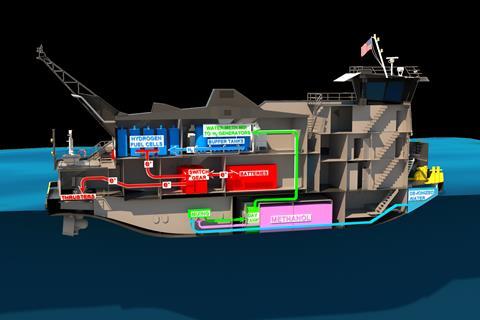
At the heart of the project is the dual-fuel methanol propulsion configuration, which Kotug Canada describes as a ‘revolutionary hybrid’ system enabling the vessels to operate on either methanol or conventional marine diesel.
Each tug is powered by twin ABC 16V DZM methanol-diesel dual-fuel engines from Anglo Belgian Corp, driving two Schottel azimuth thrusters. The propulsion system incorporates Schottel’s Sydrive-M mechanical hybrid arrangement – a cross-link system that allows a single engine to power both thrusters, significantly reducing fuel consumption during transit operations, according to Kotug.
When running on methanol, the vessels offer reductions in CO₂ emissions and greenhouse gases compared with conventional diesel-powered tugs of equivalent power, it claims.
Both vessels meet IMO Tier III emission standards and are fitted with exhaust after-treatment systems to minimise NOx emissions.
The ABS class notation for SD Aisemaht includes ENVIRO, SUSTAIN-2(2020), and OSR-C2 notations alongside the full escort vessel and towing vessel certifications, reflecting the vessel’s design and oil spill response capability. With a bollard pull of 115 to 120 tonnes, the two tugs will be among the most powerful escort tugs operating anywhere in Canada.
Other vessel features
The RAsalvor 4400-DFM design from Robert Allan Ltd was developed specifically for the project’s demanding operational and environmental requirements.
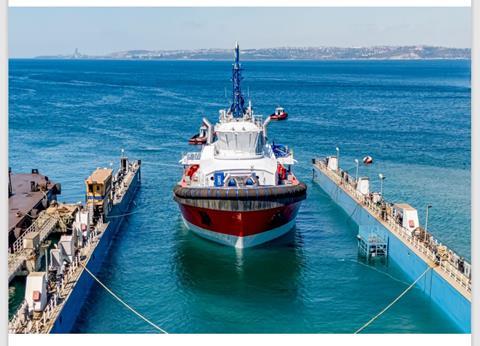
Along with escort duties, the vessels are designed for long-range towing, anchor-handling, rescue and salvage. Each is equipped with fire-fighting equipment and carries the largest oil spill response capability of any tug operating on the British Columbia coast. The hulls are coated with a graphene-based paint from Graphite Innovation Technologies to reduce biofouling, lessen underwater radiated noise and improve fuel efficiency.
Sanmar, which has built the vessels at its shipyards in Turkey, confirmed the steel-cutting in March 2024 and the keel-laying ceremony in May 2024. The first vessel was launched in September 2025.
“The launch of this radically new tug, the first of twins, is an important day for the whole tug industry,” said Ali Gürün, Sanmar’s Vice Chairman and CEO, at the launch. “It marks a major step forward in the use of alternative fuels to protect our planet. These are among the most powerful tugs ever built, yet have environmental protection at their heart.”
“The launch of the world’s first dual-fuel methanol escort tug is more than a milestone for Kotug Canada – it is a defining moment for the maritime industry,” said president and CEO of Kotug International Ard-Jan Kooren. “These powerful vessels prove that sustainability and performance can go hand in hand.”
The project continues a pattern of alternative-fuel innovation on Canada’s West Coast.
Sanmar has previously delivered LNG-powered tugs and a fleet of battery-electric vessels to operators in British Columbia, and Robert Allan has a long-established relationship with Sanmar spanning more than 300 tugs across multiple fuel types and propulsion configurations.