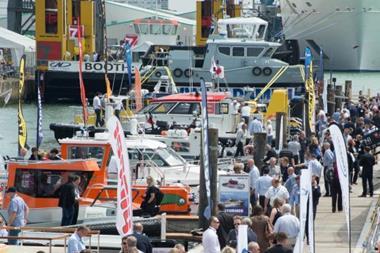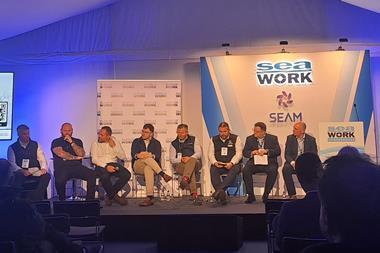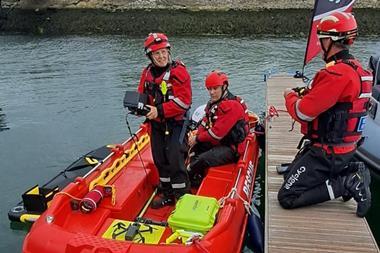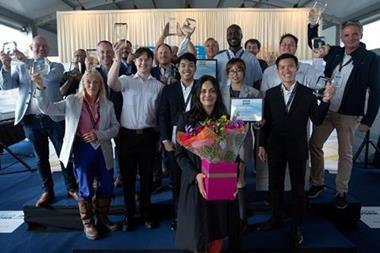


With Oceanology International awash with launches this year, it would be impossible to list all of them. Here is a sample of some of them.
Fugro looks through a new prism
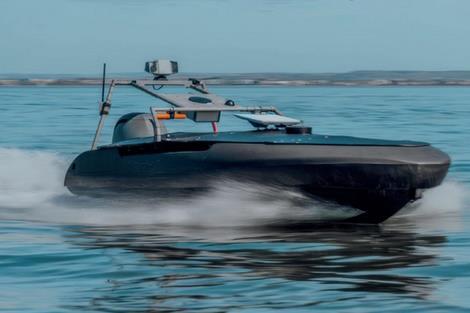
Fugro has launched a 17m survey vessel – Blue Prism – that is powered by marine biodiesel engines.

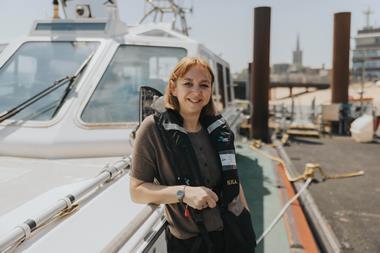
Marco Gilissen, Global director Marine Geophysics (L) and Mark Schreiber, Product director Site Screening, with Fugro
Unlike its earlier survey vessel Blue Eclipse, the latter iteration will not have ROVs, instead it will deploy three towed sensors that can be used for site screening at offshore wind farms or cable lay routes, for example.
“All the other USVs on the market now are much smaller, with shorter endurance,” said Product director Site Screening Mark Schreiber. “They can offer one towed sensor at a time. Ours has three.”
The data is sent through Fugro’s proprietary software and it’s done through satellite communications so it’s live, real-time sending, or the vessel can come into port and download it.
Because the vessel runs on diesel and not alternative fuels or battery power, it has greater endurance, said Marco Gilissen, Global director Marine Geophysics, presenting the vessel at the launch.
“We haven’t covered it with solar panels and we’re not chasing fuel cells to power it,” he said.
The vessel was designed by Kooiman Engineering and Van Oossanen Naval Architects and has been specifically engineered for coastal and deeper sea environments for bathymetric and geophysical data collection.
Watch this space for an in-depth interview with Fugro’s CEO, Mark Heine – coming soon.
Skarv Technologies
While not strictly speaking a new launch, it’s the first time Skarv Technologies has revealed its vehicle to the world outside Norway.
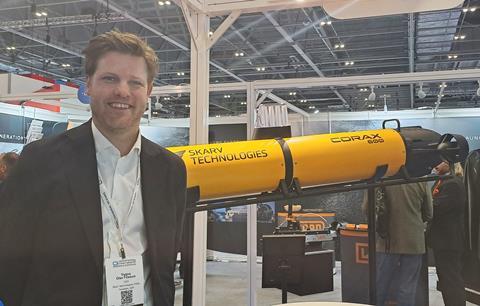
Skarv Technologies CEO Trygve Olav Fossum
Calling it a hybrid, CEO Trygve Olav Fossum explained that the company’s product is both an ROV and an AUV.
“Lots of people want to segue into ROVs and we are lowering the threshold so you don’t need to be a specialist service operator to have one,” he said. “You can run with an ROV and operate it remotely with a joystick, and then when you’re comfortable you can launch it for mapping areas autonomously.
“For the larger jobs, remotely operating them can be tedious with an ROV. For bottom tracking, terrain knowledge etc. The quality of data is better because the camera isn’t being used for navigating at the same time, it’s strictly for mapping.”
With a range of 12 hours for the smaller one, they also have a larger cousin that can last for more than 24 hours.
It’s lithium battery powered, and there is a safety valve.
“We deliver the whole package, no one has to go to different vendors for all the payload etc,” Fossum said. “It’s a turnkey data collector. If you are a start-up company you can go straight into it.”
Dynautics cuts the umbilical at OI
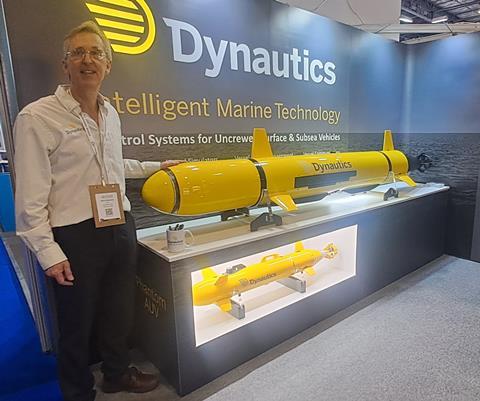
Dynautics is advancing underwater autonomy with Phantom Two, an AUV designed to operate in the challenging environment beneath the sea, where GPS and radio signals are ineffective.
CEO Dr Henry Robinson was at Oceanology when Maritime Journal caught up with him a few weeks after he gave us a preview of the launch.
The company’s work evolved from self-tuning autopilots for small surface vessels to adaptable control systems capable of managing many types of underwater vehicles, from torpedo-shaped AUVs to work-class ROVs operating thousands of metres deep.
Underwater autonomy is essential because once an AUV is untethered it must operate independently within strict limits such as depth, pitch, roll and battery levels.
Phantom Two embodies this philosophy with safety-focused design features, including a nose-up buoyancy that helps antennas clear the waves if it surfaces and can connect to communication systems to aid recovery.
The vehicle is primarily aimed at seabed survey missions for energy, security and science. With onboard GPUs processing large sonar datasets, it can detect anomalies during missions, enabling faster, more efficient surveys while reducing risk and cost compared with human divers or crewed vehicles.
Read our full report on Dynautics and other AUV technologies here.
Modular AUV rules the seas with Poseidon’s Forge
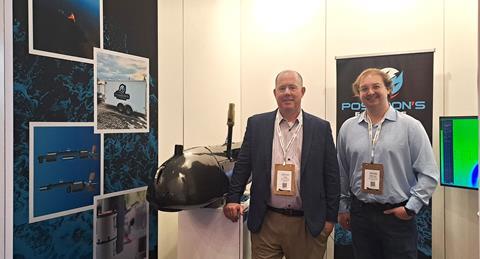
US-based Poseidon’s Forge is just a year old, but its people have roots in AUV technology.
The start-up unveiled its AUV at OI 2026 with what it says is a key difference from others on the market.
“A traditional AUV is a single tube, but we have a flooded architecture that can be reconfigured per vehicle for different depths and sensors,” says Business Development principal Jim Kirk. “It also has a retractable spine.”
“Most of them are just tubes – pressure housing with a fixed purpose – but it’s really hard to change them,” said Eddie Purfell, senior electrical engineer. “We can swap out what’s inside.
“We also have a solid-state battery, which are two to three times as expensive as traditional ones but have about three times as much as power density. Where the traditional ones last for about 12 hours, ours can go for more than 30. We also have a BMS that can control the battery.
“The software is in-house developed and we can deploy more than one at a time – so for example if three are sent out together and one fails, one of them can cover the third one autonomously.
“It’s for commercial and defence – mapping, side scanning. We are replacing the bigger boats with AUVs and you can have different levels if you don’t need so much accuracy.”
RBR Global’s new water quality sensors
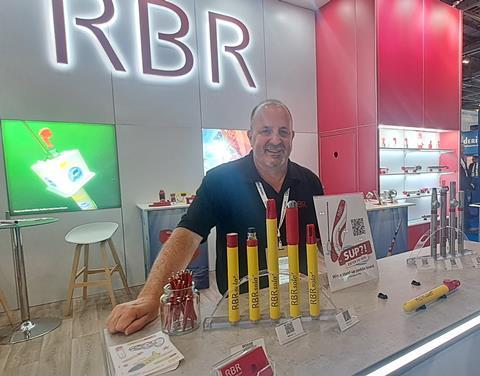
Canada-based oceanographic instrumentation company RBR used OI to launch new sensors for measuring water quality for things like turbidity, pressure, temperature and dissolved oxygen.
Ranging from single sensors to sensors integrated into a single data logger, they can be attached to mooring lines, for example, or frames on the seabed.
The specific sensor launched at OI is an exchangeable solo or duet Compact Logger, which can have different sensors plugged in to the same base depending on requirement.
“We can sit them on the seabed then pull them out and download the data,” said director of Marketing Stef Stimson. “You could have one taking samples once a second and it would last for years.”
The company has been going for a remarkable 52 years, and Stimson himself has been there since 1998.
“The main changes in the industry I’ve seen is the amount of data we can now collect,” he said. “We focus on using low power consumption – we feel that’s critical. To be as efficient as possible.
RBR’s main clients are in ocean science research.