

As we went to press, news was coming in that Iran had opened the Strait of Hormuz.
It says the strait will be fully open to commercial vessels for the remainder of the ceasefire.
Before the announcement we looked at oil prices and how the workboat sector was being affected – and in fact, for the short term, it’s not so bad.
If the situation deteriorates and oil runs out – possibly by the end of the month, Workboat Association CEO Kerrie Forster suggests charters may try to claim force majeure and avoid breach-of-contract penalties. They cannot do this for costs alone.
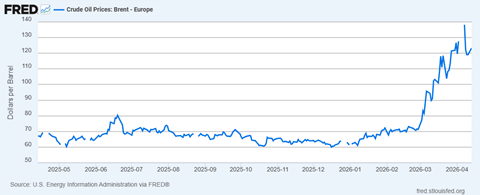
The oil price peaked at $138 a barrel on April 7, and had come down at the time of writing to just under $100, according to Reuters.
“For the majority of the workboat industry it’s actually not a bad place to be in because in the majority of contracts either the client pays so it doesn’t affect the owner; or the owner buys the fuel and sends the receipt to the client with a handling charge,” says Forster.
The handling charge is usually calculated as a percentage of the fuel cost – therefore will increase as the fuel price increases.
“For people with boats, it’s business as usual,” says Forster. “Some vessels have gone down from being manned 24 hours a day to 12.
“It’s only a handful of companies where the contract has included fuel in the day rates that will be affected, and the mature companies are unlikely to have contracts like these.”

“The fuel price in ports where we operate has gone up by 30-50% in the last month,” said Tidal Transit CEO Leo Hambro. “In most cases the effect on us is limited as the client pays for the fuel directly to the supplier. In some cases we supply the fuel and re-charge, and in these situations it has stressed our working capital facilities a little to have more cash outstanding to service our client’s needs with little to no benefit in providing this facility.”
Svitzer view
“We have teams globally following the situation closely and working diligently around the clock supporting our customers with their operations in the current environment and that includes being mindful about fuel utilisation and cost.,” a spokesperson told Maritime Journal.
“We recognise that reducing fuel consumption has multiple benefits for our customers. It is also a standing component of our operating strategy. As well as delivering cost and decarbonisation benefits it is also about resilience in uncertain times, such as being experienced currently.
“Demand management is an important lever we have and using fuel smartly allows us to serve more customers with the fuel available and build greater resilience into port and terminal operations.
“Svitzer has a proven practical approach already in place around fuel savings, one of which is our ‘Aim for 8’ initiative. This involves operational optimisation and driving behaviour to target the supporting movements for operations and ultimately targets driving speeds at under eight knots. (E.g. mobilisation and demobilisation for a tug job, or tug deployment for maintenance or in advance of another job. It does not include for example towage while under pilot orders supporting a vessel.)
“We track fuel utilization closely and have a range of tools available right down to the crew and tug level to provide visibility on fuel operating efficiencies.”
Longer term
If the situation does not change, oil could run dry by the end of this month, Forster believes.
“Potentially fuel will be rationed,” he says. “People will only be able to get small amounts of it and the people with the best legal teams and best contracts will win.”
Ironically, he says, the aviation sector is likely to be given priority for fuel – even though without ships to bring it to them they can’t fly.
“If the Strait of Hormuz opens tomorrow, every tanker in the world is going to go through and then you’ve got the Red Sea and Houthi problem and they might have to go around the Cape. Which means there won’t be oil for months,” he says.
All the oil that has been drilled and is stuck in the Middle East is building up, he says, filling storage capacity to the maximum – which in turn means drilling operations are having to be paused.

Likening the situation to a vein being opened, Forster says when the oil is released, ‘every ship is going to turn up and need tugs to move them – all the pipelines are going to open and it’s going to be complete chaos’.
Kerrie Forster believes that the Covid pandemic was a ‘good trial’ for today’s plight, with people now practised in what to do. “Everyone’s used to it,” he says.
“For the whole industry it’s business for the boats that are out there. I don’t know what the end point is, whether it’s supply chain, people or materials. At some point resistance will have to be scaled down and the Strait of Hormuz opened.
“There might be deals made with certain countries if they haven’t been seen as involved.”
In the meantime, oil companies are staying tight-lipped about their predictions for what may happen, with neither Shell nor bp replying to Maritime Journal’s request for comment.
Sultan Al Jaber, chief executive of Abu Dhabi National Oil Company (ADNOC), warned that restricted access to the waterway is directly tightening markets and pushing prices higher. “Every day the Strait remains restricted… markets tighten, prices rise,” he said, calling for it to be reopened “fully, unconditionally and without restriction.”
Casualties
Of course the most important issue is not the cost of fuel.
A UAE tug crew was killed in early March while assisting a ship that the Iranians decided to bomb, according to the UK Maritime Trade Operations.
Other tugs and workboats remain trapped in the region, and there is a possibility of vessels simply being abandoned due to contracts being pulled, although this is not being seen yet.