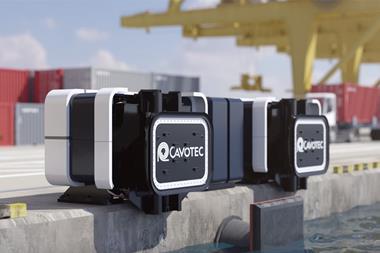



Three UK ports have piloted a government-backed shorepower project aiming to circumvent grid limitations and high connection costs.
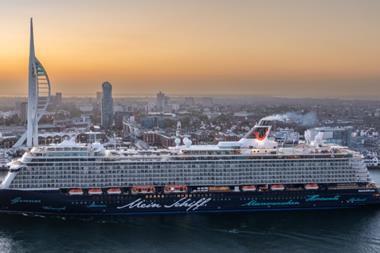
The Port Infrastructure using Novel Energy Storage (PINS) project focused on Falmouth, Cowes and Portsmouth, and the study looked at the different operational needs and infrastructure challenges among them.
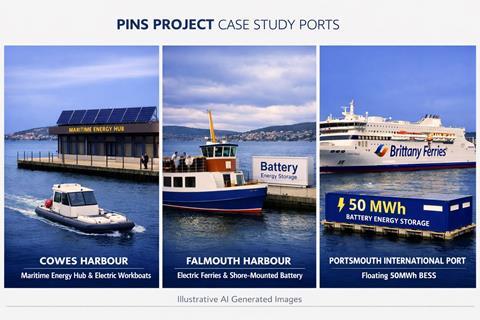
The upshot – battery storage paired with smart energy management could be feasible, scalable and affordable and essential if shorepower for berthed vessels is to become a reality in a scenario where the power grid is simply not up to it.
Funded by the government through the UK Shipping Office for Reducing Emissions (UK SHORE) in the Department for Transport, PINS was coordinated by MSE International with nine partners from across industry and academia, combining maritime operations, energy storage technologies and systems engineering knowhow.
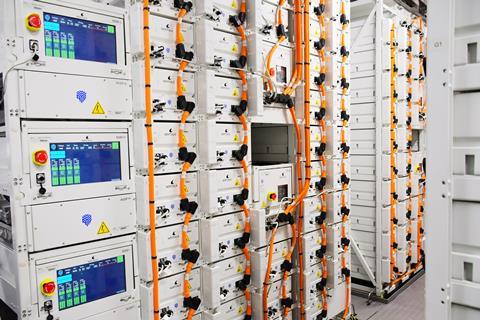
The PINS project team assessed present and future vessel charging requirements, modelled duty cycles and reviewed four battery types: lithium-iron phosphate (LFP), second-life lithium-ion, sodium-ion (NIB) and soluble lead-flow batteries (SLFB).
Evaluation criteria included cost, performance, safety and suitability for diverse port environments, revealing that both established and emerging battery technologies can support port electrification.
Advanced modelling demonstrated that battery-supported systems can decrease peak grid demand, enable higher-power charging even with limited grid connections and optimise onsite solar generation.
Charging infrastructure
The project examined charging infrastructure options, ranging from CCS-based DC charging for small vessels to high-power shore connection systems for ferries and cruise ships. Wireless charging and DC microgrids were also looked at.
Findings indicate that integrated energy storage solutions reduce reliance on expensive grid upgrades, boost operational flexibility and will help the UK maritime sector transition towards cleaner operations. The next phase hopes to see a real-world demonstration at one of the pilot sites, validating technical performance, operational processes and commercial models to provide robust evidence for wider adoption across UK ports and harbours.
Economic benefits include the prospect of job creation in battery integration, electrical contracting, vessel-charging infrastructure and port energy system management. The project highlighted opportunities for UK supply chains in sodium-ion and soluble lead-flow batteries, as well as in smart charging and microgrid control technologies.
Overall, the PINS project demonstrated that storage-led port electrification is both technically viable and commercially attractive, provided systems are tailored to site-specific constraints. A potential real-world demonstration would aim to validate this approach and accelerate widespread adoption across the UK maritime sector.
“Historic maritime energy transitions have depended critically on the infrastructure that makes energy resources available in ports at a competitive price,” said Dr Jonathan Willliams, CEO of MSE International. “This is also true today - and PINS has shown how ports and harbours can create the electrification infrastructure that their customers will increasingly demand.”