


With nine fatal incidents involving conventional tugs since 1998, an Marine Accident Investigation Branch (MAIB) safety bulletin on the 2023 Biter loss has put the dangers of tugs girting and capsizing under the spotlight again. Peter Barker analyses what can go terribly wrong on seemingly simple operations.
The loss of the vessel and its crew involved a standard operation performed safely and without incident in ports worldwide hundreds of times a day but even with lessons learned following each accident, reminds us that the inherent dangers and potential risk to life never go away.
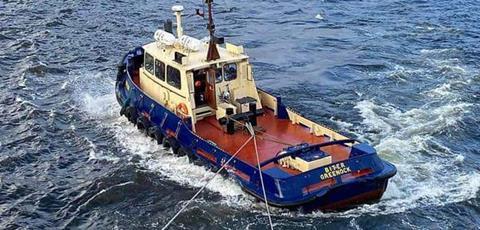
The incident occurred while the 16m long, twin screw conventional tug/workboat was assisting the 71m long passenger vessel Hebridean Princess as it made its approach to James Watt Dock at Greenock.
Biter was the first of two similar tugs to arrive and assist Hebridean Princess, the second designated as bow tug, Biter acting as stern tug providing steering and braking assistance.
Travelling at a speed of around 6kn and running ahead, Biter approached the starboard quarter of Hebridean Princess to pass its towline. The lack of centre-line fairleads on the assisted vessel necessitated use of double-ended towlines, known locally as a bridle, and made fast to each side of Hebridean Princess.
With the vessel’s speed reducing, the next stage involved Biter transitioning from running alongside and bow first to stern first and behind Hebridean Princess, involving a 180o turn while connected to the vessel, which itself was making way.
When around 45o to the right of the passenger vessel’s track, the starboard element of the towline became taught. pulling the tug sideways and heeling it to port. Dramatic video captured by a shoreside CCTV camera shows the speed with which Biter subsequently capsized, the crew on Hebridean Princess cutting the towline connection with the tug, which sank within around 30 minutes.
Gob rope
When towing over the stern, Biter had a disc-type towing hook behind the wheelhouse. When connected to the towline this is normally considered the ‘point of tow’. The further aft this position is the better for the tug, in that any force exerted by the tow (above the force of the tug itself) can be corrected, ensuring the tug remains roughly parallel to and not at right angles to the vessel.
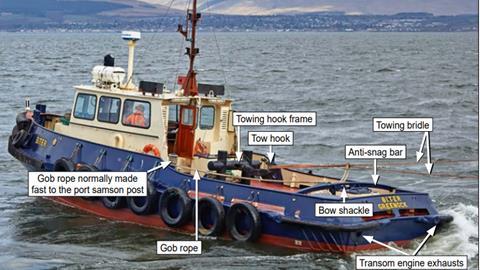
Traditionally (and not related to more modern shiphandling tug designs), the point of tow has generally been close to the tug’s mid-length, and moving the point of tow further towards the stern is achieved with a gob rope.
With, for example, long-distance ocean towing, where progress is largely unchanging, this can consist of a simple length chain or rope attached to the tug’s deck aft, the towline passing through a bow shackle on the free end of the chain/rope.
The fixed length determines how far forward the point of tow can move should the object under tow overtake the tug on either beam and risk girting, or pulling the tug sideways. The relative location of the propeller(s) and rudder(s) are another consideration here.
When conventional tugs undertake port shiphandling operations, particularly when assisting ships in areas restricted by available dock space, the ever-changing positional relationship between tug and tow requires a more dynamic approach to handling the gob rope.
This can involve the deck connection being routed to a tugger/gob winch controlled from the wheelhouse or on deck or, in smaller tugs, a manual handling arrangement, where a crew member, in close coordination with the person on the helm, adjusts the gob rope length (when not under tension) as the situation changes, aligning the tug more with the direction of tow.
The investigation pointed out that when using a bridle arrangement the gob rope can ‘push’ independently on either leg of the bridle, influencing the vessel’s speed and heading.
Watching such skilfully coordinated and executed manoeuvres in real time demonstrates how tried and tested seamanship skills are still required in a world where technology and advances in tug design are making such operations safer.
The investigation examined the gob rope arrangement on Biter, including the difference in its location compared with the bow tug, a similar vessel but with its point of tow further aft. Speed of the vessels during the operation was another factor, the report suggesting Hebridean Princess was moving faster than recommended.
A factor that appears regularly in reports of such incidents is where hatches and doors are not kept shut when required while at sea, situations that can result in rapid flooding should a tug heel beyond critical angles.
Modern designs
This description of girting and how to avoid it relates to single or twin-screw conventional tugs, traditional designs originally intended for open sea towing and adopted for shiphandling roles in ports.
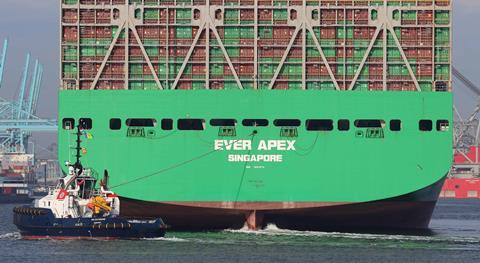
Modern designs have led to safer operations, whereby tug owners or port and terminal operators considering new or replacement tugs have a choice of options, often configured specifically for one location rather than a fleet of near-identical vessels serving several ports.
Important in making operations safer is manoeuvrability. Tugs with conventional arrangements may lack the ability to ‘manoeuvre’ themselves out of trouble, something that modern designs, quite different to the traditional, can achieve.
Options include Azimuth Stern Drive (ASD) tugs towing over the bow; so-called Tractor Tugs with azimuth or cycloidal propulsors mounted forward and towing over the stern; and Rotortugs featuring two azimuth thrusters forward and one aft, described as an active skeg.
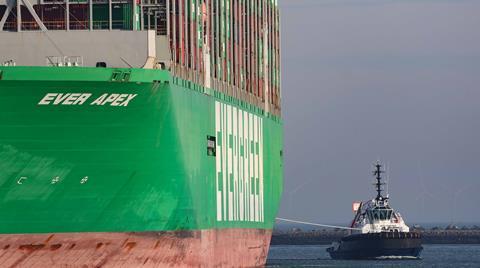
The future looks promising for safety-conscious operators including Svitzer’s TRAnsverse tug, designed in conjunction with Robert Allan and featuring an omnidirectional hull, inline thrusters and a patented towing staple that increases the range of angles that can be achieved safely.
Symmetrical or near-symmetrical hull designs have been explored, and another modern design is Damen’s popular RSD 2513 (Reversed Stern Drive) tug, which while similar to ASD configuration features twin skegs and increased shear ‘aft’ the tug, described as ‘always bow first’.
Escort or indirect towing at higher speeds, where hydrodynamic forces of the underwater hull, including a larger skeg, provides the force rather than the traditional direct (low speed) direct force from the towing winch are popular at some ports.
In summary, production line, identical conventional tugs, while still in demand for many applications, are now being complemented by an array of what have been called ‘novel’ designs offering safer operations that will hopefully reduce such incidents.