


Hydrogen is widely positioned as a future fuel for deep-sea shipping. But as Dave Lee, Executive Director at e1 Marine, explains, its first credible applications are emerging in a very different part of the fleet – and for practical reasons rather than aspirational ones.
Green hydrogen appears in almost every maritime decarbonisation roadmap, yet large-scale adoption for ocean-going vessels remains distant. Production costs in Europe currently sit around €4-8/kg, several times higher than the energy-equivalent cost of conventional marine fuels, and this is before factoring in storage, transport and infrastructure challenges.
![Dave Lee, Executive Director, e1 Marine [headshot]](https://d3oegytn6n7k3n.cloudfront.net/Pictures/280xAny/5/1/9/341519_daveleeexecutivedirectore1marineheadshot_866774.jpeg)
Beneath that debate, a quieter shift is under way. Hydrogen fuel-cell systems are already being deployed on ferries, workboats, short-sea vessels and harbour craft, proving how engineering solutions can circumvent hydrogen’s most vexing barriers without waiting for global infrastructure to catch up.
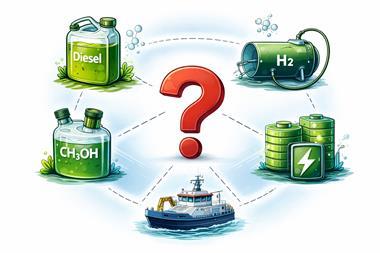
Battery-electric ferries have proven effective on short, fixed routes, and hybrid propulsion is spreading across workboats and offshore vessels, while methanol and ammonia are also being explored. Hydrogen fuel cells – particularly when paired with on-demand generation – are finding a role where onboard storage limits, charging constraints or a need for greater operational flexibility make other options harder to deploy.
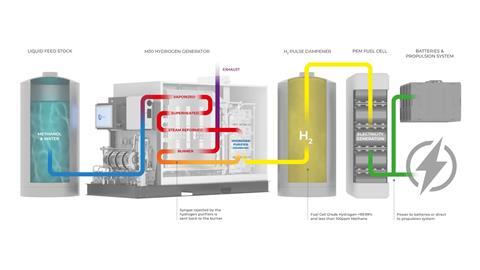
The key change is not scale but design philosophy. Instead of storing large volumes of hydrogen onboard, emerging systems generate hydrogen on demand and feed it directly to fuel cells, removing the storage penalty associated with compressed or liquefied hydrogen while avoiding dependence on bunkering networks still in their infancy.
Fuel cells also offer characteristics well suited to short-sea operations: relatively high electrical efficiency compared with conventional marine engines, rapid response under variable loads, and quiet operation in ports and coastal environments. PEM fuel cells typically operate in the 40-60% efficiency range, compared to 25-45% for diesel engines.
Why short-sea shipping moves first
Independent research by the European Maritime Safety Agency suggests hydrogen-fuelled vessels may be better suited to short-sea than deep-sea operations, as shorter routes and frequent port calls mitigate storage and bunkering constraints.
A North Sea Hydrogen Valley study identified 13 hydrogen- and methanol-powered vessels in operation as of 2025 on short-sea and inland routes, with further vessels on order in the 0.6-6.4 MW range for delivery before 2030.
The operational logic is straightforward. Short-sea vessels operate on predictable routes, require comparatively modest fuel volumes, and many are transitioning toward hybrid propulsion combining batteries with electric drive – a configuration into which hydrogen fuel cells integrate naturally.
Regulation reinforces the urgency. FuelEU Maritime came into force in January 2025, requiring progressive reductions in GHG intensity towards 80% by 2050, while the EU ETS expanded to cover 100% of regulated shipping emissions in 2026. Shore power remains patchy across European ports, with grid constraints and permitting timelines delaying deployment – making modular, grid-independent hydrogen fuel-cell systems an increasingly practical alternative.
From stored hydrogen to on-demand generation
Hydrogen’s physical challenges are well understood. Its low volumetric energy density means that even in compressed or liquefied form it requires significantly more storage space than conventional fuels, while its wide flammability range demands careful system design and ventilation. For vessels where space is finite, simply scaling up hydrogen tanks is impractical.
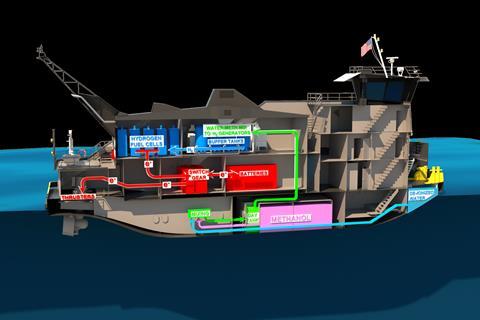
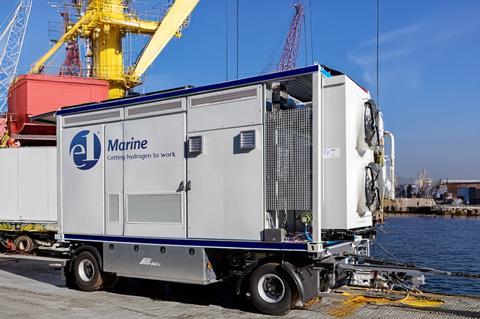
On-demand generation offers a different approach. Using methanol as a hydrogen carrier – a liquid fuel available in more than a hundred ports worldwide – integrated onboard reforming systems convert a methanol-and-water blend into high-purity hydrogen in real time. This is then supplied to PEM fuel cells, which produce only water and heat as by-products.
For vessel designers and operators, the practical advantages are clear. Methanol fits within familiar liquid-fuel logistics, storage integrates more easily into vessel designs, and the volumetric penalties of compressed or cryogenic hydrogen are avoided. Classification societies have begun publishing dedicated rules for ships using hydrogen, and IMO and national regulators are developing risk-based approval frameworks.
Evidence from the water
These are not theoretical propositions. Norway’s MF Hydra entered regular service as one of the first liquid-hydrogen-powered ferries, using fuel cells combined with batteries on a fixed coastal route. In the US, the MV Sea Change began public service in July 2024 as the first commercial hydrogen fuel-cell-powered ferry in San Francisco Bay and has since been refinanced through a sale-and-leaseback arrangement with Maritime Partners, signalling growing commercial confidence.
Norwegian studies examining high-speed ferry conversions have found that compressed hydrogen can be one of the most cost-effective zero-emission options under certain conditions, with projections suggesting hydrogen fuel-cell passenger ferries could approach cost parity with diesel between 2025 and 2030.
Samskip has selected Norwegian Hydrogen to supply liquid green hydrogen for two new 730-TEU hydrogen-powered short-sea containerships scheduled for delivery in 2026, extending momentum beyond the ferry sector.
The hydrogen-ready electric ferry Cap de Barbaria, operated by Baleària between Ibiza and Formentera, is the first ferry in Europe to use e-methanol to produce renewable hydrogen onboard, powering a fuel cell to generate auxiliary electricity and reduce reliance on conventional generators. Its significance lies in demonstrating hydrogen fuel-cell power deployed without dedicated hydrogen bunkering infrastructure.
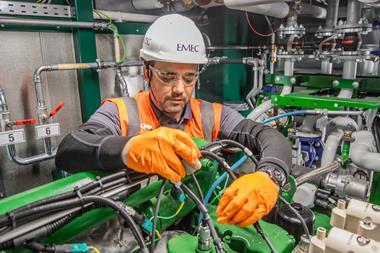
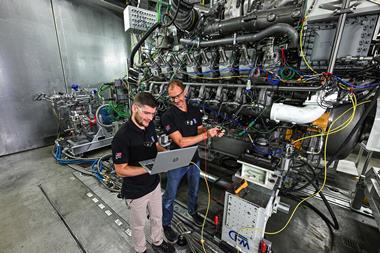
e1 Marine has received an order from PowerCell Group for eight M30 reformers to support the first commercial sale of the M2Power 250 methanol-to-power system, forming part of a 2 MW installation contracted by a major European shipyard. Each 250 kW module combines e1 Marine’s methanol-to-hydrogen generator with PowerCell fuel-cell stacks, replacing conventional diesel gensets without requiring high-pressure hydrogen storage.
Independent operational modelling of e1 Marine’s technology, based on approximately 50,000 hours of aggregated workboat data, indicates lifecycle GHG reductions of up to 85% when renewable methanol is used, alongside elimination of NOx, SOx and particulate emissions at the point of use.
Starting where the conditions are right
The maritime industry’s wider debate about hydrogen – storage versus combustion, green versus blue, ammonia derivatives versus pure H2 – will continue and rightly so. But it should not obscure what is already deployable.
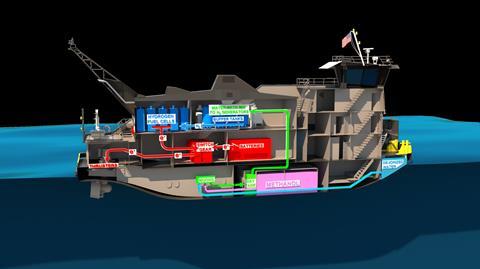
The most promising early applications share three characteristics: constrained or absent shore power, operations in or near emission-controlled waters, and continuous power needs that map well to modular fuel-cell systems. Ports across the North Sea region are positioning themselves as clean energy hubs, combining offshore wind, hydrogen production and maritime fuel supply.
Hydrogen will not replace marine diesel across the global fleet in the near term. But coastal fleets have historically served as testbeds for new propulsion technologies before wider adoption. In specific short-sea and coastal segments, hydrogen is beginning to move from pilot projects towards early deployment, offering operators a realistic pathway to cut emissions and reduce compliance risk without waiting for perfect global infrastructure to arrive.
Read more of our Special Report features on Alternative Fuels here.