



With a successful full-engine test behind them and a commercial product targeted, Rolls-Royce’s application engineering team explains why methanol is the most realistic alternative to diesel for tugs, ferries and offshore vessels – and what still needs to be solved before the technology hits the water.
Maritime Journal talks to Tobias Kohl, Vice President Application Engineering, and Peter Gommeringer, Application Engineering Marine – Methanol Engine, both at Rolls-Royce.

Performance: Same power, different fuel

At the heart of Rolls-Royce’s methanol programme is a deceptively straightforward claim: that a methanol engine can deliver the same power output as its diesel equivalent.
For Tobias Kohl, vice-president of Application Engineering, that claim rests on a firm distinction between two different kinds of density. “Power density is on a combustion engine and on the system,” explains Peter Gommeringer, Application Engineering Marine for methanol. “The kilowatts coming out of the block – that’s something we can influence. On the fuel side, we can’t change it.”
What Rolls-Royce has done is keep the core engine – specifically the well-proven mtu Series 4000 platform – largely intact, while adapting the combustion process. Diesel ignites under compression; methanol does not, it needs a spark.
“If we talk about single-fuel methanol, it is an auto-burning principle, so we need a spark ignition – a spark plug,” says Kohl. “It’s not like a diesel combustion process, but we have experience with that. We have an LNG engine in the field with spark ignition already.”
The company has been running single-cylinder tests on methanol combustion for several years, accumulating data on the fuel’s behaviour.
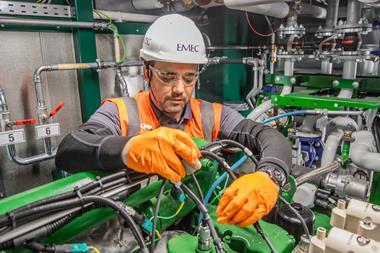
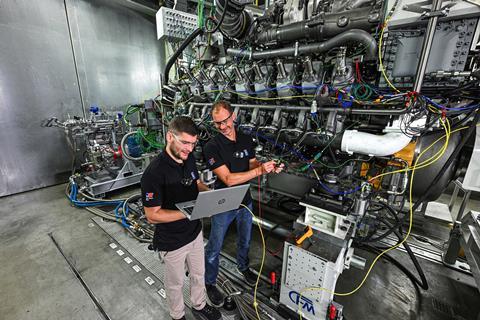
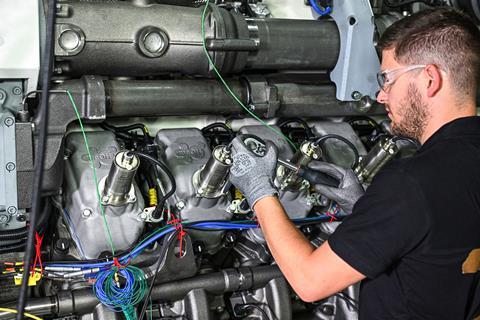
Last year, it completed a full Series 4000 engine test as part of a publicly funded project called meOHmare, examining not just combustion, but emissions, vibration, transient response and cold-start behaviour across a full four-month test programme.
“You can’t test everything on a single cylinder,” says Gommeringer. “You can test the combustion itself, but you can’t test real emissions. You can’t test the vibrations of an engine.”
The results were, by Kohl’s account, ‘super successful’. At commercial ratings – the de-rated output levels suited to long-haul workboat operation – the methanol engine matched the diesel’s power output from the same block dimensions.
There is a caveat: at the highest performance ratings used in planing yachts, the comparison does not hold. But for the tugs, ferries, offshore supply vessels and platform support vessels that form Rolls-Royce’s commercial marine market, the numbers, Gommeringer and Kohl believe, stack up.
One open challenge is lubrication. Diesel is self-lubricating; methanol is not. This has implications for injectors and other components in direct contact with the fuel.
“If you would like to use it today, the maintenance costs will be higher,” Kohl admits. The company is now working through the disassembled full test engine, examining each component for wear and identifying where material changes will be needed.
“Changing materials will help in the most cases,” says Gommeringer.
Expensive fuel, manageable engine
The economics of methanol are not straightforward. As a fuel, methanol produced from renewable electricity via hydrogen is more expensive to manufacture than diesel. Producing e-methanol from renewable sources is ‘definitely not the cheapest fuel in the end’, says Gommeringer.
“This is totally clear,” he says. “But on the other hand it’s important that you can really bunker the fuel and manage to have the same operation that you have to today – it doesn’t have to be the same, but it needs to be feasible somehow.”
The process stacks costs at each stage: electricity, electrolysis, CO2 capture, synthesis; but set against those are the costs of the alternatives.
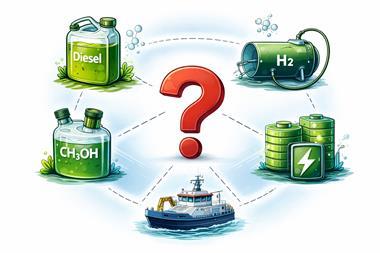
Compressed hydrogen, which attracted a lot of regulatory and financial attention several years ago, requires between 20 and 40 times the onboard volume of diesel to store the same energy – an impossible ask for a workboat where space is already at a premium.
Liquefied hydrogen is more compact but introduces cryogenic complexity that drives up tank and bunkering costs. Batteries can work well for short-range, predictable routes, but for vessels with variable operational profiles, the maths rarely adds up beyond a hybrid supplementary role.
E-diesel – synthetic diesel from renewable sources – is simpler to handle and compatible with existing infrastructure, but is more expensive than e-methanol. Biofuels are available now and cheaper in many cases, but their supply is fundamentally constrained.
“The global production capacity of biofuels is roughly the same as the marine energy demand,” says Gommeringer. “But marine energy demand is about 3% of global energy demand. So what about aviation? What about on-road?”
On the engine hardware itself, Kohl’s expectation is that a production methanol engine will not be significantly more expensive than a comparable diesel, with the same engine core, just a different combustion process.
Applications: Where methanol makes sense
Rolls-Royce’s methanol engine targets a specific segment of the marine market: vessels in the 700kW to roughly 4MW power range, operating in applications where operational patterns are less predictable than a simple harbour ferry.
Tugs, ferries on longer or more variable routes, offshore supply vessels and platform support vessels are the primary targets, along with the commercial yacht sector.
The choice of methanol, Kohl explains, followed a systematic process of elimination. The company ran studies examining the available onboard volume on different vessel types, their operational profiles and the infrastructure likely to be available at their ports of call.
“We identified methanol as a very good compromise,” he says. “Methanol, if it’s coming from green sources, is CO2 neutral. We can achieve a similar behaviour close to diesel in terms of dynamics and the characteristics of the combustion process.”
The key advantage for workboat applications is that methanol shares many practical properties with diesel. It is liquid at ambient temperature, can be bunkered using relatively conventional infrastructure, and does not require the cryogenic handling that liquefied natural gas or liquefied hydrogen demand. Its lower energy density does mean that a methanol-fuelled vessel needs roughly twice the bunker capacity of its diesel equivalent, but Kohl argues this is manageable.
Cold-weather performance was examined closely during the meOHmare test programme. Methanol’s high enthalpy of evaporation – the energy required to vaporise it – means that starting a cold engine demands a preheating system.
Testing showed that at 45-50 degrees Celsius preheat, the engine started reliably every time, but without preheating, it did not start at all. The good news is that preheating systems are already standard on many commercial marine diesel installations in cold-weather regions, so the requirement does not represent a significant additional cost in most cases.
Retrofit versus newbuild
One of the more commercially significant questions is whether methanol can be retrofitted to existing vessels, or whether the transition will be confined to newbuilds. Vessel operators have substantial capital tied up in their existing fleets, and a technology that requires a new ship to deliver its environmental benefits faces a much longer adoption curve.
On the engine itself, retrofit is not the obstacle: the Series 4000 block dimensions are unchanged, the power output at commercial ratings is comparable, and the gearbox, shaftline and generator can be retained.
“From the engine side, it’s not that big an issue,” says Kohl. The challenge lies on the ship side of the installation.
Methanol requires double-walled tanks with cofferdams, double-walled pipework, a nitrogen generation system for inerting and fuel pumping equipment adapted to handle a non-lubricating fluid. In a vessel not originally designed for these features, finding the space and carrying out the structural modifications means a substantial investment.
“If the boat is not from the beginning prepared for methanol in regards to cofferdams, tanks and pipework, in my personal view, it is not unrealistic, but it means a very high investment,” Kohl says.
The industry response, particularly in the superyacht sector, has been to design new vessels as ‘methanol-ready’ – laid out and piped for eventual methanol use, but delivered running on diesel. Dutch yacht builders are already offering this configuration.
Not everything needs to be installed upfront: the double-walled pipes, nitrogen generator and fuel pumps can be added later, provided the space is reserved. The tank itself, which must be double the diesel volume, is the hardest element to accommodate after the fact.
Safety and vodka
Safety is one of the first concerns raised when alternative fuels are discussed, and methanol is not without hazards. It has a lower flash point than diesel and burns with an invisible flame, and it is toxic – absorbed through the skin as well as inhaled – and once ingested is converted in the body to formaldehyde, a much more dangerous compound.
“Methanol sits in between gasoline and ammonia, but significantly closer to diesel and far away from ammonia,” says Kohl. The practical mitigation is a double-walled installation: tanks and pipework sealed against the possibility of fuel contact.
“From the outset, you can make sure that you have a safe system, double-walled and so on, that it will not happen that you go into this risk – then it’s quite safe,” says Gommeringer. “Today, nothing happens if you have skin contact with diesel and gasoline – this happens today, but nobody cares about it. It’s not less toxic – it’s just that it’s well known.”
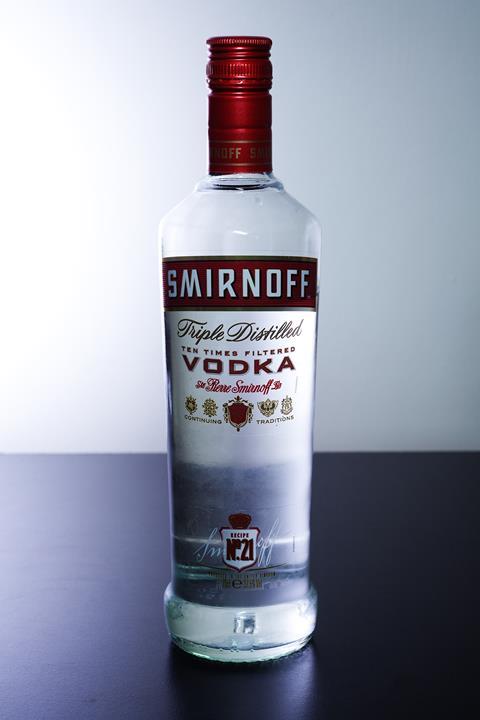
The treatment for methanol ingestion – rapid consumption of ethanol (or alcohol), which the body preferentially metabolises, blocking the conversion of methanol to formaldehyde – is established and effective, though needs prompt action. And this is why next to Rolls-Royce’s test bench is a handy bottle of vodka, just in case.
Diesel to dual-fuel transition
Rolls-Royce is not betting everything on methanol displacing diesel by the end of the decade. Regulatory uncertainty clouds the market outlook, and the hoped-for acceleration from IMO legislation – a net-zero framework that would have created large, predictable demand for low-carbon fuels – has not materialised in the timeline the industry anticipated.
“We did hope that the whole methanol development from the IMO side would accelerate a bit more,” he says.
The practical response has been to continue investing in diesel alongside methanol, ensuring that every new engine development is specified for both fuels. “All investments we are doing, all developments we are doing at the moment have diesel and methanol in the specification,” Kohl says.
Dual-fuel engines – capable of running on either diesel or methanol – are also on the table, but this creates engineering problems of its own.
“You have diesel on board, you have urea on board, and you have methanol on board, and you have all these exhaust gas after-treatment solutions,” he says. The result is an installation that is bulky, costly and demanding to maintain. From my personal perspective, I don’t think it’s a good solution.”
The company’s commercial methanol product is targeted for 2028–2030, timed to coincide with what its market intelligence suggests will be the period of meaningful demand growth. Between now and then, the engineering gaps – injector lubrication, cold-start optimisation, materials durability – will continue to close.
The underlying technology, both Kohl and Gommeringer insist, is already proven in principle. What remains is turning a test-bed demonstrator into a product fit for a century’s worth of marine service – with the bar set, whether they like it or not, by the diesel engine it is trying so hard to replace.