

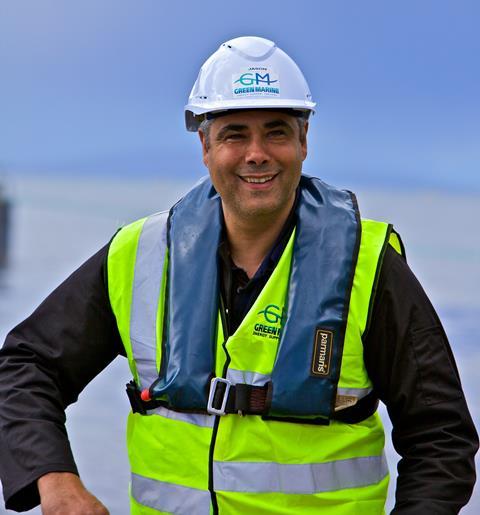
Green Marine UK is looking ahead to a new generation of fully zero-emission vessels, including hydrogen-powered CTVs and SOVs. Serena Shores spoke to managing director Jason Schofield about what the project has achieved so far – and what comes next.
Green Marine’s brainchild, ‘Project Verdant’, looks at how retrofitting an existing crew transfer vessel (CTV) with hydrogen fuel cell technology can offer a real-world testbed for integrating zero-emission propulsion into today’s offshore fleets – without waiting for new-builds.
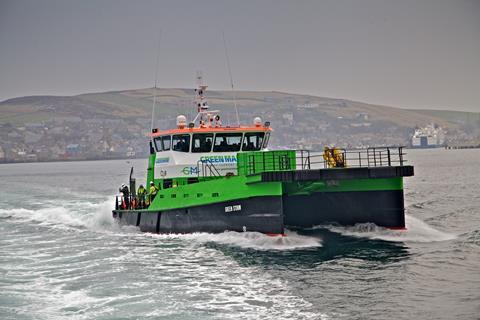
Green Storm, bought by Green Marine in 2019, is the primary testbed for retrofit hydrogen technology and the vessel is scheduled to undergo an innovative integration of hydrogen fuel cells and battery storage.
This conversion will not only demonstrate that a diesel-powered CTV can have its lifespan extended, it also serves as the functional blueprint that process the concept behind Project Verdant, pioneering the transition for offshore fleets to be repowered with clean energy.
Based in Orkney, north of Scotland, Green Marine is working on the project with the European Marine Energy Centre (EMEC).
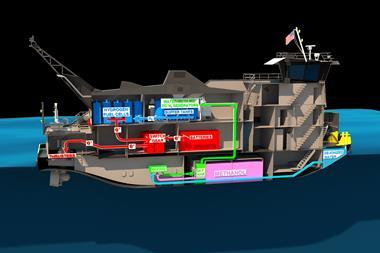
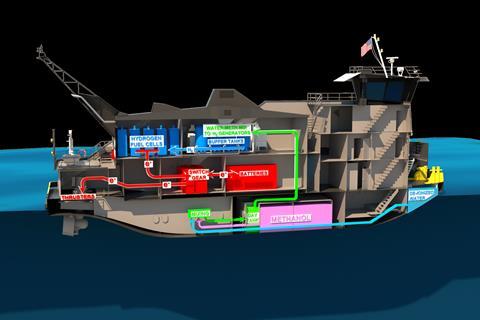
“Project Verdant’s conceptual design incorporates hydrogen fuel cells connected to electric motors, working in conjunction with existing diesel-fuelled engines, which can be shut down to enable zero emission operation at slow speed while servicing offshore wind farms,” says Jason Schofield.
“The aim of the project is to significantly reduce operational emissions and advance sustainable maritime practices in a challenging sector, by enhancing vessel redundancy and flexibility without impacting the vessel’s operational profile.”
An opportunity for transition
CTVs operate in low power mode roughly 70% of the time, when standing by or loitering in offshore wind farms and harbours. When in low-power mode, the power drawn is about 5-10% of the power needed for high-speed transit, so the addition of hydrogen fuel cells will result in reducing CO2 and NOx by up to 30% and 40% respectively.
In 2024 the Innovate UK-funded project received RINA AiP (Approval in Principle), which unlocks future project phases for Green Marine UK.
“In terms of opening the door to subsequent project phases seeking to execute design, engineering and sea trials, obtaining AiP was a key objective for Project Verdant,” says Schofield.
It also provides confidence in the CTV’s ability to operate safely in UK waters in accordance with the MCA (Maritime & Coastguard Agency) regulations MGN 664 and RINA Rules Pt C, Ch 1, App 14, Appendix 14: Hydrogen Fuelled Ships.
“Project Verdant focused on engineering a credible solution and to come up with that we worked along with RINA throughout all processes,” Schofield says. “Everything we developed and engineered was evaluated by RINA, then we got approval for the engineering works carried out, so to get that recognition was really important.”
Making the benefits of retrofitting a reality
Phase 1 of Project Verdant was the feasibility study. The technologies required to convert the CTV to operate as a hydrogen fuel cell hybrid are pre-existing and commercially available and the fuel cell technology selected by Green Marine is known as Proton Membrane Exchange (PEM), which has already been proven safe in different means of transport.
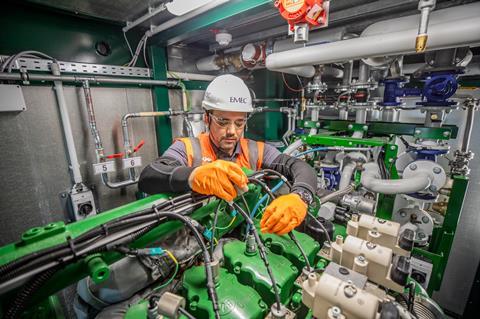
PEM fuel cells use an acidic polymer membrane electrolyte and a platinum-based electrode. These lower-temperature fuel cells are more expensive, but they deliver a longer lifespan, reducing maintenance costs and improving the number of hours they can work until they need to be replaced, making them a more environmentally friendly solution.
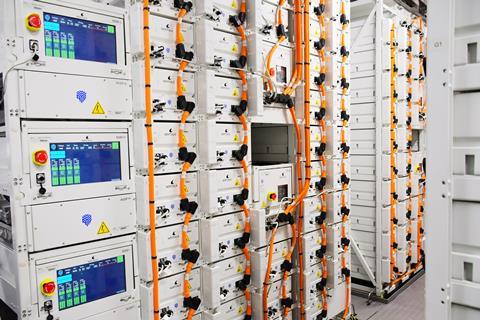
“The same goes for the battery system,” says Schofield. “It will help the vessel meet required peaks in power when operating on zero-emissions mode, while at the same time making the vessel completely noiseless if needed, if the CTV is operating in that mode. Several companies have also proven its safety through different safety features such as thermal runaway insulation. Both solutions are modular, making the installation on board the CTV’s constrained deck space very promising.”
Phase two involved integrating the hydrogen fuel cell into the power frame and gear box and testing and operating the converted CTV.
Specialist consultancy Waves Group was a very important partner in this project, providing all the naval consultancy architecture services required. Schofield also stresses the importance of the collaborations with EMEC in looking at where they could get the fuel from for the production of hydrogen.
“EMS (Engineered Marine Systems) provided technical expertise in the integration of alternative fuels, conducting a comprehensive feasibility assessment and developing a robust preliminary design framework for the retrofit,” he says. “EMS was excellent in calculating where all systems fit within the vessel, incorporating retrofit fuel lines and electrical systems into the retrofit.”
Another strategic partner was global leader in hydrogen systems Energys, one of the technology leaders for marine fuel cell generators.
“Energys helped design and provide engineering and modelling. As technology leaders for making electrolysers, they were a fundamental part of the overall design,” Schofield says.
“In all there will be five phases acknowledging that technology changes the whole time. With the diesel engine as back-up on the retrofit, Green Marine is wanting to operate four days at a time on hydrogen for six hours a day, in loitering mode and in transit mode to reduce fuel emissions.”
Based on Green Marine’s hindcast vessel-operating profiles, the direct saving of a converted CTV using an H2 fuel cell for low-power mode is anticipated to be 300 te (tonnes of CO2 equivalent) (12hr operations) up to 450te/yr (24hr operations) of GHG emissions.
The drive towards 100% zero emissions
The next stage is preparing specifications for the new-build zero-emission CTV, then commissioning a new-build. When it comes to SOVs there are no plans to retrofit, but to focus on new-build 100% zero-emission vessels incorporating the new technology. There will be no retrofit CTVs running alongside the new-build.
“By converting an existing vessel with a conventional engine to include a hydrogen fuel cell (for use in low-power-mode), Green Marine will get valuable insight into the challenges of building and operating a CTV powered 100% by hydrogen,” Schofield says.
They can also start the progressive training of the crew, while developing maintenance routines for this new power source. The ultimate mission is to capture sufficient learning from the operation of a retrofitted vessel to enable Green Marine UK to expand its fleet with new-build zero-emission CTVs and SOVs.
“We are engineering into new-build CTVs to eventually be 100% hydrogen powered.”
All retrofit and new-build vessels will increase efficiency, reducing their carbon footprint. Schofield feels that industry confidence that the technology is reliable is countered by the need to not exceed the budgets available to increase the number of vessels.
“The end goal of all CTVs operating in UK and EU offshore wind farm fleets being zero-emission vessels would eliminate 472,850 te per year at current rates,” he says. “Increasing competitiveness by achieving true zero and spearheading innovation comes with challenges, but the success of this five-phase approach will de-risk the project by steadily increasing Green Marine’s know-how.”
A greener future
Green Marine will naturally move on once it has proven a concept viable and reliable to build up market confidence.
“The project will run in a certain sequence, but it is vital to prove the concept in an operational environment,” says Schofield. “Everything moves to the right; the timescale of the project runs over three years going from the feasibility study to the commission of a new CTV and a further three years to design.”
This will be prefixed by designing the SOV with the same system, subject to technology improving.
Project Verdant’s advantages over other awarded projects in the UK and Europe stem from its location and maritime industry segment.
“The demand for CTVs to support offshore wind after the recent ScotWind lease is on the rise and due to the big push on green hydrogen technology in the north of Scotland, the supply of zero-emission fuel should not represent a concern,” he says.
This feature is part of our SPECIAL REPORT - to read the whole report, click here