

With green investment drying up and hydrogen still years from commercial viability according to Green Navy, a pragmatic approach to future fuels is what’s needed. CEO Charles Cardi talks to Maritime Journal about the company’s approach.
At two recent international events that once flourished in the ‘green’ sphere, Green Navy CEO Charles Cardi was amazed to see how the mood had changed.

Where Hyvolution in Paris and EuroMaritime in Marseille had once been bursting with enthusiasm for minimising CO2 emissions and investing in new technologies, the last two events were ‘undeniably negative’, Cardi says, with a distinct lack of government presence, no investors and worse than that – no customers.
“It was a very little fair compared to what it was the year before,” he says. “There was no business being done during the fair. It was mainly manufacturers there, sharing that it was also a very tough time. Some exhibitors told him they were considering attending for the last time.”
Green Navy is a French maritime technology company that had been formed to develop hydrogen-powered vessels to decarbonise coastal shipping.
Based in La Forêt-Fouesnant in Brittany, in the Finistère region on the Atlantic coast, the company is a subsidiary of the aviation and logistics group Vallair, and works with a number of maritime partners, including Seco Marine.
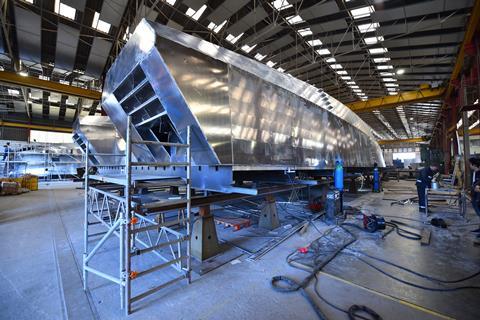
So in view of this reluctance what is the company, whose electro-hydrogen flagship project Prometeo has been running since 2019, going to do?
“Commercially, in this new environment, it would be suicide to continue the sole focus on electro-hydrogen propulsion, and in fact the company has already been sensing that there was a change in attitude from operators, and local regions, towards new technologies,” Green Navy says.
“The global enthusiasm is being severely impacted by the focus on fossil fuels in the US and the lack of funding for infrastructure investment across Europe as governments struggle.”
Regulations are not yet pushing ship owners towards alternative fuels, and without the carrot of financial incentives or the stick of compliance requirements, the commercial logic simply isn’t there.
“It’s just not financially viable yet,” Cardi says. “The answer is to have parallel strategies that can converge when the time is right.”
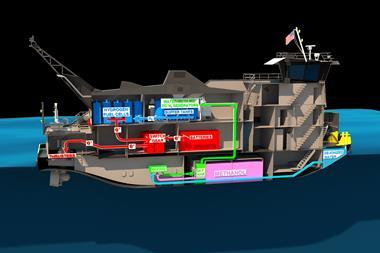
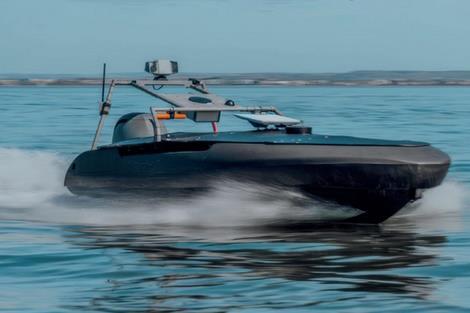
The plan is to develop a fully electric passenger catamaran – Prometeo – with diesel generator that can be retrofitted with hydrogen fuel cell technology or hybrid options when it makes sense to do so.
At the same time, it’s not giving up on the hydrogen option: it will continue to improve its fuel cells and work with certification authorities to get accreditation for when the time is right.
Three vessels, one hull design
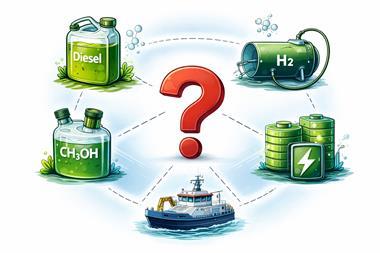
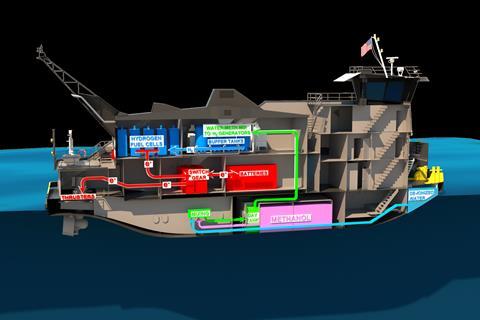
Green Navy’s response is a modular architecture built on a single hull concept that underpinned Prometeo from the start. The vessel can now be configured in three distinct versions, all with an identical weight footprint.
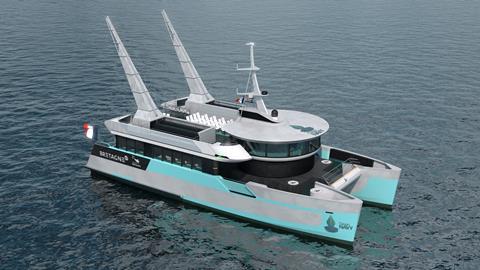
The first is a fully electric version, running purely on batteries — adequate for shorter routes where autonomy requirements are modest. The second is a diesel-hybrid: still electric in propulsion, but with a diesel or HVO generator to recharge the batteries, extending range.
The third is the original electro-hydrogen vision, with a hydrogen fuel cell acting as the range extender in place of the generator.
The crucial feature is that all three variants are hydrogen-ready. The vessel’s architecture means the generator can be removed and a fuel cell installed “as soon as you have the hydrogen ready at a competitive price”.
“You take off the generator and then you install the fuel cell on board. It’s as simple as that,” says Cardi.
Moving from full electric to a range-extended version means halving the battery capacity and using that saved weight for either the generator and fuel, or the fuel cell and hydrogen storage.
Selling the vision to ship owners
The commercial pitch that is now resonating with operators is a straightforward one: buy a vessel today that protects your investment for a 30-year operating life. Ship owners who must commit to new tonnage now, but cannot yet afford or justify hydrogen propulsion, can take delivery of a hybrid or electric vessel knowing they are not stranded when green fuels eventually reach price parity.
“Those ships, they will be running and be operated for 30 years,” Cardi says. “To know that your investment is already ahead of this time, that’s very appealing to them.”
He says that since pivoting the commercial offer, Green Navy has started to attract fresh interest from ferry operators, particularly in coastal regions of Brittany and western France, who were previously cool about the project.
A parallel study under way with a shipowner partner is modelling the capital expenditure and operating costs of all three versions against a conventional diesel-powered equivalent.
The results, which Cardi expects to share in the coming weeks, are intended to give operators hard data, covering energy costs from diesel and HVO through to electricity and two hydrogen production pathways, to inform fleet decisions.
Cracking the safety question
Even among operators who accept hydrogen’s long-term potential, safety anxiety remains a significant barrier.
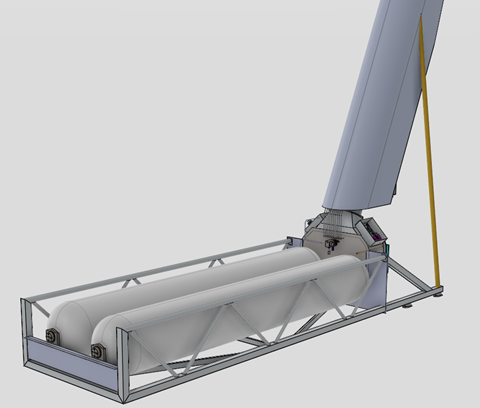
Cardi says Green Navy’s key innovation is the elimination of ATEX zones: areas where hydrogen leakage could create an explosive atmosphere.
The solution relies on layered containment and ventilation. Double- and triple-sealed piping routes any leaked molecules to large exhaust and ventilation systems mounted on the upper deck. The hydrogen storage bottles, made from a plastic liner wrapped in carbon fibre, sit inside a sealed casing connected directly to the exhaust system, with automatic detection, auto-cutting, and continuous monitoring throughout.
“Prometeo, when it will be approved, will be able to have passengers close to the H2 bottle because those bottles are safe and there is no leak possible happening,” Cardi says. The approval he refers to is an Approval in Principle from Bureau Veritas for the complete electro-hydrogen system, which he expects to be granted within weeks. It will be among the first such certifications for a passenger vessel of this type.
Eyes on the horizon
Green Navy is also tracking alternative fuel pathways.
Solid oxide fuel cells — high-temperature systems capable of running on hydrogen, methanol and methane alike — are being studied with partners as a way to broaden the vessel’s future options further.
Ammonia, by contrast, is not on the near-term roadmap for vessels of this size, though Cardi acknowledges it could have a role as a hydrogen carrier for larger deep-sea shipping.
The broader picture, he believes, is one without a single winning fuel. The maritime transition is more analogous to the current energy mix than to the coal-to-oil shift of the last century — a mosaic of solutions deployed where they make most sense.
“We have to offer those versions that actually are a step ahead, that you will be able to convert this ship into the H2 version because we’re going to have the approval in principle next month,” he says.
“It’s going to require more time than what we all believed at the beginning.”
For more of Maritime Journal’s Special Reports click here.