


Choosing your vessel’s fuel shouldn’t feel like a gamble. Nick Dalton picks his way through an increasingly complicated field.
It is fair to say that few inventions since the wheel have changed the world as much as the diesel engine. Without it, we would not have the global trade we rely upon nor the lifestyle we have come to expect, and it has shaped and perhaps even defined the marine industry as we currently know it.

If Rudolph Diesel were to return to earth, 100-plus years since his mysterious death, he would be thrilled to see that millions of copies of the engine he invented are to be found working away in every corner of the world. From cars and trucks to boats and ships, via every scale of power generation imaginable, the engine type and the fuel it uses still honour him by their name: diesel.
He’d no doubt be impressed at some of the improvements that have been made over time, and pleasantly surprised at how little the main mechanical elements of his design have changed. And he would find the fuel familiar from a century ago. Wherever you are on earth, you’re not far from a diesel engine, nor probably from an engineer who can fix it and a source of fuel, and this ubiquity is a practical and safety feature we take for granted.
The fraction of crude oil we call diesel suits its purpose well as a safe and economic source of densely stored energy, below explosive gasoline in the refinery tower but above the thicker lube oils. It’s a natural lubricant that doesn’t form an explosive atmosphere, great for safety, and yet it doesn’t need a spark to ignite it, making for simpler engine designs.
Of course, nothing is perfect and when you burn diesel you generate emissions including carbon dioxide, nitrogen oxides, sulphur oxides and soot. Engine designers, pushed by legislation, have improved efficiency and reduced emissions over time but some exhaust products are chemically inevitable, especially CO2.
Now, with the world focused on finding the path to a Net Zero carbon future, the search is on for sources of energy that can replace diesel and lower or eliminate greenhouse gas (GHG) emissions. In a rapidly evolving and uncertain regulatory environment, manufacturers, with their eyes firmly set on a large market up for grabs, are vying to promote a growing range of new fuels and engine technologies.
The potential benefits of any new fuel type must obviously be weighed against any opportunity costs in terms of complexity, reliability, cost, supply chain and impacts on trading.
For the vessel owner considering power options for some future project, the obvious old choices have been replaced by a decision making process infinitely more complex and unpredictable than once it was. And of course, the datum point remains: diesel.
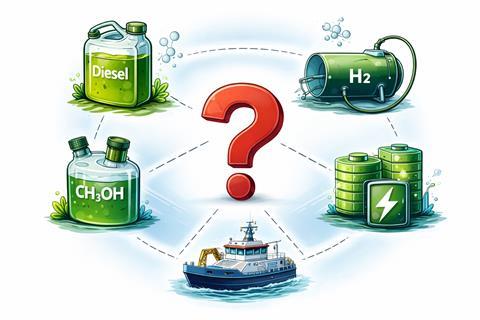
So what are the main “new fuel” options and how do they compete – with each other and with diesel - in environmental, financial and practical terms?
Liquefied Natural Gas / Compressed Natural Gas
Natural Gas (NG) is probably the best known of the “alternative fuels” – normally in liquefied form (LNG) - with significant early uptake in the marine industry (dual fuel MEGI engines in LNG carriers, for example) and peremptory engine preparation in other vessel types.
Primarily consisting of methane, NG is collected from natural fossil fuel reservoirs, contains a lot of energy by weight and produces lower emissions than diesel, especially CO2 and NOx, and zero soot. “Methane slip” can offset GHG savings.
NG is well understood globally as a fuel source and has a good distribution network, piped into homes or in canisters for cooking and heating. Existing engines can be converted to LNG at added cost and complexity, but still require some diesel as a pilot fuel.
Only small quantities can be stored and shipped as a compressed gas, but low temperatures allow bulk transport as a liquid, with regasification at the other end. NG is explosive so any leaks are dangerous, but it is lighter than air and disperses rapidly into the atmosphere.
Bio-fuels (Biodiesel etc)
“Biofuels” are produced from non-fossil fuel sources of fats and oils, processed to mimic existing types of fuel such as diesel, albeit about 10% less energy-dense. They are either used alone or blended with their conventional counterparts.
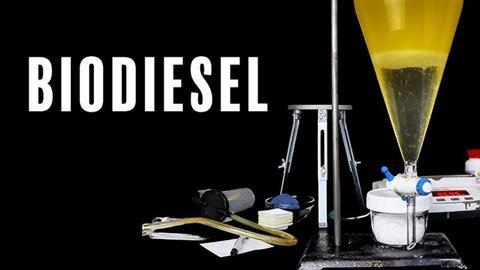
Typically quite intensive to produce in terms of agricultural land, fuel, fertiliser and water inputs, biofuels still produce CO2 and other emissions when burnt. Since CO2 is also sequestered during their production, any net environmental benefit is difficult to calculate.
With the current cost of living crisis and global fertiliser shortages, the logic to using farm land to produce fuel feedstock, always debatable, requires greater scrutiny than ever.
Liquefied Petroleum Gas
LPG is an energy-dense fossil fuel liquid, requiring lower pressures to contain and transport compared to LNG. It burns hot and very clean with no carbon soot. It is seen as a possible “bridging fuel” to lower carbon alternatives but, being hydrocarbon based, it does still produce significant CO2 as a product of its combustion. It provides more energy for a given volume (but less for a given weight) than diesel.
LPG takes energy to produce from petroleum and the gas it forms is explosive and heavier than air, so leaks in confined spaces are serious. The supply network for LPG is well established, and whilst it can’t be used in diesels, modified petrol engines can burn it, often in a switchable dual-fuel format.
Ammonia
Being nitrogen based, ammonia produces no CO2 when it burns but it does make Nitrous Oxide and some NOx, and unburnt NH3 is also likely. It requires some diesel to be injected to act as a pilot fuel and thus relies on significant engine modifications.
Ammonia is an experimental fuel just reaching real-world trials now. It takes twice as much energy to make as it contains, complicating the analysis of any benefits. It also has only 1/3 the energy density of diesel, so requiring three times greater supply and storage volumes, and flow rates.
It can be stored as a liquid (ammonium hydroxide) at atmospheric pressure, but it is very toxic and corrosive. Even small amounts produce an explosive, highly caustic atmosphere that will burn eyes and lungs, causing blindness and permanent lung damage.
Methanol
Methanol can be produced either via industrial processes requiring significant energy inputs – hence with their own carbon costs – or via fermentation of cereal crops, impacting food supply. Methanol is a liquid that can be stored at atmospheric pressure and ambient temperature; it has flammable vapours and burns with an invisible flame.
Methanol, whilst only one carbon molecule longer than the ethanol in an alcoholic drink, turns into highly toxic formaldehyde and then formic acid if ingested or spilled on the skin, causing neurological damage including blindness and death, even from a small dose.
Depending on the method of production, methanol takes about 1.5 times as much energy to make as it contains, and like ammonia is only about 1/3 the energy density of diesel, requiring three times greater storage volumes and flow rates. CO2 is still emitted in the exhaust gas, and any carbon benefit is down to how inputs are calculated.
Hydrogen
The most abundant element in nature takes considerable energy to capture and store, about 1.5 times what it releases when burnt in an engine. It is highly explosive, but burns cleanly, producing only water.
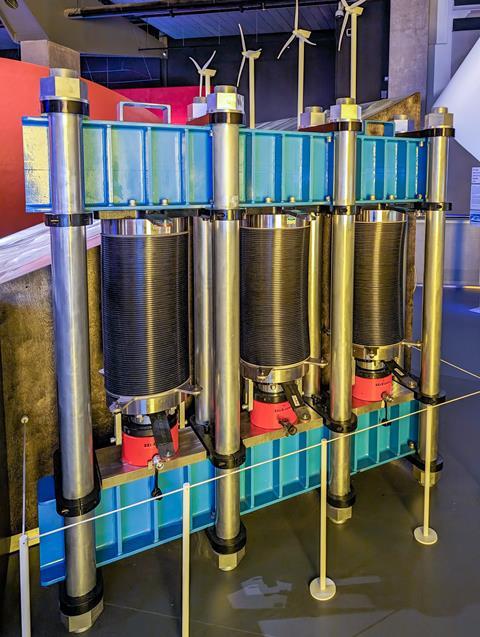
A hydrogen electrolyser is an impressive, large piece of kit
Hydrogen is the smallest atom and thus - as H2 - also the smallest molecule, so small in fact that it will escape through metals, making them brittle. Tanks are therefore made of expensive and bulky wound carbon fibre which in order to contain meaningful amounts of energy must typically hold the hydrogen at 700 atmospheres of pressure. This carries obvious safety concerns, although in its favour H2 rises rapidly in air and disperses quickly.
Even at such high pressures, a litre of diesel still contains over seven times as much energy by volume as H2 . Hydrogen engines have been around for many years, but the cost and complexity of the supply chain has meant that to date hydrogen has remained an experimental novelty rather than a practical fuel.
“Green” hydrogen (only 1% of global production) is made via the electricity-hungry process of electrolysis, meaning that the costs vs benefits vary widely according to power source. This does mean that it’s potentially a good use of “spare” renewable electricity, once an economic solution is found for capturing and storing it, and fuel cells could be a quiet, safe future way of converting it back to electricity.
Battery power / EV (Electric Vessel)
Batteries as a source of motive power (if not a fuel per se) are increasingly familiar to us all as a result of the push towards EVs on the road. As with road vehicles, weighing the real world pros and cons of battery power for marine use is complicated, but the calculation starts with about double the CAPEX of a conventional vessel.
The obvious main advantage of EV technology is zero emissions at the point of use, although of course no source of electricity is truly free of emissions. The obvious main environmental drawback of EV technology, regardless of power source, is the complexity, cost and resource-intensity of getting enough power to where it is needed to recharge a vessel, and at a sufficient flow rate, and storing it onboard ready for use. Power availability is also a consideration, especially in a world of grid constraints and rapidly expanding, power hungry AI.
Range will limit the applications for which pure EV power is a realistic option to port-bound vessels or those on fixed short routes with good power supplies at both ends. Battery power will not yet, if ever, suit vessels that trade widely, or change berth often, or spend long periods at sea, although hybrid installations can broaden this envelope.
In an application where fuel volume and weight has a bearing on range, efficiency, speed, draught and freight capacity, battery size and mass is a major consideration. Batteries lose efficiency over time, as we all know, and unlike liquid fuels, they don’t get lighter as the stored energy reduces. Power-heavy vessels such as tugs will likely need grid upgrades to enable them to operate effectively, and charging time will naturally impact availability. Changes of berth, jobs in other ports and refit runs will be complicated.
And finally, one cannot discuss this topic without acknowledging the resource demands and impacts of renewable energy and EV technology, different though they are from those of conventional power. Lithium, lead, copper, cobalt and cadmium production have enormous environmental and human costs, including child slavery and toxic waste, and much of the hardware required for generating and storing renewable energy is, ironically, not recyclable.
By the honest reckoning of even its most ardent supporter, Net Zero by 2050 will take more copper than has been mined, globally, ever. That means – assuming we can find enough of it – opening nearly 200 new large-scale copper mines, or 8 a year. Even if that turns out to be possible the environmental impact, however measured, will be enormous.
In conclusion
Of course, any new fuel or propulsion technology in any market will have pluses and minuses in operational, economic and environmental terms, and have challenges to overcome as it beds in over time; progress is rarely linear, after all. But it’s not binary either, and the transition to any new fuel will naturally be a trade-off.
New fuels will need new distribution chains, with their own demands in terms of infrastructure, personnel, investment, safety, training, parts, maintenance, insurance and licences, and these costs will be passed on. Bunkering hydrogen or ammonia is a very different prospect from topping up a diesel tank.
Multiple fuel types will also mean parallel supply lines, and with engines tied to one fuel type (or maybe two), we may soon see vessels that can only operate in certain ports, from certain berths, or on particular routes, and for which refit and emergency voyages are greatly complicated or even impossible. This loss of flexibility will render business models more fragile, at a time when resilience has never been so important.
It’s natural to want ongoing environmental improvement from our industry, of course, and there has been much of that in the recent past. But it’s also right that new technologies must stand on their own two feet in the real world and not merely satisfy new rules from the IMO (UN International Maritime Organisation) which, seeking environmental benefits at one level, often have unforeseen costs at another.
When it comes to fuel choice, there is no panacea. Complexity is an environmental risk. Reliability is an environmental benefit.
A dollar can only be spent once. And CO2 is not the only game in town.
Nick Dalton has run Quantum Marine Marketing Ltd for the past 20 years, offering bespoke sales, communications and business development consultancy focused on the commercial marine industry. A marine biologist by training, Nick is as passionate about the marine industry as he is the marine environment.
References:
Hydrogen: https://www.iea.org/energy-system/low-emission-fuels/hydrogen
https://www.lr.org/en/knowledge/research-reports/2025/fuel-for-thought-hydrogen/
Ammonia: https://marine-offshore.bureauveritas.com/shipping-decarbonization/future-fuels/ammonia
Copper mines: https://carboncredits.com/the-world-needs-6-new-large-copper-mines-a-year-to-reach-net-zero-energy-transition/
Battery Power: https://www.zerocarbonshipping.com/publications/understanding-the-potential-of-battery-electric-propulsion-for-cargo-vessels
Child slavery in cobalt mining: https://www.wilsoncenter.org/blog-post/drc-mining-industry-child-labor-and-formalization-small-scale-mining