

Underwater technology firm Sonardyne has signed a Memorandum of Understanding with engineering company AMOG to deliver subsea asset-monitoring services to offshore energy operators.
Combining Sonardyne’s underwater monitoring, positioning and communications technologies with AMOG’s engineering assessment capabilities, the companies say the service aims at operators of floating offshore wind installations, oil and gas moorings, pipelines and risers.
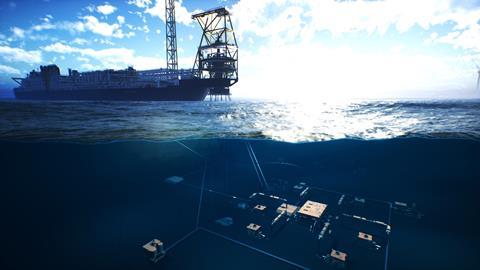
Central to the partnership is Sonardyne’s Observer system, a wireless subsea asset integrity monitoring solution offering high and low-frequency motion monitoring, third-party sensor integration and onboard edge analytics.
The two companies are already working on a near real-time mooring monitoring system for an unnamed European floating offshore wind project.
AMOG director Dr Hayden Marcollo, a specialist in moorings and vortex-induced vibration engineering, said the combination of subsea data and engineering assessment would give asset owners ‘more actionable, near-real-time insight into the condition and behaviour of critical subsea infrastructure through a single solution’.
“For operators, this could support earlier detection of anomalies, improved understanding of loads and motions, and more informed decisions around inspection, maintenance and integrity management, as well as asset longevity, in one end-to-end solution,” he said.
Sonardyne Business Development manager Frank Rose said integrating monitoring data with engineering models was an opportunity to provide a more complete picture of asset performance, whether supporting day-to-day operations, integrity assurance or life-extension strategies.
Other technologies in the space
Several other companies are developing comparable subsea monitoring capabilities.
Norwich, England-based Acteon subsidiary 2H Offshore offers mooring integrity monitoring systems combining sensors and analytical software; French steel tube manufacturer Vallourec provides riser monitoring solutions using fibre-optic sensing technology; and Dutch geotechnical and survey firm Fugro operates remotely operated and autonomous underwater vehicles equipped with inspection sensors for pipeline and mooring surveillance.
Digital twin platforms from Swiss structural simulation company Akselos and Norwegian classification society DNV allow operators to model structural behaviour of offshore assets in real time, complementing physical monitoring systems by enabling predictive maintenance and life-extension planning.