![MaritimeJournal[Seawork]](https://www.maritimejournal.com/wp-content/uploads/2026/09/MaritimeJournalSeawork.svg)


Cargo ship crashes into North Sea wind turbine
German maritime casualty investigators say time will tell whether the collision of a cargo ship into a North Sea wind turbine could become a more regular occurrence given the growth in offshore wind farms.
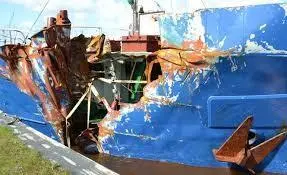
The cargo ship, reportedly carrying grain, was seriously damaged when it crashed into a wind turbine in the North Sea last week. No one was hurt.
The German vessel Petra L had a large hole gashed in the top of the starboard side of her hull, but managed to limp in to the German Port of Emden, where she is still moored.
The incident happened at the Gode Wind 1 offshore wind farm, owned by Ørsted, which is operating northwest of Norderney in the German North Sea.
The turbine involved is one of 55 Vestas turbines at Gode 1, which is one of three Ørsted farms – Gode 2 is also operational; and Gode 3 is in the development stages.
Ulf Kaspera, director of the German Federal Bureau of Maritime Casualty Investigation (BSU), told Maritime Journal that not many details could be released while the investigation was ongoing.
“The question why the accident happened is of course a major part of the investigation,” he said. “However, we are not solely looking for the main cause but as well at all aspects that could have contributed to the accident, off and onshore.
“This is the first accident in the German EEZ (Exclusive Economic Zone) of a cargo ship alliding with the pile of a wind turbine that was reported to BSU. Whether it is likely that accidents like this will happen more frequently in future is hard to predict. One could say that the larger the wind farms grow, the less space is left for navigation.
“Furthermore, the traffic of offshore supply vessels will increase as well. More traffic and less space may lead to a greater risk. On the other hand, the wind farms keep enough distance from shipping routes and there are many measures in place, both on and offshore, to prevent such accidents. Time will tell.”
Ørsted released this statement:
“On 24 April, a cargo ship collided with a wind turbine at Orsted’s Gode Wind 1 offshore wind farm. No persons were injured in the incident.
“Further investigations have already been launched. The cargo ship itself did not directly contact the maritime surveillance, but Ørsted’s in-house control centre has documented the incident. The offshore wind turbine involved has been taken out of operation for further investigation.
“The offshore wind farm is located about 45 kilometres from the coast and 33km off the islands of Juist and Norderney.
“A total of 55 wind turbines have been installed at the Gode Wind 1 offshore wind farm. The turbines have a rotor diameter of 154m.”
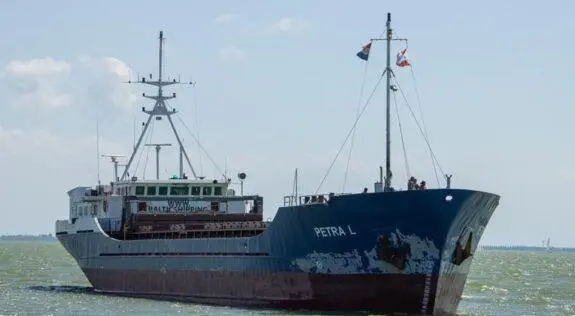
The Baltic Shipping Company, based in Denmark, which has details on its own website about Petra L, refused to comment on why the collision occurred and would not even confirm whether it owned or operated the vessel.
Some have speculated that the ship had been put on auto pilot and the skeleton crew on board had not been on the bridge to observe the wind farm before the vessel crashed into one of the turbines.
According to the company’s own specifications, the vessel was built in 1984, has a length of 73.66m and a beam of 11.5m. She was carrying grain, reports said, to Belgium, but was not at full load. What happened to the cargo has not been disclosed.