
The Consortium Mekante Diek (Ploegam, Van Oord, Dura Vermeer) is proving the value of electric equipment during a dyke reinforcement project commissioned by Rivierenland Water Board.
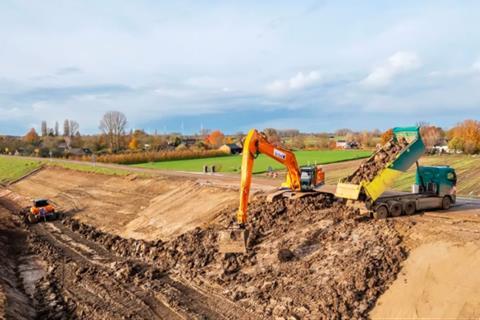
It is the first large-scale construction project in the Netherlands to be completed using almost entirely electric equipment and is helping prove that large-scale sustainable construction is feasible without compromising on time or efficiency.
”During the tender, Mekante Diek met our goals and ambition in an appealing way with maximum commitment to zero emission implementation,” said Peter Lobbezoo, HWBP programme manager at Rivierenland Water Board.
”This exceeded our expectations. Demonstrating entrepreneurship in deploying zero emission equipment on this project has helped accelerate the transition to zero emission construction.”
Sustainable impact
Rivierenland Water Board challenged the market with the 2020 tender to achieve the greatest possible emission reduction which was won by Mekante Diek. Implementation of the Tiel-Waardenburg dyke reinforcement started in 2023.
The project is using 40 largely emission-free machines, with mostly interchangeable, rechargeable battery packs, including trucks, tractors, cranes, asphalt sets and piling rigs.
It has also created WattHub, Europe’s first XL fast charging plaza, developed together in partnership with Betuwewind.
The charging plaza, situated next to the dyke reinforcement site, is powered by renewable electricity, specifically designed for trucks and heavy equipment and is accessible to all.
Mekante Diek commissioned TNO to study the efficiency and sustainability impact of the whole project where zero emission equipment has been compared with conventional diesel equipment in various age categories.
The results underline that large-scale emission-free construction is possible. The project saves over 1,190 tonnes of CO₂ and 3,260 kg of nitrogen (NOx) per year, equivalent to what 59,500 trees can absorb in a year. 100% green electricity is used to charge the equipment, 90% of which comes directly from wind turbines, preventing grid congestion.
TNO’s research shows that great strides have been made, but there is still room for improvement. For example, in charging schedules and energy consumption.
The Tiel-Waardenburg dyke reinforcement is part of the national Flood Protection Programme (HWBP), the largest dyke reinforcement operation since the Delta Works.
Waal dyke between Tiel and Waardenburg will be raised, widened and fitted with more than nine kilometres of sheet piling over a distance of about twenty kilometres.
Work is well on track. So far 7km of sheet piling has been installed and 4.7km of the dyke has now been protected against flooding. Completion is expected in 2027.