

A £101 million (€117 million) contracted has been awarded to contractors for the next stage of one the UK’s most significant flood-defence projects.
The Bridgwater Tidal Barrier Scheme was first identified as necessary following serious flooding on the Somerset Levels in 2012-14, when homes, farmland and civil infrastructure were deluged for weeks.
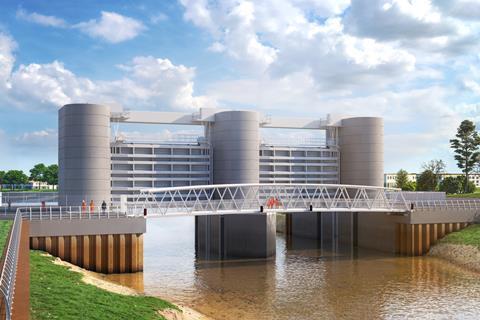
The Environment Agency subsequently identified a tidal barrier on the River Parrett as the most effective long-term solution for reducing flood risk from storm surges and high tides propagating inland from the Bristol Channel. The scheme was incorporated into the Somerset Flood Action Plan in 2014 and later refined through consultation and design reviews. Once completed, it is expected to protect around 11,300 homes and 1,500 businesses for at least 100 years.
Work began in 2023, with Manchester-based building firm Kier hired to build working platforms, foundations and major sections of the downstream flood defences.
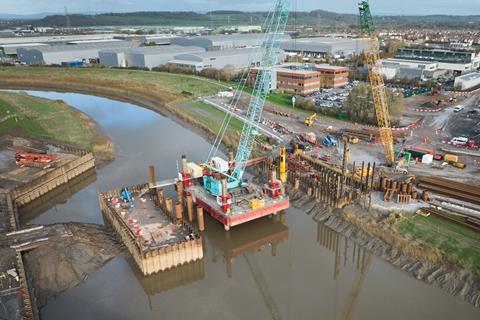
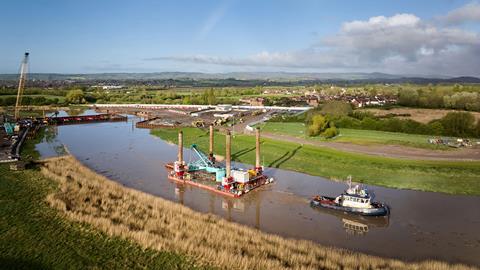
A temporary bypass channel was excavated to maintain river flows while an in-channel cofferdam created a dry work area for the barrier foundations. Red7Marine’s Haven SeaSeven jack-up barge, which dominated the Bridgwater skyline for more than a year, was used to support piling and heavy construction activities before leaving the site in April 2026, marking the completion of a major marine engineering phase and the transition to permanent structures.
Temporary becomes permanent
With Kier now secured for the next phase of construction, attention will increasingly shift from temporary works towards the installation of the barrier’s permanent towers, gate structures and associated mechanical systems.
Unlike traditional fixed barriers, the Bridgwater structure will consist of three towers supporting two vertical lift gates, each approximately 15 metres wide. The gates will remain in the raised position under normal conditions, allowing river traffic and flows to continue unimpeded, before being lowered during periods of exceptional high tides and storm surge events.
A significant redesign undertaken during development simplified the superstructure by relocating lifting equipment from an overhead gantry arrangement into the bases of the towers, reducing complexity while improving access for maintenance activities.
The tidal barrier works also include downstream embankments, habitat improvements and fish and eel passage measures.
“Delivering infrastructure of this scale requires close collaboration, careful planning and a phased approach to delivery,” said Sonal Mitra, Deputy Director at the Environment Agency.
“This next stage of the scheme will enable continued progress on critical construction activity while supporting the construction of the tidal barrier itself. We remain focused on ensuring the scheme delivers lasting flood resilience, achieves value for money and provides wider environmental and community benefits for the area.”
Tidal complexities
Bridgwater occupies a vulnerable location on the River Parrett approximately 17 km upstream from the Severn Estuary, an area influenced by some of the highest tidal ranges in the world. High tides moving inland from the Bristol Channel can combine with storm surges and high river flows to create significant flood risk for communities built on low-lying ground.
One of the most technically challenging aspects of the scheme has been creating a safe construction environment within a tidal river while maintaining water movement through the Parrett.
To achieve this, contractors first had to build extensive temporary works, such as the Haven SeaSeven jack-up.
This allowed Kier to undertake piling and other heavy construction activities from a stable working platform above fluctuating tidal levels, rather than using floating pontoons.
The departure of the vessel signalled completion of two critical temporary engineering elements – a bypass channel and an in-channel cofferdam.
The bypass channel was excavated adjacent to the existing river alignment to maintain flows while construction activities progressed within the river itself. Temporary culverts and hydraulic control measures ensured continuity of water movement through the site.
Meanwhile, the cofferdam created a dry working area within the Parrett, allowing contractors to excavate, place foundations and undertake structural works protected from tidal inundation.
Such arrangements are common on large estuarine projects but require careful sequencing, particularly where environmental considerations and fish migration routes must be maintained.
Foundations first
Since Kier commenced works in 2023, much of the effort has centred on preparing the site for the permanent barrier.
Kier says the enabling works are now substantially complete, allowing attention to turn towards the barrier’s permanent substructure.
“Together, we are focused on delivering a resilient, long-lasting flood defence that will help protect Bridgwater and surrounding communities,” said Ross MacKenzie, managing director of Natural Resources at Kier Infrastructure.
“This contract award reflects the strength of our long-standing partnership with the Environment Agency and the significant progress our talented teams have already made on site. We are proud to be shaping such a nationally significant project that will leave a legacy for Somerset communities.”
The continuation contract is intended to maintain momentum while future stages of delivery are developed.
The Environment Agency has emphasised the importance of progressing the scheme in a controlled and phased manner, reflecting the challenges associated with constructing large hydraulic structures within operational river systems.
Beyond the flood barrier
Although the barrier itself will eventually become the defining feature of the project, engineers regard it as only one component within a much broader system designed to manage tidal risk.
The downstream embankments currently under construction are intended to work in conjunction with the barrier, reducing overtopping risks and providing a continuous line of defence along vulnerable sections of the Parrett.
The fish element was another complexity that had to be added.
For marine contractors, the project provides an example of how temporary marine infrastructure can often represent one of the largest and most technically demanding elements of major civil engineering schemes.
The use of a large jack-up barge, temporary bypass river, cofferdams and heavy foundation works demonstrates the degree to which marine construction techniques have become integral to flood resilience projects.
Once completed, the Bridgwater Tidal Barrier will stand as one of the UK’s most significant tidal flood defence projects as well as one of its most challenging marine operations. It is going to take another five or so years to complete, and the current cost stands at £249 million (€288 million).