


Despite being a proven and predictable energy provider, tidal range opportunities are being ignored by the UK government based on a flawed report, says Kate Gilmartin, chief executive of the British Hydropower Association (BHA).
For her, the case for tidal range energy is both simple, long overdue and ideal for Britain’s geography.

Yet for nonsensical reasons, the Department for Energy Security and Net Zero (DESNZ) has so far refused to get on board with it, making its assumptions on the back of a flawed report which ‘overlooks decades of evidence’.
Tidal range is essentially a low-head hydropower – either a barrage or a lagoon holding water back in a river, estuary or the sea.
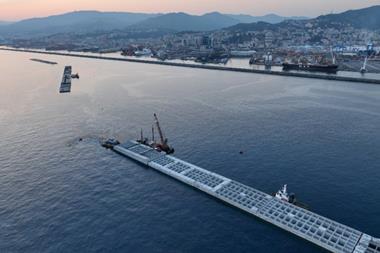
Giant caissons are towed out to sea and placed next to one another, which can then create a bridge or pathway linking headlands and simultaneously acting as a flood barrier.
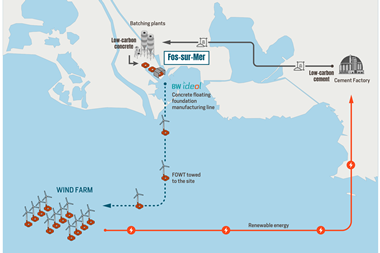
The caissons would be made on land before being floated out and put in position, which also means infrastructure at ports would have to be improved, creating jobs and skills.
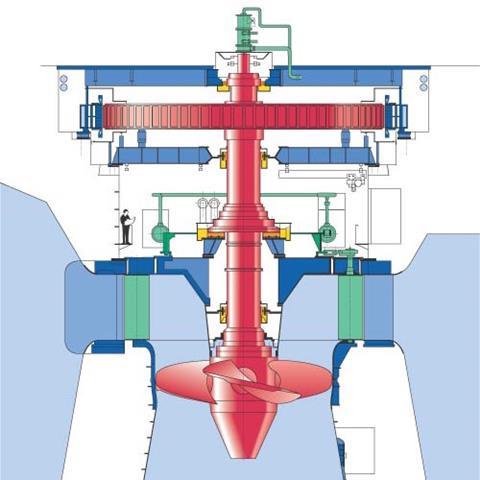
Kaplan turbines, axial flow reaction turbines that have been used in river hydropower for more than a century, within the caissons generate electricity as tides rise and fall. They are predicted to last for 120 years.
“You start in the middle and slowly build out caisson by caisson until five years in, you’ve got your entire structure,” Gilmartin says.
Unlike tidal stream – underwater wind turbines that sit in a tidal current – tidal range sits on the coast, and the two technologies are fully compatible.
“They don’t interfere with each other because one’s under water and one is on the coast or an estuary. They both offer timetabled generation, but they’re different technologies.”
Predictability is one of the key benefits of this form of electricity generation, as opposed to the randomness of wind and sun. And knowing exactly when the four-hour window of non-generation is could be fitted in with electric vehicle use, or other battery storage on land.
“It’s steady. It’s timetabled,” she says. “We know exactly how much energy we’re going to generate at any one time. You can map that for 5,000 years and beyond.”
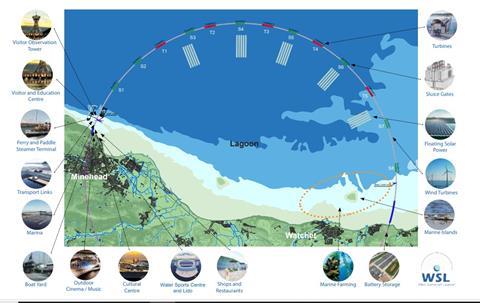
Yet large-scale schemes such as the proposed Western Somerset Lagoon – a 2.5GW project with 125 turbines – have so far not been given a chance.
Flawed report and misconceptions
If the technology is so promising, why has the UK failed to build a single tidal range scheme?
“Our biggest problem is the Department for Energy Security and Net Zero (DESNZ),” Gilmartin says.
Misconceptions about cost stem from the UK’s use of levelised cost of energy (LCOE), a metric that heavily penalises very long-lived infrastructure, she says.
“If you use a blunt metric where you discount 120 years of tidal range, then tidal range looks expensive. But if you put everything on the same timeline, it suddenly looks quite reasonable,” she says, pointing to new work carried out on sustained cost of energy, which compares technologies based on their full operating lifetimes.
In a recent National Energy System Operator (NESO) report, which the industry hoped would provide a neutral assessment, ‘deeply flawed parameters without the rationale for why’ meant that the facts about tidal range were easily misconstrued.
Worse, a final copy of the report was not even given to the BHA before being leaked to the Financial Times and DESNZ, who commented on the findings even though they were flawed.
“DESNZ actually saw the FT headline and agreed to put a quote to it despite the fact we didn’t even get sight of the report. That speaks to them being quite underhand in their dismissal of tidal range.”
One of the biggest errors in the report was proposals to put the technology on the east coast, where tidal ranges are small and it wouldn’t make sense.
NESO also modelled circular, offshore lagoons, which are vastly more expensive than the coastal crescents that developers are actually proposing.
Because the report didn’t clearly explain the counterfactuals, it allowed the impression that tidal range is inherently uneconomic, Gilmartin says.
She suspects the department lacks bandwidth and is ‘pushing hard on nuclear’, leaving tidal range to languish without staff or political attention. She also sees a deeper problem: “Only 9% of civil servants have a STEM background. This is an engineering solution, but it’s being treated as a policy solution… and we’re a decade behind.”
Despite major academic studies including the extensive Severn Estuary Commission, chaired by offshore wind pioneer Andrew Garrad, DESNZ has not reviewed the evidence rigorously. Instead, Gilmartin says, “it’s gone to a junior civil servant who’s done a briefing.”
The result is a Catch-22: without DESNZ policy recognition, NESO cannot include tidal range in its Strategic Spatial Energy Plan; without being in the plan, it cannot move forward.
Next steps
Despite the setbacks, Gilmartin insists the sector is ready for progress if government will meet it halfway.
The BHA is calling for a six-month ‘task-and-finish’ group involving NESO, technical experts, academics and devolved authorities. Its job would be to evaluate the existing evidence base, research, proposed schemes and NESO modelling to provide the secretary of state with an expert, politically independent assessment of tidal range’s role in the energy system.
Regional leaders are already pressing ahead. Liverpool City Region mayor Steve Rotheram is championing the Mersey Tidal Barrage, while other coastal areas view tidal range as a source of jobs, infrastructure and resilience.
“The mayors really want to develop tidal range,” Gilmartin says. “They see it as a big energy infrastructure asset.”
As for engineering capability, ‘we have a lot of it that can be mobilised’. The work done a decade ago for the Swansea Bay Tidal Lagoon is a foundation, and major turbine manufacturers have already expressed interest in establishing UK production if given a sustained pipeline.
“Give us a pipeline that will keep us going for 10 years and we will come and manufacture in the UK,” they have told her.
The UK has done this before, she argues, pointing to the 1950s hydropower programme and, more recently, the Thames Tideway project. “Let’s envelop that, let’s use that and springboard into the next sequence of infrastructure.”
Above all, she says, “this is too big a piece of the energy policy jigsaw not to be in place.”
Lessons from La Rance and South Korea
While the UK hesitates, other countries have already demonstrated the long-term value of tidal range power.
Built in 1966, La Rance was the world’s first large-scale tidal barrage and still one of the most successful.
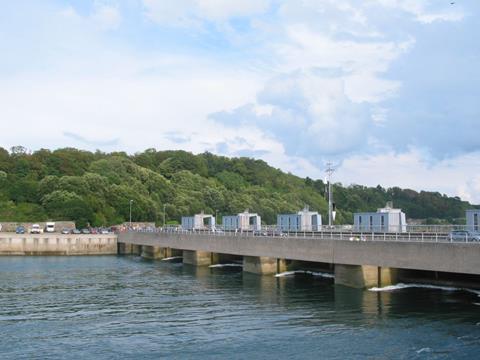
“It now provides the cheapest electricity in France,” Gilmartin says – and nearly all the turbines are still the original turbines. In other words: almost six decades of continuous operation, minimal turbine replacement, and electricity costs far lower than most modern renewables.
South Korea’s Shiwa scheme, completed in 2011, is the world’s largest tidal barrage by installed capacity. Gilmartin visited it last year.
“They’ve got an observatory tower… and 1.5 million people come to look at this,” she says. The country is now planning a second tidal range scheme.
“Both of their schemes already have the lagoon wall,” she says, so the new project involves retrofitting turbines into existing infrastructure, making the economics even stronger.
The BHA is putting its backing behind the western Somerset Lagoon.
“It would be the biggest renewable energy project in the UK, a 2.5GW scheme with 125 turbines,” Gilmartin says. “To give you a sense of scale, the Three Gorges Dam project in China has 68 turbines.”