


A wave energy device that Spanish firm IDOM presented as a prototype at World Maritime Week in Bilbao just over a year ago has now been deployed in the Bay of Biscay.
Several wave energy technologies were presented at ‘World Maritime Week’ in March 2025 in the northern Spanish city, where offshore wind is difficult because of the very deep waters.
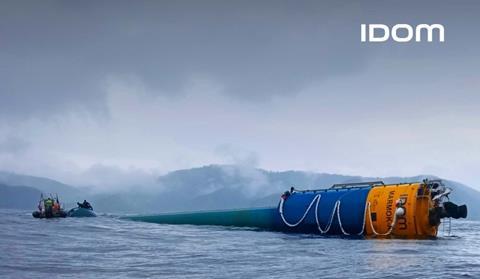
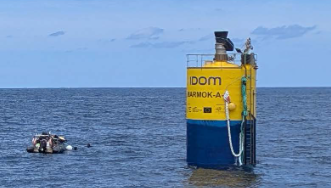
IDOM’s MARMOK-A-5 wave energy converter has been towed out and installed at the Bay of Biscay Marine Energy Platform (BiMEP) as part of the EuropeWave project, co-funded by the European Commission, the Basque Energy Agency (EVE) and Wave Energy Scotland.
The device works on a principle that Patxi Etxaniz, head of Marine Energies at IDOM, explained in Bilbao last year.
“It’s an oscillating water column, a buoy structure with a water column inside, with the cylinder open at the bottom,” he said. “There’s an air chamber at the top of the cylinder, and a turbine on top of the chamber which generates electricity as the air is pushed out. It’s very robust, there are no moving parts and little maintenance.”
The 2,000-tonne structure is 42 metres long and five metres in diameter, and in its earlier configuration generated electricity through two 15kW turbines turned by the movement of air displaced by water flowing in and out of the hollow cylinder as waves pass.
The new deployment goes further, and IDOM has upgraded the Wells turbine design, adding variable pitch blades that the company says significantly improve both efficiency and the range of sea states in which the device can operate.
Other upgrades
Additional work has been done on the mooring configuration – one of the trickiest challenges that Etxaniz, speaking to Maritime Journal in Bilbao, flagged at the time.
“Mooring is more expensive in deep water, but there’s a balance,” he said then. “The deeper the water, the stronger the tides.”
The new version also features improved umbilical cable routing and refined installation and removal procedures, with the recent offshore operation already demonstrating a substantial reduction in installation time.
The technology has had a choppy sea to this port.
Originally funded by Spanish energy giant Iberdrola, the project lost that backing around seven years ago when the company felt the path to commercialisation was too long.
IDOM subsequently acquired the project, and last year Etxaniz spoke about the challenges that remain.
“I am confident it works, but at what price?” he said. “You need lots of time and resources to be competitive. All technologies are very different and need a lot of public money to be developed.”
Wave energy has historically been one of the more stubborn problems in renewable energy. As Etxaniz put it at World Maritime Week: “Wave energy was in fact the first technology to be developed, but it’s complicated. The minute you put something under the water it gets more difficult.”
The EuropeWave deployment at BiMEP represents the latest attempt to prove that the economics can be made to work, and the improvements in installation time and turbine performance suggest IDOM is making incremental but concrete progress towards that goal.