

The oil tanker MT Sounion was attacked off the coast of Yemen by Houthi militants using three aerial drones that had damaged the vessel’s engine so it lost power. They then boarded the drifting vessel and planted explosives on it, and although the 21 crew were safely evacuated, a million barrels of oil catching fire and falling overboard would have been one of the worst polluting disasters in history.
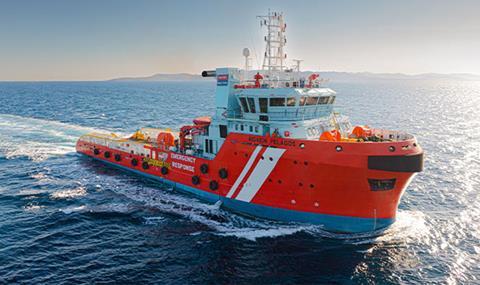
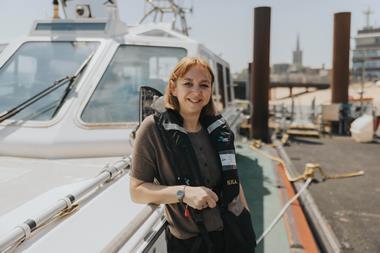
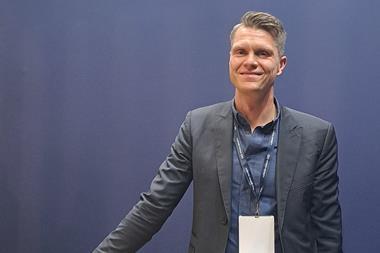
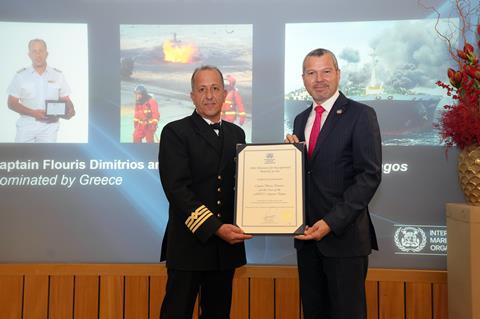
The captain of the Megatugs’ Aigaion Pelagos (Aegean Sea), Dimitrios Flouris, on behalf of the crew, was presented with a Certificate of Commendation for Exceptional Bravery at Sea at the International Maritime Organisation awards ceremony in London on Monday.
He spoke to Maritime Journal about the incredible bravery of his crew, and how the tug he has operated for five years – ‘she’s like my house’ – was more than up to the task.
Sequence of events
MT Sounion, owned by Greek firm Delta Tankers, was on route from Iraq to Greece, on August 21, 2024, loaded with 150,000 tons – about a million barrels – of crude oil.
“My company called me about the container ship, and said it had explosives on it,” said Captain Flouris. “It was 01.00, so it was dark but the weather was good, which was a very important factor.
” We saw this big tanker on fire. We knew there had been 18 explosions and it had no power, and was starting to sink. No oil was coming out but if much time had passed it would have leaked.
“We went alongside the tanker and we knew that the area was risky because of the Houthis, so we were worried about that and the priority was to tow the tanker out of the area. We went alongside, three of my crew jumped on to the tanker and fastened the towing equipment. They were the best.”
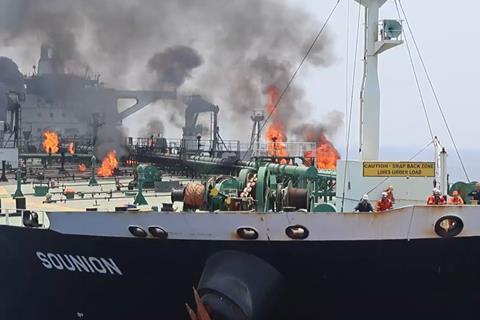
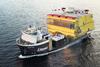
It took almost an hour to secure the tow on the blazing vessel, all the time not knowing if there would be any more explosions, before the three men could return to the Aigaion Pelagos, a 70m long, 2,320GT salvage tug with a bollard pull of 120 tonnes that was built at the Polish shipyard Remontowa.
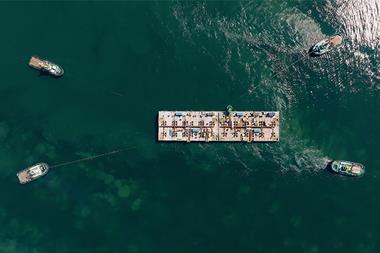
With the priority getting out of the area, the tug, with a crew of 10 plus a salvage team of eight, and the tug Panormitis in support, began the 100nm journey to safety.
Local ports refused to take the tanker, which was on fire for about 20 days, which was taken to a safer anchorage past Eritera then on to the Suez Canal.
Once in safer seas, work began to put out the flames, which took another 20 days, Captain Flouris said. Only then could the cargo be pumped out.
All in a day’s work
All salvage tug operations have risk, and this is not the first time Captain Dimitrios Flouris has faced life-threatening danger – chalking up 200 cases in recent years, he said.
This was possibly the most dangerous, although competition is tough – he told Maritime Journal of an incident in 2011 when, working for another company, he was involved in rescuing crew from Somalian pirates.
The vessel Orna had been attacked, he said, with 21 crew on board, two of whom were killed by the pirates. Orna had been boarded in Somalia, and Captain Flouris’s tug was deployed to the area while the ship owners tried to pay the ransom, he said.
After a third attempt to pay – which was successful – the vessel was towed away, while the pirates – “13 and 14-year-old boys with guns” – disembarked on their own small boats.
“Sometimes I wanted to smoke but was afraid to reach for my cigarettes in case they thought I was reaching for a weapon,” Captain Flouris said.
Captain Flouris paid huge credit to his crew, who he thinks of as his family.
“The most important thing is to work as a team and have a plan,” he said. “The worst part is being scared for my crew and for our families. But after the Sounion, when the insurance company gave us a five per cent of success, I now feel like I can do anything.”
Also attending the IMO event was the Greek minister of Shipping, Vasilis Kikilias, who had nominated the captain and his crew for an award.
“This was a magnificent and very brave effort and showed the skills required in being able to save and retrieve this ship – very courageous and professional and real proof of Greek shipmanship,” he said.
According to Suez Canal Authority chairman Admiral Ossama Rabiee, ahipping is slowly returning to the waterway, with statistics from July to October 2025 recording the transit of 4,405 vessels with a total tonnage of 185 million tons, compared to 4,332 vessels with a total tonnage of 167.6 million tons during the same period last year.