

The world’s first commercial shipping-scale tunnel has been signed off, with the contractor due to be announced once final approvals have been given this Friday.
The Norwegian Coastal Administration (Kystverket) has submitted a revised budget for the building of the Stad Ship Tunnel, which has been in the offing for 150 years.
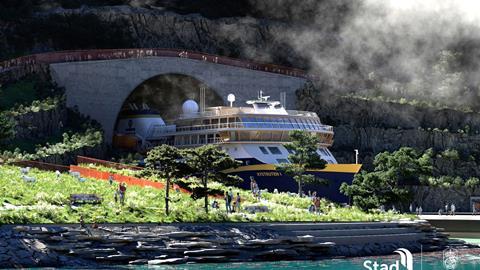
The tunnel will be built at the narrowest point of the Stad Peninsula, between the Moldefjord and Kjødepollen, in the Vanylvsfjord. It will be 1.7km long (2.2km including entrance areas), 50m high and 36m wide, which means that vessels up to the size of the Coastal Route/Hurtigruten will be able to safely navigate past Stadlandet.
Conceived so that ships could avoid the dangerous waters around the peninsula, supporters say it will have huge safety and reliability benefits while critics have questioned whether those benefits justify the cost. However a quote of NOK 8.6 billion, about €791 million, which was considered too high, has now been reduced and accepted, the Coastal Administration said, without giving the figures.
“The Norwegian Coastal Administration has completed its evaluation of the bids submitted by the three consortiums competing for the main construction contract,” the Administration said. ”At the same time, several other contracts are ready to be tendered, including a demolition contract for buildings that must be removed near the tunnel site and a contract for new water pipelines on both sides of the tunnel.
“This is a major project, but we have prepared thoroughly over several years. We are ready as soon as we receive instructions from the Ministry of Trade, Industry and Fisheries.”
The final contract will be awarded to one of three bidding contractors – AF Gruppen, Eiffage Génie Civil, and the Skanska/Vassbakk & Stol consortium – with construction scheduled to begin next year.
Engineering expertise
The Stad Ship Tunnel is unique not just because it will allow ships to pass through a mountain, but because of the unprecedented scale of the excavation.
The tunnel will have a cross-sectional area of 1,661m², and unlike many major tunnelling projects, it will not be excavated using a tunnel boring machine. Instead, Kystverket plans to use conventional drill-and-blast techniques with tunnel drilling rigs and bench rigs. The upper section will be excavated in a similar manner to a road tunnel before engineers progressively blast downwards in layers, creating what Kystverket says will be more akin to a vast underground cavern than a conventional transport tunnel.
Approximately three million cubic metres of solid rock will be removed, producing around 5.4 million cubic metres of blasted material – equivalent to roughly 750,000 lorry loads. Because local road infrastructure cannot accommodate such volumes, much of the spoil is expected to be transported by barge.
Another unusual aspect is that the tunnel will be excavated largely in dry conditions despite connecting two bodies of water. Kystverket says temporary rock ‘doorstops’ will be left at both ends during construction, while other project descriptions refer to cofferdams being used to keep seawater out. Only once excavation is complete will these barriers be removed and the tunnel flooded for navigation.
Ground investigations have confirmed generally good-quality gneiss rock along the route, although extensive core drilling revealed significant groundwater inflows in places, with water ingress of up to 500-600 litres per minute under pressures exceeding 20 bar.
Managing these conditions will be one of the project’s key engineering challenges.