



A two-year project to lay offshore wind farm subsea cable so that Normandy’s first offshore wind farm could be connected has been completed and the wind farm commissioned.
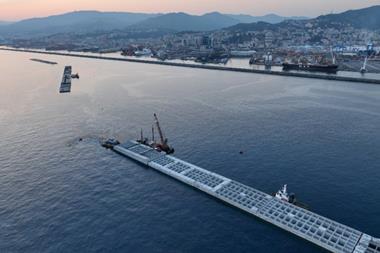
The work involved laying high-voltage cables through a 90m flood defence barrier while replacing a 100-year-old jetty, a tourist icon and therefore quite sensitive.

Despite the complexity and challenge of the works, they were completed without a single disruption to shipping operations at one of France’s busiest ports.
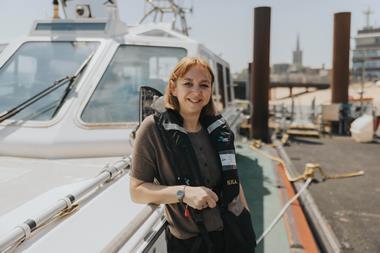
In an interview with Maritime Journal, De Romein Nearshore’s senior project manager Jamie Howard explained how results were achieved despite huge challenges with planning, tides, harsh environmental conditions and mass pouring of marine-grade concrete.
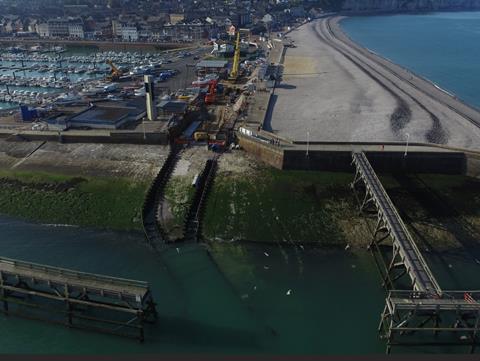
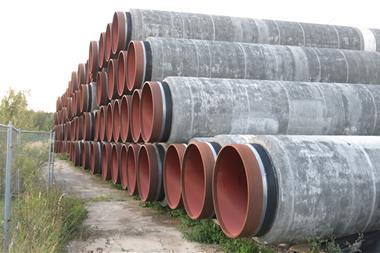
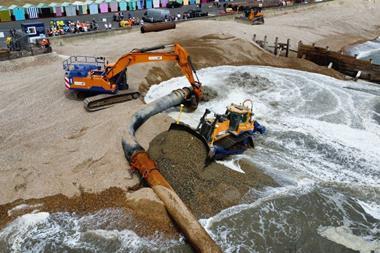
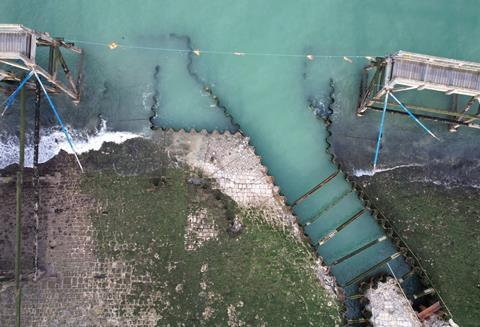
The key task involved digging a trench through the middle of Fécamp Port to lay the end of a 14km export cable from the Fécamp offshore wind farm substation in Normandy, which has now been commissioned.
But this was far from the only task: at the same time, a 70m section within the existing flood and storm defence barrier had to be carefully removed, reinforced and re-installed, first by dismantling the 100-year-old timber jetty and rebuilding its foundations.
“We had to build through the port, ensuring there were no interruptions to shipping traffic over two years,” said Howard. ” We had to deal with huge tides and 8m unforgiving waves, which is why the wind farm was built there. It all required careful coordination with the harbour master, sometimes a tense process, but we proved it could be done.”
Equipment and vessels
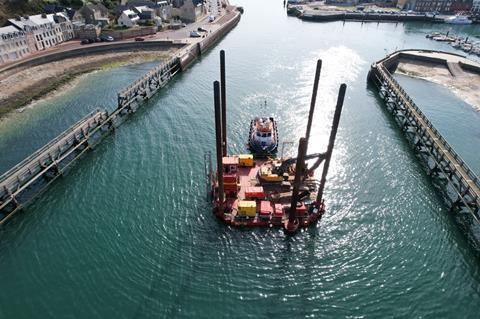
Once the cable was laid from the wind farm substation to landfall, De Romein Nearshore, with a 120t C57 jack-up barge at its disposal equipped with cranes, a cherry picker and long-reach excavator for dredging and demolition, assisted with the trenching and cable installation.
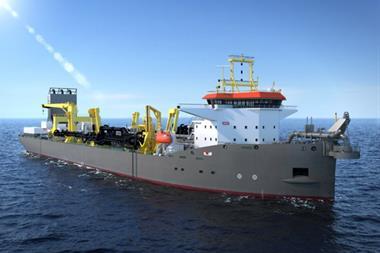
De Romein’s fleet also includes the Capall Mara (Seahorse) back hoe dredging vessel, which completed most of the dredging campaign.
For the flood defence, pre-fabricated caissons were stacked up ‘like Lego’ and reinforced with steel rebar. Trucks were brought in to mass pour the concrete into them – which had to be done while it was still wet, so within 45 minutes of leaving the concrete facility.
France’s largest concrete and cement firm, Lafarge, was called in for the task of pouring and pumping concrete in two procedures – which, Howard said, the firm had not done before.
“The caissons also formed the foundations for the timber jetty – which as a tourist icon is very sensitive – to make way for the ducts for both cables,” said Howard.
The seabed had to be level within 1o of tolerance, Howard said, and all dredged material was taken 6nm out to sea to a pre-determined site and dumped.
“We had to clear every single piece of debris that could potentially get in the way of shipping operations, so we needed multiple vessels, multi-beam surveys at every opportunity and dive support,” he said.
France’s offshore wind scenario
France was late to offshore wind, only beginning its first one four or five years ago, in which Howard was also involved, he said.
In a bid to strengthen its own energy supply and remove reliance on imports, the government decided to ramp up this development, setting a target of 45GW by 2050 and an interim target of 18MW by 2035, according to the association WindEurope.
This will be a steep task, and one which Howard says is keeping De Romen Nearshore’s order books healthy for years to come.
“Our workload is primarily offshore wind,” he said. “There has also been a lot of red tape removed, so it is much quicker to get the necessary planning and approvals in place.
“We are struggling to find enough people.”
The Fécamp wind farm consists of 71 turbines with a total generation capacity of 500MW, over an area of 60km2. According to owner EDF Renewables, it began generating electricity in May 2024.
It is the first one in Normandy and the third fully operational one in France, which has more than 50 in the planning stages.