


With the demand for offshore wind components predicted to surge in the coming years, getting them to where they’re needed could become an issue, analysis by maritime data analytics company Spinergie has found.
With annual commissioned capacity expected to quadruple in 2030 – from 2.9GW in 2025 to 12.3GW by then – component volumes will of course see similar growth, with Europe likely to be the region with the highest installed capacity.

A key enabler – or potential bottleneck – to this growth will be the transport of components, the analysts Drashya Goel, senior Client Success manager, and Maelig Gaborieau, senior analyst, said in a webinar.
Monopiles are increasing in length and weight as installations move into deeper waters, so the issues facing the transport industry are not only about numbers: they are about accommodating larger and larger pieces, with no sign of the scaling stopping.
With greater distances cable length requirements will also expand, with lengths needed by 2030 expected to reach 6,000km from today’s 3,500km.
“A key trend is the increase in transport distances: on average the transport distance for offshore wind components has more than doubled in the last two years from 1,000nm to more than 2,000 nm, mainly driven by changes in supply patterns,” said Gaborieau. “We are seeing more components being transported from APAC to Europe, especially in 2025.”
With greater distances comes more complex logistics and higher exposure to risk. There’s also the reporting of emissions to be carried out under the EU ETS schemes, adding yet more costs to an already eye-wateringly expensive activity.
Transport methods
Components need different methods of transport.
The blades, nowadays more than 100 metres long, have to be transported horizontally, but they are at least stackable.
The jackets, weighing at least 1,500 tonnes and 60 metres high, have to be transported vertically. The topsides – some 10,000 tonnes in weight and measuring more than 800 square metres in area – are another factor entirely. Only the cables, which can be compactly rolled on carousels, are less of a challenge.
It also depends how far the components have to go.
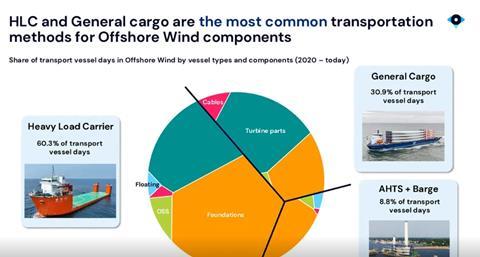
Shorter distances are often taken care of barges towed by Anchor Handling Tugs (AHTs), where for longer distances components are more likely to go by Heavy Load Carriers (HLCs) or General Cargo (GC) ships. Sometimes they can be submersible.
Today, less than 10% of the components for offshore wind are carried by barge and AHT: HLCs carry 60%, GCs 31%.
Competition and emissions
Given the surge in offshore wind it’s perhaps surprising that of all the industries competing for these transport vessels, it accounts for less than 5%.
Infrastructure, industrial modules and bulk transport still make up the far greater part, with offshore wind presenting an opportunity but certainly not, at the moment, the core.
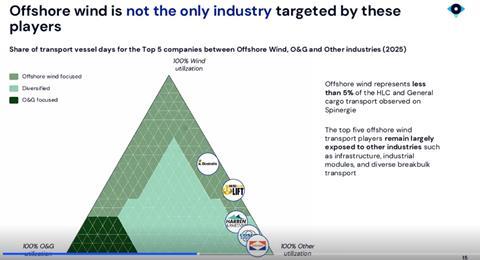
The analysts did say, however, that some of the bigger shipping companies were explicitly mentioning offshore wind as a market for the first time.
New vessels will be versatile and serve multiple industries. Some are looking at short-term contracts, like COSCO Shipping and BigLift Shipping, but others, like Amasus Shipping, are looking at long-term contracts with offshore wind markets, they said.
“Offshore wind is only a small share of the market but is the demand increasing? Of course it is, and the next five years will see a huge rise in the demand for components and installations,” said Goel, predicting in a high scenario the sector could need 75 FTE (full-time equivalent) vessels a year.
But because they are often travelling from so far away – from China to Europe, often – the emissions are much higher.
“For example 15 monopiles transported from China using a semi-submersible HLC emits 11 times the amount of greenhouse gases than if they had been transported from Europe on a four by four,” said Gaborieau. “This is an immense increase of greenhouse gas emissions.”
At the end of the day, vessel sourcing will be a trade-off between flexibility, visibility and control, with pros and cons for each:
1. Spot vessels – no long-term commitments but flexible
2. Long-term charter - Secure, cost visibility and planning – but needs a stable project pipeline
3. Owned vessels – full control, strategic differentiation, but huge upfront cost and long ROI.
Floating wind is still at the entry stage, added Gaborieau, still expensive to do and limited progress despite huge potential.