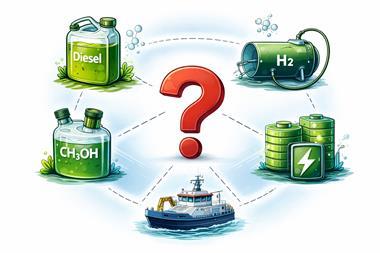




Hydrogen promises zero-emission operations for tugs and crew vessels, but real-world feasibility hinges on safety, infrastructure and operational realities. In its Fuel for Thought report, Lloyd’s Register puts hydrogen in the dock.
The classification authority presents hydrogen not as a speculative technology but as a fuel already moving into real-world maritime applications, though there are limits: it is particularly viable in short-sea and coastal segments where operational constraints are more manageable, but certainly not in other areas.
The report finds that the decarbonisation drive is accelerating faster than past propulsion transitions, but this time not primarily by economics or performance, but by environmental fears and regulation.
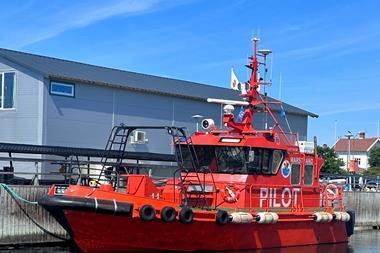
For workboats, such as tugs and CTVs, hydrogen’s feasibility depends less on technical possibility and more on operational suitability: these vessels often operate close to shore, with predictable duty cycles and regular returns to base to allow fuelling and obviate the need for large storage capacity on board.
Hydrogen’s core technical promise
Hydrogen’s attraction as a marine fuel is straightforward: when used in fuel cells, operational greenhouse gas emissions can fall to near zero.
The report explains that hydrogen combustion produces water as the primary by-product, though high temperatures may lead to nitrogen oxide formation, which must be controlled.
Lloyd’s Register emphasizes that hydrogen has ‘the highest energy density of any fuel by mass’, but also the lowest by volume compared with candidate marine fuels such as methanol.
This contrast explains why hydrogen presents both opportunity and limitation: while it is a good energy carrier, in theory, when it comes to onboard storage needs, it’s a challenge.
Liquid hydrogen storage requires cryogenic temperatures at around minus 253°C, while compressed gas storage demands large tanks and high pressures. And while these factors are problematic for long-range ships, they are potentially workable for harbour and coastal vessels, the paper says.
Propulsion pathways: fuel cells and engines
Lloyd’s Register confirms the two main hydrogen propulsion options:
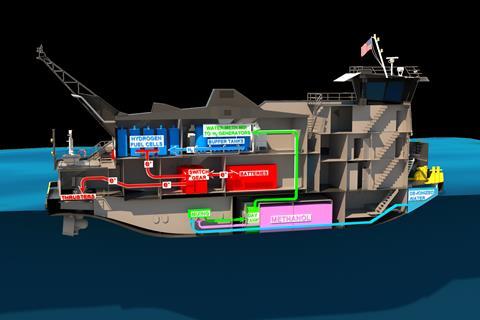
- Hydrogen fuel cells, which produce electricity to power propulsion and offer quieter operation and zero carbon emissions at the point of use, making them attractive for port operations and vessels serving offshore wind.
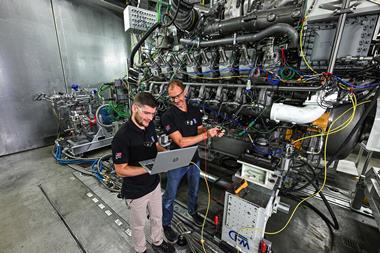
- Hydrogen internal combustion engines, which work in the traditional way, swapping diesel for H2. These may remain more relevant for tug operations that need sudden peak power.
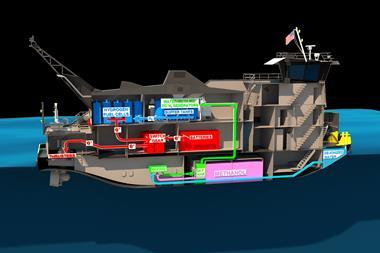
In practice, many early concepts blend these systems with batteries, creating hybrid vessels that balance efficiency with operational flexibility.
Safety and operational reality
Hydrogen’s feasibility cannot be discussed without acknowledging safety concerns.
Lloyd’s Register repeatedly stresses that hydrogen is an extremely flammable gas with a wide flammability range and very low ignition energy.
The report highlights several specific considerations:
- nearly invisible flame in daylight
- rapid dispersion in ventilated spaces but accumulation risk in confined areas
- hydrogen ‘embrittlement’, when hydrogen atoms permeate solid metals, causing a reduction in ductility and making them prone to cracking
- cryogenic hazards for liquid hydrogen systems.
These challenges do not prevent adoption but require safeguards in vessel design, bunkering arrangements and operational procedures – all of course adding to cost.
The safe adoption of hydrogen also depends on training in fuel handling, gas detection, emergency response and bunkering procedures.
The report references ongoing IMO work to develop interim training guidelines for seafarers operating alternative-fuel ships, highlighting that human factors may be as important as technology in the transition.
Lloyd’s Register has developed risk-based certification frameworks specifically to support novel hydrogen vessel designs.
For workboats, the smaller scale of systems and port proximity can make monitoring and risk management more achievable compared with larger ships.
Regulations and commercial drivers
Lloyd’s Register emphasises that regulation is one of the strongest forces driving interest in hydrogen.
EU and IMO frameworks increasingly reward fuels with low lifecycle emissions, and hydrogen – particularly ‘green’ hydrogen – aligns well with these future requirements.
The report says shipping companies are assessing hydrogen partly because future carbon pricing and fuel intensity rules may make zero-carbon fuels economically attractive despite higher upfront costs.
For workboats operating under port authority or offshore wind contracts, compliance advantages may outweigh fuel price disadvantages before they do in other sectors.
The report is clear that bunkering infrastructure is also a major barrier: international standards for liquid hydrogen bunkering are still emerging, and only limited pilot operations currently exist.
However, workboat sectors may again have an advantage. A single port-based hydrogen facility can support an entire local fleet, avoiding the need for a global supply network.
Hydrogen bunkering locations are already being explored in parts of Europe, North America and Asia, which aligns naturally with tug and crew-transfer operations tied to fixed geographic hubs.
Realistic assessment
Another factor shaping hydrogen’s feasibility for workboats is the changing role of ports themselves.
Increasingly, ports are not just locations where vessels refuel; they are becoming integrated energy hubs, linking renewable electricity, industrial hydrogen production and maritime demand. This ecosystem model matters because hydrogen economics improve dramatically when production, storage and consumption are geographically clustered.
For workboat fleets operating from a single base, the possibility of shared infrastructure – servicing tugs, pilot boats and CTVs together – reduces risk and spreads capital costs across multiple users.
This evolution also aligns with broader trends in offshore wind development.
CTVs operate within fixed corridors and predictable schedules, making them ideal candidates for early hydrogen adoption. In some regions, developers are already exploring direct links between offshore renewable generation and hydrogen production, creating local energy loops that bypass long supply chains.
At the same time, hydrogen adoption may reshape operational culture. Operators accustomed to measuring fuel in tonnes and endurance in days are beginning to think in terms of energy management, charging windows and hybrid optimisation, the report says. In this sense, hydrogen is not just another fuel choice – it signals a shift towards more integrated, data-driven vessel operations, where efficiency depends as much on how energy is used as on what fuel is stored onboard.
Prediction
Hydrogen may not replace diesel overnight, but within harbour and coastal operations it is already moving from theory to implementation.
As Lloyd’s Register frames it, the question is no longer whether decarbonisation will occur, but how quickly shipping can adapt to the fuels and technologies that make it possible.
Hydrogen’s future in workboats will not be decided by a single technological breakthrough, but by thousands of operational decisions made across ports, shipyards and fleet operators over the coming decade.
The evidence gathered by Lloyd’s Register suggests that hydrogen is neither a universal solution nor an unrealistic ambition; it is a fuel whose success will depend on matching technology to the right operational context.
The real test will not be whether hydrogen works in principle, but whether it can be integrated into everyday maritime practice without compromising reliability or commercial performance.
If that balance is achieved, the smallest vessels in the fleet may once again lead shipping’s biggest transition.