


Cummins has expanded its emissions control offering with the launch of a selective catalytic reduction (SCR) system for lower-horsepower marine engines.
Unveiled the day before Seawork 2026, it has been developed with exhaust after-treatment specialist Eminox and provides a new route to IMO Tier III NOx compliance for a section of the market that has until now lacked a dedicated solution.
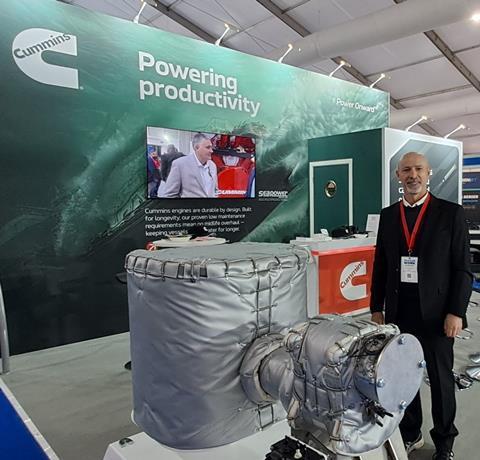
Cummins Mark Sylvester, Business Development Manager, Marine
“The dynamics are changing,” said Mark Sylvester, Business Development manager, Marine, at Cummins. “We want to do the right thing while maintaining our position in the marketplace and still making money.”
For many operators, the immediate emissions challenge is nitrogen oxides rather than carbon. While IMO Tier III NOx limits have applied in Emission Control Areas for some time, demand for compliant propulsion solutions is growing.
“We understand the need for greener vessels and removing NOx out of the exhaust to keep central areas cleaner,” Sylvester said, “but we never had a solution for the lower horsepower range.”
Addressing the gap
That gap has now been addressed through the partnership with Eminox, with the new SCR system making its industry debut at Seawork 2026.
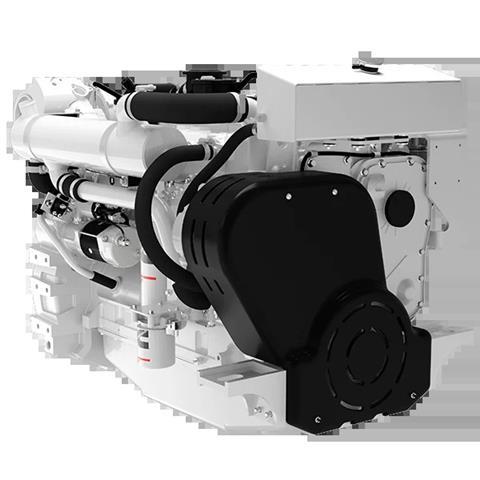
The SCR system has been developed specifically for three of Cummins’ marine diesel platforms: the QSB6.7, the QSC8.3 and the QSL9. Together these cover a broad power band and a wide range of vessel types.
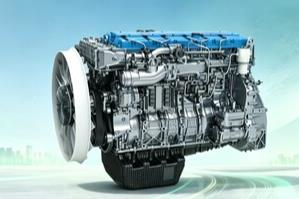
The QSB6.7 is a 6.7-litre inline six-cylinder four-stroke rated from 230 to 550hp, employing a Bosch high-pressure common-rail fuel system, turbocharging and aftercooling, and a 24-valve cylinder head designed for high power density.
The Cummins QSC8.3 is an 8.3-litre inline six-cylinder marine diesel engine producing between 490 and 600 hp in its higher-rated recreational variants. It combines high-pressure common-rail fuel injection with turbocharging and seawater aftercooling for improved fuel economy, lower emissions and reduced exhaust smoke.
The QSL9, a 9-litre inline six-cylinder with outputs from 290 to 410 hp, is designed for demanding commercial work – fishing vessels, workboats and displacement craft – with an emphasis on durability and long service life.
A deliberate design decision ties the three together.
“It’s the same architecture across all three platforms, which cuts down on engineering time,” Sylvester says.
That commonality also simplifies the integration of the new SCR across the range.
Perfect partners
“Eminox is the expert in the field and the perfect partner to develop this solution specifically for marine,” says Sylvester, adding that other SCR products on the market have been re-engineered from non-marine applications and lack the robustness required.
The Eminox unit has been developed with reduced vibration, lower complexity and better resistance to seawater contamination – factors that matter considerably in commercial marine environments.
One technical challenge inherent to SCR fitment is the back pressure it creates in the exhaust system, which engines are not designed to tolerate without consequence.
“When you fit SCRs you create back pressure, which the engine doesn’t like, and we have reduced that,” Sylvester says. “Some of the SCRs need to accommodate this to create longevity.”
The compact form factor of the system also addresses a practical constraint for retrofit applications: older vessels tend to have less available space, but the SCR can be mounted on deck, giving integrators flexibility that conventional below-deck installations would not permit.
The target market is the lower end of the commercial and recreational spectrum – pilot boats, pusher tugs, crew transfer vessels and pleasure craft. It is a segment that has historically been under served by Tier III solutions, and Cummins is already working on a first project in France that is expected to be among the first installations to receive regulatory approval.
Lead times for the SCR system are quoted at 12 to 14 weeks, with engines available in approximately 16 weeks. Installation quality assurance is handled through Cummins’ IQA programme, registering work with the manufacturer and maintaining the standards expected for a system designed for long operational life.
Future fuels
Cummins is exploring methanol as a dual-fuel option – it already has this in trucks – but the marine case is not yet viable, Sylvester says.
“There’s not enough green methanol around for marine, plus the ports don’t have the infrastructure and can’t support it,” he says.
By the end of 2027, even with significant resources deployed, he does not believe there is enough time to bring a marine methanol solution to market with confidence in its longevity.
“We don’t have that assurance that it’s going to run for so many years,” he says.
The SCR partnership with Eminox represents something more immediate: a commercially available, regulation-compliant solution for the vessels that need it most, delivered by a company that, for all its scale – 70,000 employees, operations spanning sectors from power generation to transport – draws only around five per cent of its business from marine.