


Archipelago Yachts owner Stephen Weatherley talks to Maritime Journal about his work to find a potential range extender for commercial vessels using methanol.
Stephen Weatherly arrived at methanol by a process of elimination.
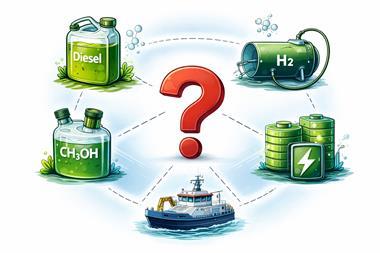
When he began looking seriously at alternative fuels for the leisure and light commercial marine market, he worked through what he sees as the five main contenders: batteries, ammonia, hydrogen, LNG and methanol.

Stephen Weatherley
Ammonia was ruled out immediately: “It’s just too poisonous,” he says. “You’re certainly never going to get it on a leisure vessel. I can’t see it ever being carried on a high-speed craft.”
Hydrogen has theoretical appeal but practical difficulties: unless stored at 300 bar or cryogenically, its energy density is poor, and confining a molecule that small is technically demanding. Its explosive properties when mixed with air present further obstacles, particularly for leisure users.
LNG he regards as largely irrelevant to any serious decarbonisation discussion, since it remains a fossil fuel.
That left methanol. It can be stored as a liquid, has a relatively benign toxicity profile compared to ammonia or hydrogen, and dissolves in seawater without harming aquatic life in the event of a spill. Its energy density is roughly half that of diesel, meaning vessels need to carry approximately double the volume for equivalent range, but that is a manageable constraint compared with the alternatives.
Critically, it has a credible pathway to becoming genuinely clean: most methanol today is ‘grey’, which means it is derived from natural gas, or ‘brown’, produced from coal, predominantly in China. But biomethanol, made from degrading organic waste matter, and e-methanol, synthesised from seawater and renewable electricity, offer lower-carbon routes.
“Methanol is interesting because it can come from clean sources,” Weatherly says.
Its one significant safety concern is the invisible flame it produces when burning, which means heat detectors rather than visual observation are required to identify a fire.
Weatherly acknowledges this but does not regard it as a fundamental barrier.
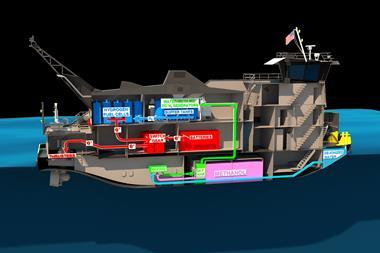
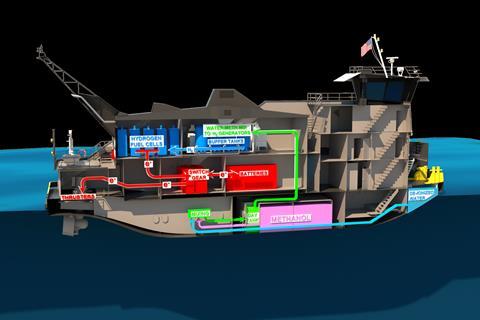
It can also be used in two distinct ways for propulsion: either burned directly in a combustion engine, which engine manufacturers including the major diesel producers are actively developing for dual-fuel applications; or fed through a reformer that cracks it into hydrogen and carbon dioxide, with the hydrogen then passed through a fuel cell to generate electricity. That is the pathway Weatherly and Archipelago are currently exploring under an Innovate UK grant as part of the CMDC6 programme: developing a methanol reformer fuel cell combination as a range extender for electric vessels.
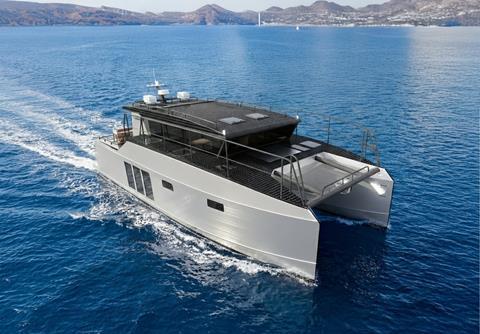
“Given that methanol is 20 to 25 times more energy dense than batteries,” he says, “you don’t need to store a huge amount of methanol to really have a significant impact on the range of your vessel.”
The case for and against batteries
Although he is currently building an all-electric vessel for a customer who has specifically requested it, Weatherly is sceptical about electric vessels.
“Batteries are great for one use case, which is doing short distances between places so you can charge up and refuel,” he says.
The fundamental problem is energy density. Batteries remain 40 to 50 times less energy dense than diesel. To achieve equivalent range on battery power alone, a vessel would have to carry 40 to 50 times the weight of a diesel installation.
Port-side charging infrastructure for large vessels is also limited, and the time required to recharge high-capacity battery banks is an operational constraint that does not apply to liquid fuels.
Weatherly also has environmental reservations about the mining of lithium and cobalt and the challenges around end-of-life disposal.
“All of these big technical leaps require early adopters who are technically willing to take the risk and also have relatively deep pockets,” he says. “This stuff is expensive.”
The reformer fuel cell route has its own complications, however. The purity requirements for the methanol feedstock are stringent. Standard commercial methanol is not sufficient; the reformer demands something close to laboratory grade, and the deionised water used in the process must also be chemically pure. The reformers and fuel cells themselves are heavy and expensive, with catalysts requiring replacement after several thousand hours of operation.
Greenwashing, dual fuel and the regulation problem
Weatherly is sceptical of what he calls the dual-fuel approach being pursued by much of the commercial sector, where vessels are fitted with both a diesel tank and an alternative fuel tank but operate predominantly on diesel.
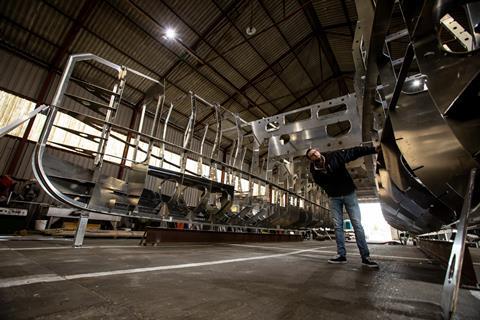
His concern is that without binding regulation requiring operators to demonstrate actual use of alternative fuels, there is no commercial incentive to bunker anything other than diesel. He would like to see a framework that requires CTV operators, for example, to prove a minimum percentage of methanol use over a given period or face financial penalties.
“Unless that exists, you’re just going to go into a port, bunker up with diesel and you’re off,” he says.
The major marine engine manufacturers are developing dual-fuel engines, but Weatherly notes that most are not expected to reach market until around 2030, having been in development for years and with further testing ahead. That timeline, combined with the absence of methanol bunkering infrastructure, means the commercial case for alternative fuels remains weak without external pressure. “I think we have to be honest with ourselves about it,” he says. “I don’t think it will become a thing unless it’s forced upon operators of these vessels, because it’s too hard, it’s too expensive.”
He is careful about the form that pressure should take, however. Legislation introduced before the technology and infrastructure are mature can be self-defeating, locking in requirements that cannot practically be met. He sees incentivisation, through carbon credits or tax relief linked to demonstrable alternative fuel use, as a viable intermediate step. “It doesn’t necessarily need to be legislative at first. It could be incentivisation. Carrot and stick.”
The case for simplicity: weight, speed and vessel design

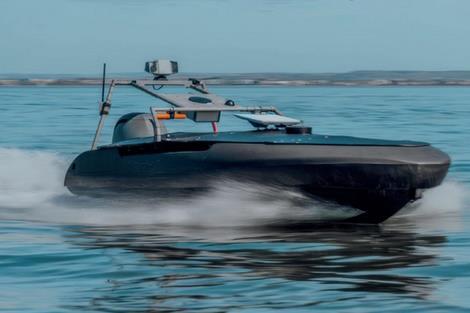
All Electric 40 Solar deck
Running alongside Weatherly’s work on alternative fuels is a conviction that the industry is overlooking the most straightforward decarbonisation measures available to it. The argument is simple: slower vessels burn less fuel.
“Just go slower,” he says of CTV operators. “Go out at 20 knots rather than 25, you’ll probably cut a hell of a lot more carbon than you will using a dual-fuel solution.”
Modern CTVs, he says, have also become much heavier than their predecessors, driven by a combination of regulation, crew comfort requirements and operator-specified equipment. The additional mass translates directly into higher fuel consumption for equivalent distances.
Computational fluid dynamics has made hull design experimentation far more accessible, removing the need for physical tank testing and models, but Weatherly believes operators’ requirements still constrain what designers can achieve.
When operators specify 25-knot transit speeds and particular turbine push-on loads, the resulting design brief leaves limited room for optimisation. The outcome is a semi-planing hull carrying more weight than it needs to, burning more fuel than it should.
Archipelago wants to push back against this trend.
“It’s a pretty fundamental belief of mine that boats are too complicated, too heavy, and people are not appreciating enough the simplicity of a twin-engine installation that’s a very accessible, lightweight fit out. It’s a boat. It’s not a home.”
He advocates for simpler, lighter outfitting, accessible engine installations and a design aesthetic that acknowledges the marine environment rather than working against it. Less equipment means less weight, less fuel consumption and less to go wrong.
Weatherly draws a parallel with the development of other transport technologies, where safety standards tightened as experience accumulated rather than being imposed before the technology was understood.
The leisure sector, with its lighter regulatory framework, is where he sees the most scope for experimenting. Foiling technology followed the same path, starting with leisure craft before moving into commercial ferry applications.
“Start small and build it up,” he says.